
Trump’s State of the Union on Immigration
What He Said vs What’s Actually Happening

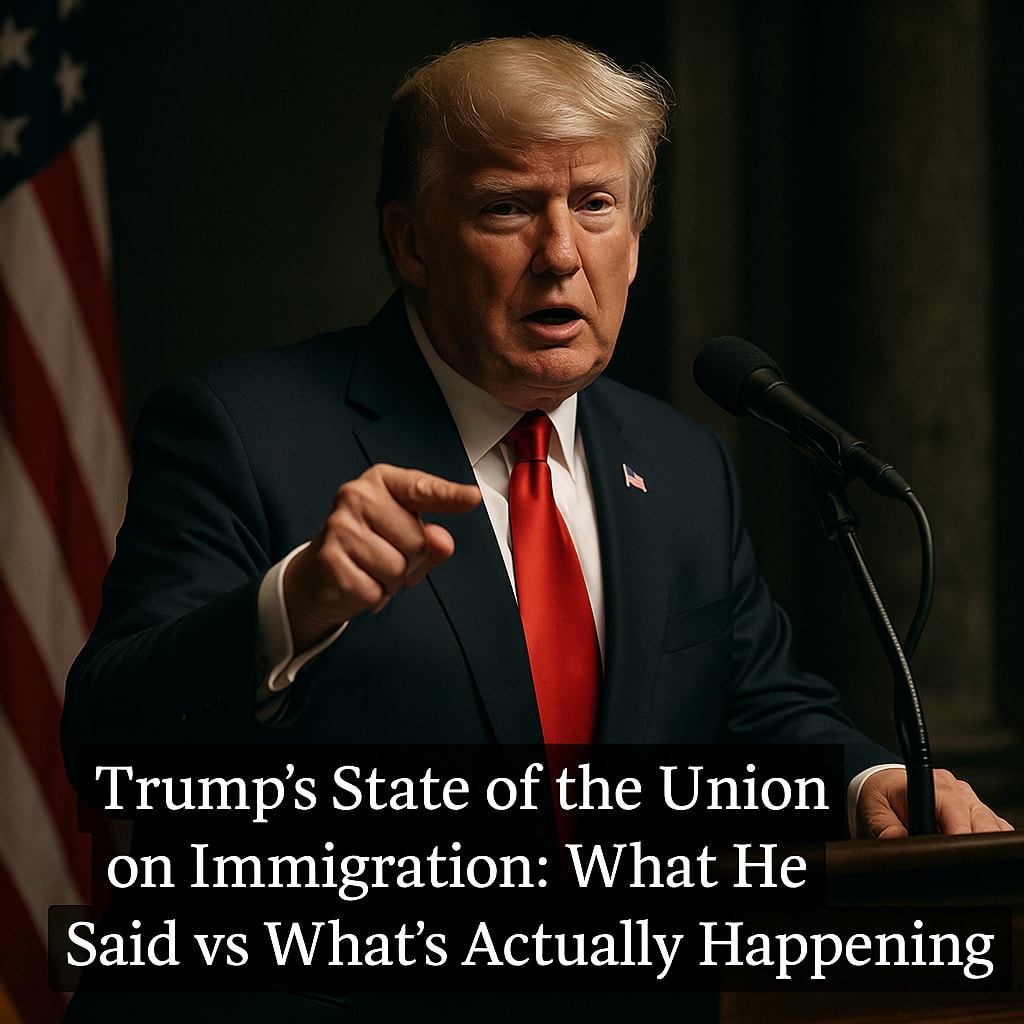
When the Speech in Your Living Room Doesn’t Match the World Outside Your Door
I watched Trump’s State of the Union on immigration with my phone in one hand and my jaw clenched.
On the screen, he was talking about “invasions,” “poisoning the blood,” and “ending the migrant crime wave.”
Outside my window, my neighbor José was unloading drywall from his truck after a twelve-hour shift, still in his work boots, still waving at my kid who kept yelling, “Hi, Mr. José!” like it was the highlight of their day.
The gap between those two realities felt like standing with one foot on a dock and one foot on a boat that’s drifting away.
One version of America was shouting through the television.
The other version was quietly taking the trash out, packing school lunches, wiring houses, cleaning hotel rooms, filling restaurant kitchens.
And the more Trump talked about the border, the more I realized: whatever this speech was, it wasn’t about what’s actually happening.
It was about what he needed people to feel.
Fear. Anger. Siege.
But facts and lives don’t bend as easily as applause lines.
So here’s what he said about immigration that night—and what’s actually happening when you step away from the stage lights and into real life.
“Biden Opened the Border” vs What the Numbers Actually Say
Trump loves one sentence in particular:
“Biden has thrown open our borders.”
You hear it in rallies, interviews, and it showed up again in the State of the Union rhetoric—just with more polish and flags behind him.
It sounds simple. It’s also not true.
The border is not “open.” It’s chaotic, overwhelmed, and deeply political—but not open.
Here’s the unglamorous reality:
Under Biden, Border Patrol encounters hit record highs, especially between 2021–2023.
That part is true: more people showed up at the border, driven by poverty, violence, climate disasters, and political collapse in places like Venezuela, Haiti, and Central America.
At the same time, Biden continued and expanded many enforcement tools:
He kept using Title 8, which allows fast deportation for people crossing illegally.
He created new legal pathways (like the parole programs for some nationalities) but tied them to stricter penalties for irregular border crossings.
It’s a messy combination: more arrivals + stretched resources + political gridlock.
That looks like chaos.
Trump calls it “open.”
But “open border” would mean what? No agents, no walls, no checks, no deportations.
Instead, the U.S. is spending billions on border enforcement and still detaining, deporting, and rejecting hundreds of thousands of people every year.
The border is not a wide-open door.
It’s more like a jammed revolving door where people keep pushing harder, and the people controlling the mechanism can’t agree which direction to turn it.
The “Migrant Crime Wave” vs What Police Data Shows
One of the loudest moments in Trump’s immigration message is always the same:
He points to horrific crimes committed by undocumented immigrants and then stretches those tragedies to cover millions of people.
He did it again in the State of the Union, spotlighting specific cases and using them as proof of a “migrant crime wave.”
I’m not going to pretend those crimes don’t matter.
If someone you love is hurt or killed, statistics don’t comfort you. They shouldn’t.
But writing laws based only on the worst, rarest stories is how you end up punishing millions for what a tiny fraction did.
Here’s the thing that rarely makes it into those speeches:
Numerous studies—across red states, blue states, and multiple decades—show that immigrants, including undocumented immigrants, commit crimes at lower rates than U.S.-born citizens.
A study in Texas, where the state actually tracks immigration status in criminal records, found that undocumented immigrants were less likely to be convicted of crimes than native-born Americans.
This doesn’t fit neatly into a campaign line.
If immigrants in general aren’t driving crime rates, then what does that do to the “we’re under siege” narrative?
It doesn’t erase the pain of individual families.
It does challenge the idea that millions of people can be reduced to a single, terrifying storyline.
When Trump describes immigration, he uses the language of war.
When you look at the data, the story is far more mundane: most people are just trying to work, raise kids, and stay out of trouble, like everyone else.
The violence isn’t the pattern.
The violence is the exception being turned into a political tool.
“They’re Taking Your Jobs” vs Who’s Actually Doing the Work
One part of Trump’s State of the Union hit me right in the gut.
He started talking about Americans being “replaced,” about jobs vanishing, wages falling, and “illegals stealing your livelihoods.”
I know what it’s like to feel financially squeezed.
I grew up in a house where the lights got shut off once because the bill slipped too far behind.
When you’re desperate, the idea that someone is “taking” something from you has teeth. You can feel yourself wanting a face to blame.
But here’s what I see when I step outside the speech and into daily life.
Immigrants—documented and undocumented—are overrepresented in:
Agriculture
Construction
Food processing
Hospitality
Home health care
Child care and domestic work
A lot of these jobs are:
Physically brutal
Low paid
Often lacking benefits and stability
The kind of work that keeps society running but doesn’t make campaign ads
And yes, employers sometimes exploit immigrant workers—paying less, ignoring safety, evading labor laws—which absolutely does hurt wages for everyone.
But the culprit isn’t the guy cleaning hotel rooms at midnight.
It’s the companies and politicians who fought unions, fought higher minimum wages, and fought worker protections… then turned around and told us to blame migrants.
Here’s the quieter truth no one on that stage wants to say out loud:
The U.S. relies heavily on immigrant labor to keep prices down and services available.
Politicians like that cheap labor, but they also like having a permanent scapegoat.
If your rent is sky-high, if your paycheck hasn’t grown in years, if your health care costs more than your car—it’s not because a Guatemalan teenager crossed the Rio Grande.
But “they’re coming for your job” is easier to sell than “we built an economic system that squeezes all of us and we don’t plan to fix it.”
“They’re Poisoning the Blood” vs Who We Become When We Believe That
There was one phrase that lingered in my mind long after the cameras turned off.
Trump has used some version of it multiple times: migrants “poisoning the blood of our country.”
That’s not policy talk.
That’s not even “we disagree on immigration levels” talk.
That’s eugenics talk. That’s white-nationalist forum talk.
That’s language with a long, ugly history in Europe and the U.S., where “bad blood” meant “those people shouldn’t exist near us.”
When you describe human beings as poison, you’re no longer arguing about border security.
You’re saying their existence is contamination.
From there, cruelty stops feeling like cruelty.
It starts to feel like cleaning.
Family separation becomes “necessary deterrence.”
Slashing asylum rights becomes “defending our culture.”
People freezing in camps becomes “the price of sovereignty.”
I keep thinking about the time I met a woman in a church basement who’d just arrived from Honduras.
She was holding her toddler, who kept clinging to her neck.
She’d left after gangs threatened to kill her for refusing to let her teenage son join them. She crossed multiple countries with a child on her hip, not because she wanted to “invade,” but because staying meant burying her kid.
If that’s “poison,” what does that make us?
Language shapes who we’re willing to hurt.
When a president stands at a podium and calls entire groups of people “animals,” “invaders,” or “poison,” some people hear permission.
And you can’t measure that cost on a chart.
You measure it in how numb we get to suffering at the border… and how easily that numbness travels inward, into how we treat each other at home.
The Border “Crisis” vs the Immigration System That Never Really Worked
One trick of political storytelling is pretending that problems started the moment your opponent took office.
In Trump’s State of the Union message on immigration, the story went something like: everything was under control until Biden ruined it.
The reality is uglier and more bipartisan.
For decades:
Congress has failed to pass comprehensive immigration reform, no matter which party was in charge.
The asylum system has been overloaded and underfunded since long before Trump or Biden.
Economic and foreign policy decisions helped destabilize some of the very countries people are now fleeing.
Trump didn’t inherit a calm border and break it.
He inherited a broken system and weaponized it.
He ramped up:
Family separations
“Remain in Mexico”, forcing asylum seekers to wait in dangerous camps
Expanded detention, including children
Harsh rhetoric that made compromise toxic
Biden came in promising something more humane—but with no political appetite for the deep surgery the system needed.
So we got:
A patchwork of new rules
More enforcement layered onto an old, creaking system
Constant lawsuits from states like Texas
A Congress that uses “border crisis” as fundraising fodder but won’t actually legislate
When Trump says, “I will fix it on day one,” it sounds strong.
It’s also fantasy.
No one “fixes” a decades-old immigration mess in a day, or even a term. Not with sound bites. Not with slogans.
You fix it by:
Updating asylum laws for modern realities
Expanding legal pathways so fewer people are forced into dangerous crossings
Investing in regional stability instead of just militarizing borders
Creating clear, enforceable standards for humane treatment
None of that fits on a bumper sticker.
“Build the wall” does.
“Blood poisoning” fits in a headline.
And that’s the real story: the performative rage is winning over the boring work of actual policy.
My Own Turning Point: When the Story Broke
For a long time, I didn’t really question the “tough on immigration” story.
I absorbed it the way you absorb background noise.
Of course we needed to “crack down.” Of course “they” were “coming in droves.” Of course we had to “secure the border first.”
Then one afternoon, I was sitting at a café, scrolling through the news on my break, and I saw a photo from the border.
A father and his little girl lying face down in a river, both drowned, her tiny arm still wrapped around his neck.
The headline was clinical, but the image wasn’t.
I thought about my own kid and how they wrap their arms around my neck when they’re scared, when they’re ready to fall asleep, when the world is too big and they need something solid.
And I realized: whatever story I was telling myself about “they” and “them” had just collided with a human reality I couldn’t file away in the same folder.
Later, I started reading beyond the cable news clips.
Court decisions. Government reports. Academic studies. People who actually work with asylum seekers, Border Patrol agents, immigration lawyers, social workers.
The more I read, the more uncomfortable it got.
Not because the border isn’t a mess—it is.
But because the way it’s being talked about is designed for something other than truth.
It’s designed for control. For outrage. For clicks. For elections.
So when I hear Trump talking about immigration at the State of the Union, I don’t just ask, “Is this right?” anymore.
I ask, “Who benefits from me believing this?”
And, “Who pays the price when I do?”
What We’re Really Choosing When We Choose a Story
Trump’s State of the Union on immigration wasn’t just about policy.
It was about identity.
Who counts as “us.” Who gets cast as “them.” Whose suffering matters. Whose doesn’t.
You don’t have to love Biden’s record on the border. You don’t have to think the current system is working. You can be furious about the real chaos and real failures.
But we’re being sold two very different narratives:
One that says:
The problem is real, but the people at the center of it are human beings.
We have to find a way to manage this that doesn’t shred our own humanity.
And one that says:
The problem is real because those people are a threat.
Cruelty is not only acceptable—it’s proof that we’re serious.
You can call that “policy disagreement,” but it’s more than that.
It’s a choice about who we are when we’re scared.
A choice about whether we turn toward facts or toward fear.
Toward understanding or toward blame.
Toward fixing the system or just finding new people to hurt.
When I think about my neighbor José, about that Honduran mother in the church basement, about the father and daughter in the river, I keep coming back to one simple, uncomfortable thought:
If a government asks me to see them as poison, and I agree, what have I just agreed to become?
That’s the part no State of the Union will ever spell out for us.
We write that answer ourselves, in how we speak, how we vote, who we believe, and who we’re willing to stand next to when the cameras turn away and the speeches end.
About the Creator
abualyaanart
I write thoughtful, experience-driven stories about technology, digital life, and how modern tools quietly shape the way we think, work, and live.
I believe good technology should support life
Abualyaanart
Keep reading
More stories from abualyaanart and writers in The Swamp and other communities.
A Gathering of Evil Bosses
“I’m the queen of chin jutting while I smooth my hair, attacking, insulting, and deflecting to protect my appointer.” “Oh, please, Blondi, my hair is curled, highlighted, and longer than yours. I feature television commercials telling immigrants that we will give them a free plane ride home, and if they voluntarily turn themselves in, they will be allowed to legally apply for re-entry. It runs everywhere, and I look good in it! You can’t compete because of your blond hair. Mine is nicer, and my lips are prettier than yours.”
By Andrea Corwin 7 days ago in The Swamp
The Government's About To Drop Another Round Of Secret Files
Another Dump of Files Courtesy of Donald Trump He’s almost transparent enough you can see right through him. The most transparent president in modern US history is about to be even more transparent. After months and months of scrutiny and obsession by the American people, and the rest of the world, Trump’s about to dump all over the place. That’s more files, we hope.
By Jason Ray Morton 4 days ago in The Swamp
At My Wits’ End
Life is about taking out the trash and calling it trash because you have every reason to. It wasn't meant to be linear, they say. But the times you tried to make it straight led to problems, and you didn’t have the tools to put any of it to use. You don't put your right shoes on the right feet; you put the left shoes on the left feet. The grey hardened slab will trip you up anyway.
By Caitlin Charlton7 days ago in Humans


Comments
There are no comments for this story
Be the first to respond and start the conversation.