
U.S. National Security Strategy (General Framework)
A Brief Overview Of the United States’ National Security Policy and Strategy Toward Pakistan, Greenland, and Venezuela under the current (2025-26) administration

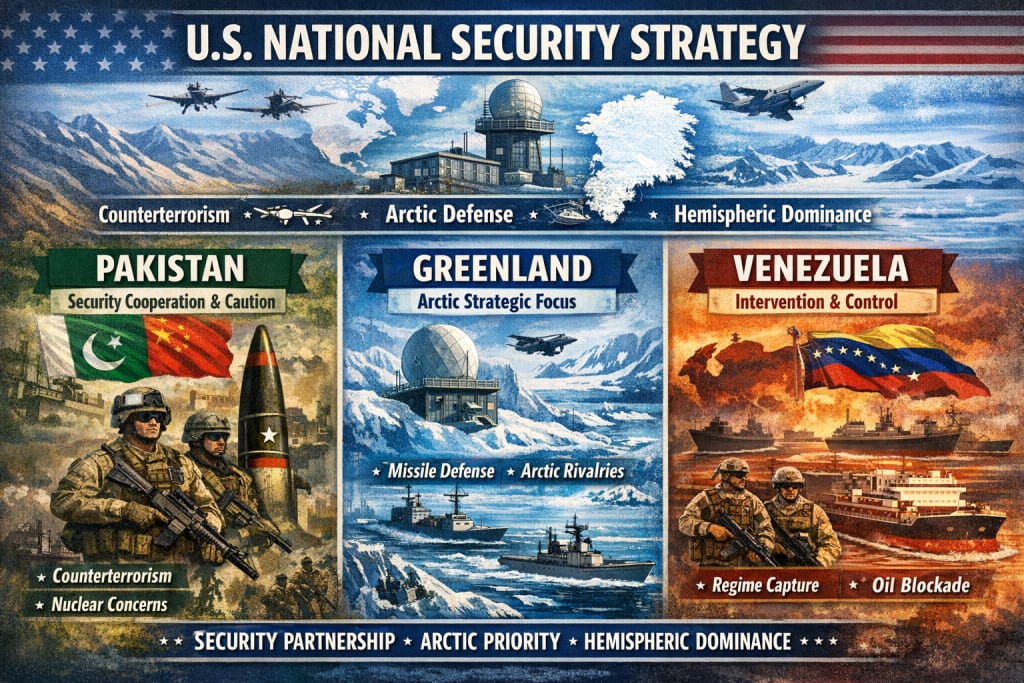
Here’s an overview of the United States’ national security policy and strategy toward Pakistan, Greenland, and Venezuela under the current (2025-26) administration — based on official strategy documents and reporting on major developments.
U.S. National Security Strategy (General Framework)
The U.S. publishes a National Security Strategy (NSS) that frames its broad priorities. The most recent NSS (released December 2025) emphasizes:
Protection of core U.S. interests, especially security of the homeland and economic strength.
A shift toward securing dominance in the Western Hemisphere and limiting influence of external rivals (notably China and Russia) near U.S. borders.
A focus on resource security and strategic geography, alongside maintaining military readiness and technological superiority.
This NSS represents a departure from recent strategic documents by prioritising immediate continental security concerns and giving greater weight to military and geopolitical influence near U.S. territory.
Policy Towards Pakistan
Strategic Context
Pakistan historically has been a security partner, receiving U.S. military cooperation and designation as a “Major Non-NATO Ally” in past administrations, reflecting collaboration in counterterrorism and regional stability.
Contemporary Dynamics
Counterterrorism and regional security: U.S. policy has focused on cooperation against extremist groups and managing security along the Afghanistan-Pakistan border.
Nuclear and strategic balance: Pakistan’s nuclear arsenal and its relations with China and India remain key strategic considerations for Washington.
Partnership tensions: There are periodic debates in the U.S. Congress about revisiting Pakistan’s allied status due to concerns over counterterrorism and regional policy.
Policy Goals
Overall, U.S. policy toward Pakistan balances security cooperation (especially counterterrorism) with strategic caution regarding Islamabad’s regional alignments, particularly with China.
U.S. Policy Toward Greenland
Strategic Importance
Greenland — a semi-autonomous territory of Denmark — occupies a high strategic position in the Arctic:
Hosts critical U.S. missile warning and early-defense infrastructure (e.g., Pituffik Space Base).
Sits between Europe and North America, important for missile defense and Arctic security.
Current Policy Direction
Under the current administration:
Senior U.S. officials have explicitly labelled securing Greenland as a “national security priority”, citing threats from Russia and China in the Arctic.
The White House has said military options remain “always an option” in pursuit of strategic goals, though European officials strongly reject any attempt to take sovereignty.
Key Elements
Geopolitical competition: The U.S. narrative frames the Arctic as a theatre of great-power competition requiring firm control of key territories.
Allied tension: Denmark — and NATO partners — oppose any forceful U.S. claim, underscoring a rift between U.S. rhetoric and alliance norms.
Policy Status
There is no formal U.S. policy of annexation, but rhetoric and strategic documents increasingly place Greenland at the centre of U.S. northern defense strategy.
U.S. Policy Toward Venezuela
Recent Actions
The U.S. recently conducted a military operation in Venezuela that resulted in the capture of President Nicolás Maduro and a blockade and seizure of Venezuelan oil tankers under U.S. sanction policy.
Strategic Rationale
U.S. policy toward Venezuela now strongly reflects a monroe-doctrine-style posture, asserting that the Western Hemisphere should remain under U.S. influence and away from rival actors (e.g., Russia and Iran).
Core Elements
Security and influence: The U.S. frames its actions as dismantling “narco-terror” and external influence while consolidating control over the region’s largest oil reserves.
Military engagement: Operations have included naval blockades and cooperative agreements with allied Latin American states under the banner of combating illicit networks.
Critiques
International observers see these moves as returning to a more assertive U.S. sphere-of-influence strategy with less emphasis on multilateral law and more on direct strategic control.
📌 Summary of U.S. National Security Policy Trends
Country/Region Main U.S. Approach Strategic Focus
Pakistan Security cooperation with caution Counterterrorism, regional stability
Greenland Strategic priority with strong rhetoric Arctic defense and resource access
Venezuela Assertive intervention and influence Hemisphere dominance and resource control
About the Creator
Ibrahim Shah
I am an Assistant Professor with a strong commitment to teaching,and academic service. My work focuses on fostering critical thinking, encouraging interdisciplinary learning, and supporting student development.
Keep reading
More stories from Ibrahim Shah and writers in The Swamp and other communities.
What resources does Venezuela have — apart from the world’s most oil?
Largest known oil reserves Venezuela has the world’s largest proven oil reserves, estimated at 303 billion barrels as of 2023, more than five times the amount the United States has, which is 55.25 billion barrels.
By Ibrahim Shah a day ago in The Swamp
A Gathering of Evil Bosses
“I’m the queen of chin jutting while I smooth my hair, attacking, insulting, and deflecting to protect my appointer.” “Oh, please, Blondi, my hair is curled, highlighted, and longer than yours. I feature television commercials telling immigrants that we will give them a free plane ride home, and if they voluntarily turn themselves in, they will be allowed to legally apply for re-entry. It runs everywhere, and I look good in it! You can’t compete because of your blond hair. Mine is nicer, and my lips are prettier than yours.”
By Andrea Corwin 8 days ago in The Swamp
When Words Become Diplomacy: France Summons the U.S. Ambassador
In February 2026, a tragic event in France quickly turned into an international issue. What began as a violent street clash in the city of Lyon led to the death of a young political activist. Within days, the situation escalated beyond France’s borders, creating diplomatic tension between France and the United States.
By dua fatima2 days ago in The Swamp




Comments
There are no comments for this story
Be the first to respond and start the conversation.