
Breakfast Cereals Market Size and Forecast 2026–2034
Global Industry Set to Reach US$ 77.4 Billion by 2034 Amid Rising Demand for Healthy and Convenient Breakfast Options

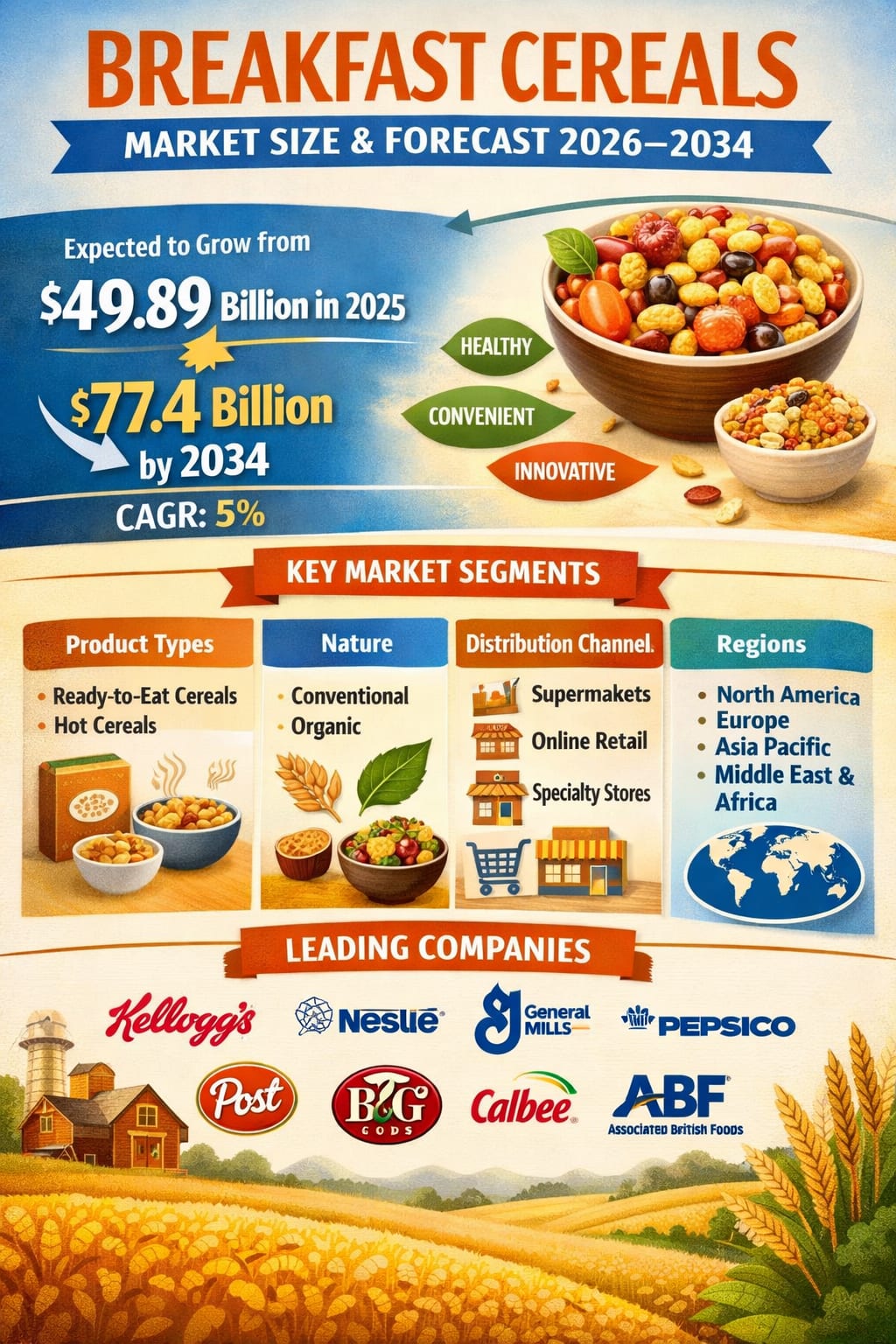
The global breakfast cereals market is entering a new phase of sustained growth, driven by evolving consumer lifestyles, health awareness, and innovation across product categories. According to Renub Research, the Breakfast Cereals Market is expected to reach US$ 77.4 billion by 2034, rising from US$ 49.89 billion in 2025, expanding at a CAGR of 5% from 2026 to 2034.
This growth reflects a broader transformation within the global food ecosystem. Consumers are increasingly prioritizing quick, nutritious, and ready-to-eat meal options that align with their health goals and fast-paced routines. From high-protein granola to low-sugar fortified flakes, breakfast cereals have evolved far beyond traditional cornflakes and oatmeal.
As the industry adapts to new dietary preferences—including plant-based, organic, and gluten-free lifestyles—it continues to strengthen its foothold across both mature and emerging markets.
Breakfast Cereals Industry Overview
The breakfast cereals industry represents a significant segment of the global packaged food market. It includes ready-to-eat (RTE) cereals, hot cereals such as oatmeal and porridge, muesli, granola, and fortified cereal products tailored for children and adults alike.
Historically associated with Western eating habits, breakfast cereals have now achieved global penetration. The industry caters to households, foodservice providers, and institutional buyers, supported by strong branding strategies and extensive distribution networks that span supermarkets, hypermarkets, specialty stores, convenience outlets, and e-commerce platforms.
Today’s cereal aisle showcases remarkable diversity. Consumers can choose from:
High-fiber whole-grain cereals
Low-sugar and diabetic-friendly variants
Protein-fortified fitness cereals
Organic and non-GMO options
Gluten-free alternatives
Kid-focused fortified cereals enriched with iron, calcium, and vitamins
This wide product portfolio allows manufacturers to address varied demographic groups, including children, working professionals, athletes, and aging populations.
Health and Wellness: The Primary Growth Engine
One of the strongest drivers behind the breakfast cereals market expansion is the global shift toward healthier eating patterns. Consumers are more informed than ever about nutritional labels, ingredient sourcing, and long-term health impacts.
Concerns about obesity, diabetes, cardiovascular diseases, and digestive disorders are encouraging shoppers to choose cereals that are:
High in fiber
Low in refined sugar
Rich in whole grains
Fortified with essential micronutrients
Free from artificial additives
Functional cereals that promote digestive health, immunity support, and weight management are gaining significant traction. Millennials and Gen Z consumers, in particular, prefer clean-label products with transparent ingredient lists.
For children, fortified cereals remain a popular breakfast choice, offering parents a convenient way to ensure balanced nutrition during developmental years. As nutritional awareness continues to rise globally, this health-driven demand is expected to remain a long-term catalyst for growth.
Convenience and Changing Lifestyles
Modern urban life has dramatically reshaped breakfast consumption patterns. Increasing workforce participation, longer commuting hours, and dual-income households have reduced the time available for preparing traditional breakfasts.
Breakfast cereals offer a quick, hassle-free solution. Ready-to-eat products require minimal preparation and are easily paired with milk or plant-based alternatives. Instant oatmeal and single-serve cereal cups further enhance portability, making them ideal for offices, schools, and on-the-go consumption.
Manufacturers are responding with innovative packaging solutions, including:
Resealable family packs
Portion-controlled sachets
Microwaveable bowls
Snack-sized cereal packs
E-commerce growth has also strengthened accessibility. Online grocery platforms allow consumers to explore diverse cereal brands, compare nutritional values, and access premium or imported variants with ease.
Convenience, combined with nutritional value, has solidified breakfast cereals as a staple in urban households worldwide.
Product Innovation and Flavor Diversification
Innovation remains central to market competitiveness. Manufacturers are constantly introducing new flavors, textures, and ingredient combinations to attract and retain consumers.
Recent trends include:
Superfood-infused cereals featuring chia seeds, quinoa, and flaxseeds
Probiotic-enhanced variants
Millet-based and rice-based cereals in Asia
Indulgent flavors such as chocolate-hazelnut, honey-caramel, and fruit blends
Flavor diversification helps brands balance indulgence with health. While some consumers seek low-calorie options, others prefer indulgent cereals that deliver taste and texture without excessive sugar.
Marketing strategies—ranging from influencer collaborations to digital campaigns—are further strengthening brand visibility and engagement.
Market Challenges
Fluctuating Raw Material Prices
Volatility in the prices of wheat, corn, oats, rice, and sugar remains a significant challenge. Weather conditions, supply chain disruptions, geopolitical tensions, and trade restrictions can all impact raw material availability and costs.
Packaging materials, energy prices, and transportation expenses add further pressure. Smaller manufacturers often face tighter margins compared to multinational corporations with stronger procurement capabilities.
To manage risk, companies adopt long-term supply agreements, diversify sourcing strategies, and explore product reformulations. However, cost management remains a continuous balancing act.
Health Concerns Over Sugar and Processing
While cereals are marketed as healthy, many traditional products have faced scrutiny over sugar content and processing levels. Regulatory bodies in various countries are enforcing stricter labeling requirements and sugar reduction targets.
As a result, manufacturers are reformulating products to reduce sugar content while preserving taste. Clean-label transparency has become essential to maintain consumer trust.
Regional Market Insights
United States
The United States represents one of the most mature breakfast cereals markets globally. Consumption spans ready-to-eat cereals, hot cereals, granola, and functional variants.
Health-focused innovation continues to drive demand. Consumers increasingly seek gluten-free, high-protein, and low-sugar cereals. However, competition from alternative breakfast options such as protein shakes, yogurt, and smoothies remains strong.
Major players like General Mills, Inc., Kellogg Company, and Post Holdings, Inc. maintain dominance through extensive distribution networks and strong brand portfolios. Despite maturity, steady innovation supports consistent growth.
United Kingdom
The UK market shows strong demand for whole-grain, low-sugar, and high-fiber cereals. Government initiatives targeting sugar reduction have encouraged reformulation across leading brands.
Established players such as Nestlé S.A. and Associated British Foods plc (owner of Weetabix) maintain strong brand recognition. The market is expected to grow steadily as consumers prioritize healthier breakfast habits.
India
India’s breakfast cereals market is experiencing rapid expansion, supported by urbanization, rising disposable incomes, and changing dietary habits. Traditional breakfasts like parathas and poha are gradually being supplemented by ready-to-eat cereals.
Companies such as Kellogg Company, Pepsico, Inc., and domestic brands are actively expanding product portfolios to include millet-based and region-specific flavors. Health awareness and working professional lifestyles are key growth drivers.
Saudi Arabia and UAE
In the Middle East, particularly Saudi Arabia and the UAE, growing expatriate populations and Western dietary influence are driving cereal adoption. Supermarkets and hypermarkets offer extensive product choices, while e-commerce supports convenience.
Multinational brands including Nestlé S.A. and General Mills, Inc. are expanding their footprint in the region. Rising health awareness further strengthens long-term demand.
Recent Developments
The breakfast cereals industry has witnessed notable product launches in 2025:
Kellogg’s introduced High Protein Bites featuring chocolate-hazelnut flavor and plant-based protein content.
Pepsico, Inc. launched Mighty Life multigrain cereal under the Life brand, focusing on immunity and bone strength.
Nestlé India introduced refined sugar-free CEREGROW multigrain cereal for children.
Seven Sundays launched gluten-free Little Crispies made with sorghum and honey.
These developments reflect the broader trend toward protein enrichment, sugar reduction, and clean-label positioning.
Market Segmentation
By Product Type:
Ready-to-eat cereals
Hot cereals
By Nature:
Conventional cereals
Organic cereals
By Distribution Channel:
Supermarkets/Hypermarkets
Specialty Stores
Online Retail
Others
By Region:
North America (United States, Canada)
Europe (France, Germany, Italy, Spain, United Kingdom, Belgium, Netherlands, Turkey)
Asia Pacific (China, Japan, India, South Korea, Thailand, Malaysia, Indonesia, Australia, New Zealand)
Latin America (Brazil, Mexico, Argentina)
Middle East & Africa (Saudi Arabia, UAE, South Africa)
Competitive Landscape
Leading companies shaping the global breakfast cereals market include:
General Mills, Inc.
Nestlé S.A.
Kellogg Company
Pepsico, Inc.
B&G Foods Inc.
Post Holdings, Inc.
Calbee, Inc.
Migros
Associated British Foods plc
Each company is evaluated across five perspectives: overview, key personnel, recent developments, SWOT analysis, and revenue performance.
These players compete through innovation, branding strength, distribution reach, and strategic acquisitions.
Final Thoughts
The global breakfast cereals market is undergoing a meaningful transformation. With projected growth from US$ 49.89 billion in 2025 to US$ 77.4 billion by 2034, the industry is positioned for sustained expansion at a CAGR of 5%.
Health consciousness, convenience, flavor innovation, and digital retail penetration are redefining consumer expectations. At the same time, challenges such as raw material price volatility and sugar-related scrutiny require adaptive strategies.
For manufacturers, the future lies in balancing taste, nutrition, affordability, and sustainability. For consumers, breakfast cereals are no longer just a quick meal—they represent a personalized blend of wellness, convenience, and lifestyle alignment.
About the Creator
Stanislav Kondrashov on SMI, S&P 500, Nasdaq and DAX as Global Markets Respond to Energy Costs and Inflation Pressure
Recent trading sessions across global stock exchanges have revealed a clear pattern: major market indices in Europe and the United States are moving in the same direction as concerns about energy prices and inflation return to the forefront. Declines recorded across several key benchmarks suggest that the pressures affecting the global economy are being felt widely and almost simultaneously.
By Stanislav Kondrashov5 days ago in Trader
Core Lithium Share Price Reaches Record Levels: What Investors Should Know
The core lithium share price has reached record levels, attracting attention from both new and experienced investors. Understanding why it has risen and what the future might hold is essential for making informed investment decisions. In this article, we explore the factors driving the core lithium share price, potential risks, and strategies to track it effectively.
By hamza mirza5 days ago in Trader
The BAFTA Awards
By now, in a stunning departure from recent years, most of the world is aware of what happened at the BAFTA film awards. Social Media Headlines will tell you the bare bones: that John Davidson, a Tourette's Syndrome advocate, shouted a racial slur at two Actors of Colour, Michael B Jordan and Delroy Lindo.
By Natasja Rose5 days ago in Psyche



Comments
There are no comments for this story
Be the first to respond and start the conversation.