
Halal Food Market Size and Forecast 2026–2034
Expanding Global Muslim Population and Ethical Consumption Trends Propel Multi-Trillion-Dollar Growth

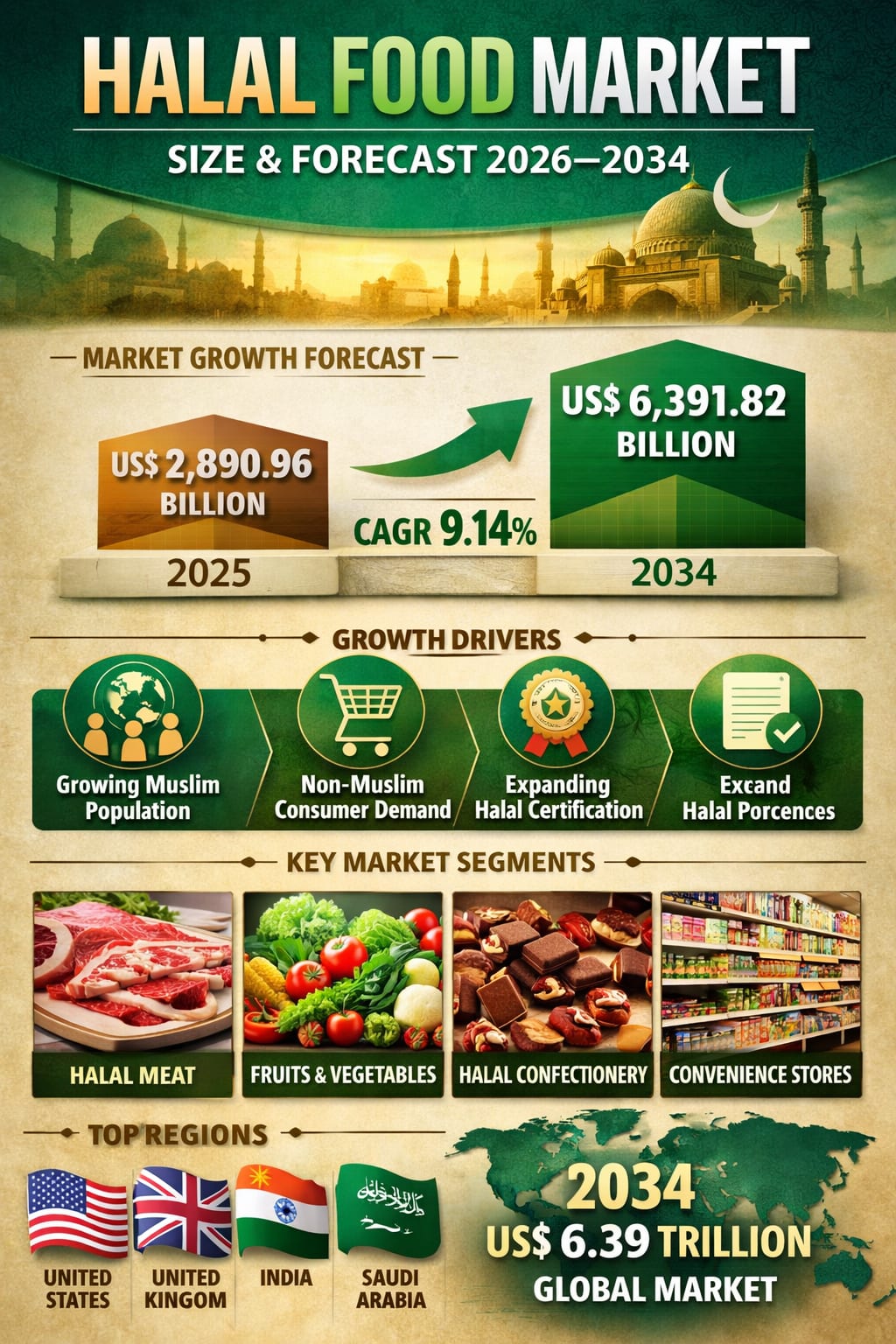
The global halal food market is entering a powerful expansion phase, fueled by demographic growth, rising consumer awareness, and increasing global acceptance of halal-certified products. According to Renub Research, the market is projected to grow from US$ 2,890.96 Billion in 2025 to US$ 6,391.82 Billion by 2034, registering a Compound Annual Growth Rate (CAGR) of 9.14% from 2026 to 2034.
This remarkable trajectory reflects not only the steady rise of the global Muslim population but also the widening appeal of halal food among non-Muslim consumers who associate it with hygiene, safety, traceability, and ethical sourcing.
Halal Food Market Outlook
Halal food refers to products that are prepared, processed, and handled according to Islamic dietary laws outlined in the Quran. The word “halal” means “permissible,” defining what Muslims are allowed to consume. These guidelines regulate ingredient sourcing, slaughtering methods, hygiene practices, and the exclusion of prohibited elements such as pork, alcohol, and certain additives.
Halal certification plays a central role in the ecosystem. It ensures compliance with religious requirements and increasingly acts as a global quality assurance mark. Today, halal food extends far beyond fresh meat to include dairy, confectionery, beverages, cereals, oils, frozen meals, supplements, and processed packaged products.
The global Muslim population is expected to grow significantly in the coming decades — from approximately 1.6 billion in 2010 to nearly 2.8 billion by 2050 — rising from 23% to nearly 30% of the world’s population. This demographic shift underpins long-term structural demand.
Beyond Muslim-majority regions such as the Middle East and Southeast Asia, halal food has gained traction across Europe and North America. Expanding retail availability, foodservice inclusion, and global trade networks are accelerating adoption.
Key Growth Drivers of the Halal Food Market
1. Expanding Global Muslim Population
The most fundamental growth driver is the steady increase in the Muslim population worldwide. Rapid urbanization, rising disposable incomes, and changing lifestyles are reshaping consumption patterns. Younger consumers demand greater variety, convenience, and innovation in halal-certified products — from ready-to-eat meals to premium snacks and functional beverages.
Manufacturers are responding by diversifying product portfolios and expanding distribution networks, ensuring that halal options are accessible in both Muslim-majority and minority regions.
2. Rising Acceptance Among Non-Muslim Consumers
Halal food is increasingly perceived as a symbol of hygiene, ethical sourcing, and strict processing standards. In the United States, surveys suggest that roughly 30% of non-Muslim consumers have tried halal-certified food within the past year.
This shift indicates that halal certification is evolving beyond a religious identifier into a broader quality benchmark. Restaurants, global food brands, and supermarket chains are introducing halal lines to cater to multicultural and health-conscious consumers.
The convergence of ethical consumption trends and transparency-driven purchasing behavior continues to support sustained demand.
3. Expansion of Certification and Logistics Infrastructure
The growth of recognized halal certification bodies has strengthened consumer trust and facilitated international trade. Governments and private stakeholders are investing in halal ecosystems, including industrial parks, cold-chain logistics, and export frameworks.
For example, Nippon Express Co., Ltd. expanded its halal-certified domestic air cargo services in Japan, demonstrating how logistics innovation is enabling cross-border halal distribution.
E-commerce platforms and digital retail channels further enhance global accessibility, allowing consumers to purchase certified products directly from international suppliers.
Market Challenges
Lack of Unified Global Standards
A significant challenge remains the absence of globally harmonized halal standards. Certification requirements vary by country and organization, creating complexity for multinational companies. Firms often need multiple certifications to access different markets, increasing compliance costs and administrative burdens.
Small and medium-sized enterprises are particularly affected, as navigating varied regulatory landscapes can limit international expansion.
Supply Chain Integrity and Contamination Risks
Maintaining halal authenticity throughout the supply chain is critical. Cross-contamination with non-halal ingredients during processing, transportation, or storage can compromise certification status and damage brand reputation.
Ensuring segregation, traceability, and compliance requires rigorous monitoring systems and investment in infrastructure. Any breach in trust can significantly impact consumer confidence.
Segment Analysis
Halal Meat Market
The halal meat segment remains the backbone of the industry. Products must originate from permissible animals and follow Islamic slaughtering principles emphasizing cleanliness and ethical treatment.
Demand spans fresh, frozen, and processed meat categories, including poultry, beef, lamb, and mutton. Expanding cold-chain networks and international trade agreements have improved availability in non-Muslim countries.
Global protein consumption trends and rising preference for traceable meat further strengthen this segment’s dominance.
Halal Fruits & Vegetables
While fruits and vegetables are naturally halal, certification ensures no contamination during processing or packaging. This segment is particularly important in packaged and ready-to-cook produce categories, where additives and handling methods must comply with halal standards.
Growing interest in clean-label and ethically sourced produce enhances this segment’s relevance in foodservice and export markets.
Halal Confectionery
Confectionery products require careful scrutiny due to ingredients such as gelatin and emulsifiers. Demand for halal-certified chocolates, candies, and desserts is rising globally.
Innovation, premium branding, and attractive packaging have broadened appeal beyond Muslim consumers, contributing to steady market growth.
Distribution Channels
Hypermarkets & Supermarkets:
Large retailers offer wide halal assortments, often with dedicated sections. Private-label halal ranges are expanding in developed markets.
Convenience Stores:
Urbanization and busy lifestyles drive demand for quick-access halal snacks and ready meals.
Online Stores:
Digital retail platforms are rapidly gaining importance, improving product accessibility and cross-border trade.
Specialty Stores:
Independent halal butchers and specialty retailers maintain strong community presence, particularly in Western countries.
Regional Insights
United States
The U.S. halal food market is steadily expanding, supported by demographic growth and rising multicultural consumption trends. Halal products are increasingly available in mainstream supermarkets and foodservice outlets.
In January 2025, Shah’s Halal Food expanded beyond New York to Dupont Circle in Washington, D.C., reflecting rising demand in urban centers.
E-commerce platforms and meal delivery services have further enhanced accessibility nationwide.
United Kingdom
The UK hosts one of Europe’s most established halal food ecosystems. Supermarkets, butcher shops, and quick-service restaurants actively cater to halal consumers.
In September 2024, Tariq Halal Meat introduced the first drive-thru halal butcher shops in the UK and Dubai, reflecting retail innovation aligned with convenience trends.
Strong certification infrastructure and transparent labeling practices support sustained growth.
India
India plays a dual role as both a large domestic market and a significant exporter of halal-certified meat and processed foods.
In October 2024, the Directorate General of Foreign Trade (DGFT) introduced updated export requirements under the Quality Council of India’s India Conformity Assessment Scheme (I-CAS) for halal certification, strengthening regulatory oversight for exports to 15 countries.
Urban consumption is rising domestically, while export demand remains a major growth lever.
Saudi Arabia
Halal compliance is mandatory in Saudi Arabia, making it one of the most mature markets globally.
In January 2026, JBS SA announced an US$ 85 million investment to expand operations in the Kingdom, positioning it as a halal production and export hub for the Middle East and Southeast Asia.
Strong government oversight, high consumer trust, and reliance on imports reinforce the Kingdom’s strategic importance.
Leading Halal Food Companies
The competitive landscape includes multinational corporations and regional specialists expanding halal portfolios:
Nestlé SA – Halal dairy, infant formula, beverages
JBS SA – Halal beef and poultry
BRF SA – Poultry and frozen halal meals
Kawan Food Berhad – Frozen Asian halal products
Cargill Inc. – Halal beef, grains, oils
Carrefour SA – Private-label halal ranges
Crescent Foods Inc. – Halal poultry and beef
VegaVites – Halal gummy vitamins
American Halal Company Inc. – Frozen halal meals
American Foods Group LLC – Halal beef exports
Al Islami Foods – Frozen halal meat and snacks
Each company competes through product innovation, geographic expansion, certification compliance, and supply chain optimization.
Product Segmentation
Meat
Poultry & Seafood
Fruits & Vegetables
Dairy Products
Cereals & Grains
Oils
Fats & Waxes
Confectionery
Others
Distribution Channels
Hypermarkets & Supermarkets
Online Stores
Convenience Stores
Specialty Stores
Others
Final Thoughts
The halal food market is no longer a niche religious segment — it has evolved into a global, multi-trillion-dollar industry shaped by demographic expansion, ethical consumption trends, and modern retail innovation.
With Renub Research projecting growth from US$ 2,890.96 Billion in 2025 to US$ 6,391.82 Billion by 2034 at a CAGR of 9.14%, the industry presents compelling opportunities for manufacturers, retailers, exporters, and investors.
As certification systems mature and global supply chains become more standardized, halal food will continue to integrate into mainstream retail channels worldwide. Ethical positioning, transparency, and convenience will define the next wave of expansion.
About the Creator
Keep reading
More stories from shibansh kumar and writers in Trader and other communities.
Global Automotive Paints Market Size and Forecast 2026–2034
The global automotive paints market is on a steady growth trajectory, supported by rising vehicle production, expanding electric vehicle (EV) adoption, and increasing demand for vehicle customization. According to Renub Research, the automotive paints market is projected to grow from US$ 12.23 Billion in 2025 to US$ 17.88 Billion by 2034, registering a compound annual growth rate (CAGR) of 4.31% during the forecast period.
By shibansh kumar2 days ago in Trader
India Commercial Air Conditioning Market Size and Forecast 2026–2034
Introduction India’s commercial infrastructure is expanding at an unprecedented pace, and with it comes a growing need for advanced climate control systems. From modern office complexes and sprawling shopping malls to hospitals, hotels, airports, and data centers, efficient cooling solutions have become essential for operational efficiency and occupant comfort.
By Sakshi Sharmaabout 4 hours ago in Trader
Writing To Succeed
If you want to find something that will help readers find your writing, possibly expand your audience, and maybe even get you noticed for other things, then you’re not alone. But how can you get it done in a world full of want-to-be writers? Look less at what you’re writing now, and more at what other writers have used to boost their views and reads.
By Jason Ray Morton 4 days ago in Writers




Comments
There are no comments for this story
Be the first to respond and start the conversation.