
Hip Replacement Market Size and Forecast 2026–2034
Aging Populations, Surgical Innovation, and Expanding Global Access Drive Steady Growth

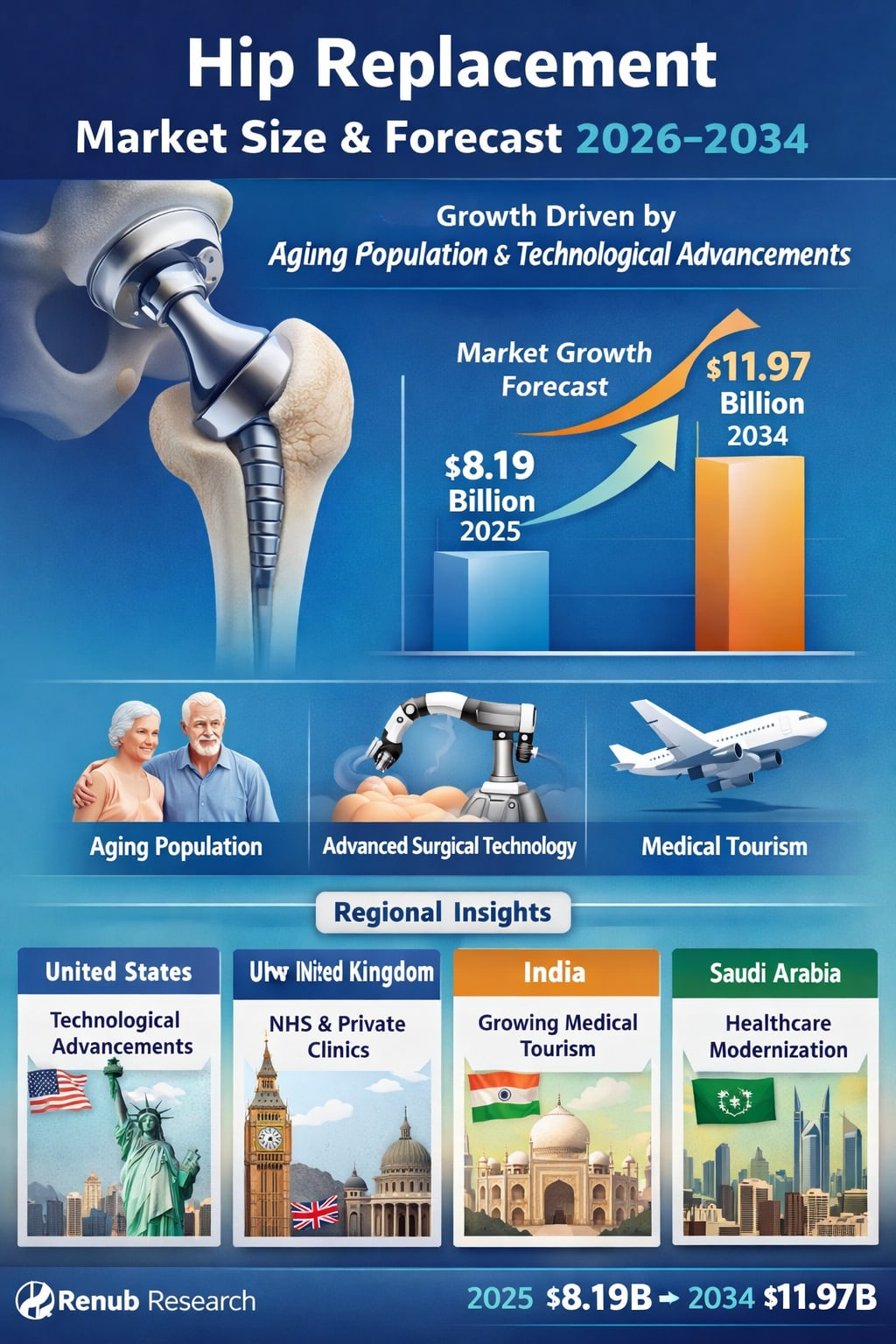
The global Hip Replacement Market is entering a decade of stable and meaningful expansion, supported by demographic shifts, technological progress, and improved healthcare accessibility. According to Renub Research, the market was valued at US$ 8.19 billion in 2025 and is projected to reach US$ 11.97 billion by 2034, growing at a steady Compound Annual Growth Rate (CAGR) of 4.31% from 2026 to 2034.
This growth reflects not only rising procedure volumes but also advancements in implant durability, minimally invasive surgical techniques, robotic assistance, and improved patient outcomes. As life expectancy increases globally and mobility expectations rise across all age groups, hip replacement surgery is increasingly seen as a life-enhancing and cost-effective orthopedic solution.
Hip Replacement Industry Outlook
Hip replacement surgery, medically known as total hip arthroplasty, involves replacing a damaged or diseased hip joint with an artificial implant made of metal, ceramic, or high-grade polyethylene. The procedure is primarily recommended for patients suffering from severe osteoarthritis, rheumatoid arthritis, avascular necrosis, post-traumatic arthritis, or hip fractures when conservative treatments fail.
The procedure removes damaged cartilage and bone and replaces them with a prosthetic ball-and-socket joint that mimics natural hip function. Modern implants are designed to last 15–20 years or longer, significantly improving quality of life by restoring mobility and eliminating chronic pain.
Globally, hip replacement has become one of the most successful orthopedic surgeries. Its rising popularity is driven by:
Rapid growth of the aging population
Rising obesity and sedentary lifestyles
Increased sports-related injuries
Expanding access to orthopedic care
Technological innovation in implants and navigation systems
In both developed and emerging economies, hip replacement is increasingly considered a long-term solution for maintaining independence and mobility.
Growth Drivers of the Hip Replacement Market
1. Aging Population and Rising Joint Disorders
One of the most powerful drivers of market expansion is global aging. Degenerative joint conditions increase significantly with age due to cartilage wear, bone density reduction, and higher fracture risk.
According to global health estimates, osteoarthritis affects hundreds of millions of people worldwide, with the majority of cases occurring in individuals over 55 years of age. Women represent a higher proportion of affected patients. Rheumatoid arthritis also contributes substantially to joint deterioration.
Regions such as North America, Europe, Japan, and China are experiencing rapid growth in populations aged 60 and above. As life expectancy increases, so does the demand for joint restoration procedures that preserve independence and activity levels.
Hip replacement is no longer viewed as a last-resort surgery for the elderly—it is increasingly performed in younger, active patients seeking long-term mobility solutions.
2. Technological Advancements in Implants and Surgical Precision
Innovation remains central to the industry’s steady growth.
Modern hip implants now incorporate:
Ceramic-on-ceramic materials
Highly cross-linked polyethylene
Improved metal alloys
Enhanced wear-resistant surfaces
These materials extend implant longevity and reduce revision rates.
In addition, surgical innovation is transforming outcomes. Minimally invasive approaches reduce incision size, minimize blood loss, and shorten hospital stays. Robotic-assisted and computer-navigated surgeries improve implant positioning accuracy, reducing complications and improving long-term joint function.
In February 2025, Gyder Surgical received FDA 510(k) clearance for its GYDER Hip System, a pin-less, non-invasive, image-less navigation technology designed for precise acetabular cup placement. Such breakthroughs highlight the market’s continuous innovation pipeline.
Advanced robotics and navigation systems are increasingly adopted in major orthopedic centers, particularly in technologically mature markets.
3. Expanding Healthcare Access and Medical Tourism
Improved awareness of orthopedic conditions and greater healthcare accessibility are expanding the global patient base.
Emerging markets are investing heavily in healthcare infrastructure, enabling:
Advanced surgical facilities
Trained orthopedic specialists
Post-operative rehabilitation services
Insurance coverage expansion
Medical tourism plays a crucial role in market growth. Countries such as India offer hip replacement surgeries at significantly lower costs compared to Western nations. A unilateral hip replacement may cost approximately US$ 5,000 in India versus US$ 25,000 or more in the United States or United Kingdom. Bilateral procedures can cost around US$ 10,000 compared to US$ 40,000 or more in developed markets.
Government initiatives aimed at promoting healthcare tourism, visa facilitation, and quality assurance further strengthen international patient inflow.
Challenges in the Hip Replacement Market
High Cost of Surgery and Implants
Despite its benefits, hip replacement remains an expensive procedure. Costs include:
Diagnostic evaluations
Implant devices
Surgeon fees
Hospital stays
Rehabilitation and follow-up care
In low- and middle-income countries, affordability remains a major barrier. Even in developed markets, reimbursement complexities and high healthcare expenses can delay procedures.
Limited insurance penetration in some regions further restricts adoption.
Surgical Risks and Implant Complications
Although considered safe, hip replacement carries potential risks:
Infection
Blood clots
Implant loosening
Dislocation
Nerve damage
Revision surgery
Implant failure over time—particularly in younger, active patients—remains a concern. Fear of complications can discourage some individuals from undergoing surgery, particularly where post-operative care infrastructure is limited.
Market Segmentation Insights
Total Hip Replacement (THR)
Total Hip Replacement holds the largest market share. This procedure replaces both the femoral head and acetabulum, making it suitable for severe degenerative conditions.
Advantages include:
Long-term pain relief
Improved mobility
15–20 year implant durability
High procedural success rates
Growing elderly populations and expanding indications among younger patients are driving steady demand.
Partial Hip Replacement
Partial hip replacement replaces only the femoral head while preserving the natural socket. It is typically recommended for specific fracture cases in elderly patients.
Benefits include:
Shorter surgery time
Less blood loss
Faster recovery
Lower procedural cost
Although more selective in application, it remains important in trauma-focused orthopedic settings.
End-User Segmentation
Hospitals & Surgery Centers dominate due to advanced infrastructure, complex case handling capability, and robotic technology availability.
Orthopedic Clinics are gaining prominence through outpatient services, pre-operative planning, and rehabilitation management.
Ambulatory surgery centers are also growing, driven by cost efficiency and shorter hospital stays.
Regional Market Analysis
United States
The United States represents one of the most technologically advanced hip replacement markets globally. High obesity rates, aging demographics, and widespread awareness of orthopedic treatments drive strong demand.
Positive reimbursement structures support procedure adoption. Robotic-assisted surgeries are increasingly common in major hospitals.
In October 2025, Zimmer Biomet Holdings, Inc. received FDA Breakthrough Device Designation for its iodine-treated total hip replacement system, highlighting innovation leadership in the U.S. market.
United Kingdom
The United Kingdom market is supported by an established public healthcare system. Rising elderly populations and degenerative joint disease prevalence sustain demand.
While waiting times and hospital capacity planning influence procedural volumes, private healthcare providers are expanding access and improving service efficiency.
Technological advancements and precision-driven research continue to enhance surgical outcomes across the UK healthcare ecosystem.
India
India is emerging as one of the fastest-growing hip replacement markets. Growth is driven by:
Expanding healthcare infrastructure
Rising arthritis prevalence
Increasing road accident injuries
Growing urbanization
Rising disposable income
India is also a global medical tourism hub. Advanced surgical capabilities at competitive pricing attract international patients.
In January 2026, Manipal Hospital, Gurugram performed a 3D-navigated Total Hip Replacement using the IntelliJoint 3D Navigation System, demonstrating increasing adoption of advanced surgical technologies.
Saudi Arabia
Saudi Arabia’s market is expanding steadily under healthcare modernization initiatives. Rising obesity rates and age-related joint disorders increase demand.
Government efforts to strengthen domestic healthcare infrastructure and reduce outbound medical travel are driving investments in specialized orthopedic facilities.
In January 2026, Dallah Al Nakheel Hospital successfully performed hip replacement surgery using the Direct Anterior Approach (DAA), a minimally invasive technique enabling faster recovery and early mobilization.
Competitive Landscape
Key companies operating in the global hip replacement market include:
Smith & Nephew PLC
Johnson & Johnson
Integra Lifesciences Corporation
Zimmer Biomet
Stryker
B. Braun Melsungen AG
Globus Medical Inc
MicroPort Scientific Corporation
Conformis Inc
Companies compete based on implant innovation, robotic integration, durability, and global distribution networks. Strategic partnerships, regulatory approvals, and technological differentiation remain central competitive strategies.
Future Outlook: Stability with Innovation
The hip replacement market is not characterized by explosive growth but rather by sustained, reliable expansion. The projected CAGR of 4.31% reflects:
Predictable demographic trends
Established surgical success rates
Continuous technological innovation
Expanding emerging market penetration
As implants become more durable and surgical approaches more precise, patient confidence is likely to rise further. Robotic-assisted surgery, smart implants, and enhanced post-operative rehabilitation models may redefine procedural efficiency over the next decade.
The integration of digital health monitoring and personalized implant design could further improve outcomes and reduce revision rates.
Final Thoughts
The global hip replacement market stands at a pivotal intersection of demographic inevitability and technological sophistication. Valued at US$ 8.19 billion in 2025 and expected to reach US$ 11.97 billion by 2034, the industry demonstrates steady resilience.
With aging populations, increasing joint disease prevalence, improved surgical precision, and expanding healthcare accessibility worldwide, hip replacement surgery will continue to transform millions of lives.
Rather than being viewed solely as a medical procedure, hip replacement is increasingly recognized as a gateway to restored independence, productivity, and quality of life. As healthcare systems evolve and innovation accelerates, the next decade will solidify its position as one of the most impactful interventions in modern orthopedic medicine
About the Creator
Keep reading
More stories from shibansh kumar and writers in Trader and other communities.
Global Ginger Market Size and Forecast 2026–2034
The Global Ginger Market is entering a phase of sustained growth, supported by evolving consumer preferences and expanding industrial applications. According to Renub Research, the market is projected to grow from US$ 5.31 billion in 2025 to US$ 8.37 billion by 2034, registering a compound annual growth rate (CAGR) of 5.72% during 2026–2034.
By shibansh kumar7 days ago in Trader
Australia Oat Milk Market 2026: Plant-Based Beverage Growth, Health Trends & Sustainable Consumption
Australia Oat Milk Market Overview The Australia oat milk market is expanding rapidly as consumers increasingly embrace plant-based and dairy-free alternatives driven by health, environmental and lifestyle considerations. Oat milk—a plant-derived beverage made from oats and water—is gaining traction as a creamy, nutritious substitute for traditional dairy milk. It is widely used in coffee, tea, smoothies, breakfast cereals and baking, and has become a staple within the rising plant-based consumption trend across Australia’s urban and regional populations. Growth is supported by rising lactose intolerance awareness, a surge in vegan and flexitarian diets, and expanded availability across retail and foodservice channels.
By Amyra Singh7 days ago in Trader
Top tipple tricks
Been thinking a lot about drinking, lately. Not least because of a recent episode of over-indulgence and the inevitable after effects. Some readers may recall the earlier articles I wrote about beating the booze. Here I set out an experiment in techniques for cutting down on my alcohol intake. The experiment was successful, the techniques worked, and I have armed myself with an arsenal of weapons in the war against the demon drink. I have yet to fire the first round however. It's all a question of timing (perhaps procrastination).
By Raymond G. Taylorabout 16 hours ago in Psyche




Comments
There are no comments for this story
Be the first to respond and start the conversation.