
India Fertilizer Market Size and Forecast 2026–2034
Rising Food Demand, Government Support, and Technological Advancements to Shape the Future of Indian Agriculture

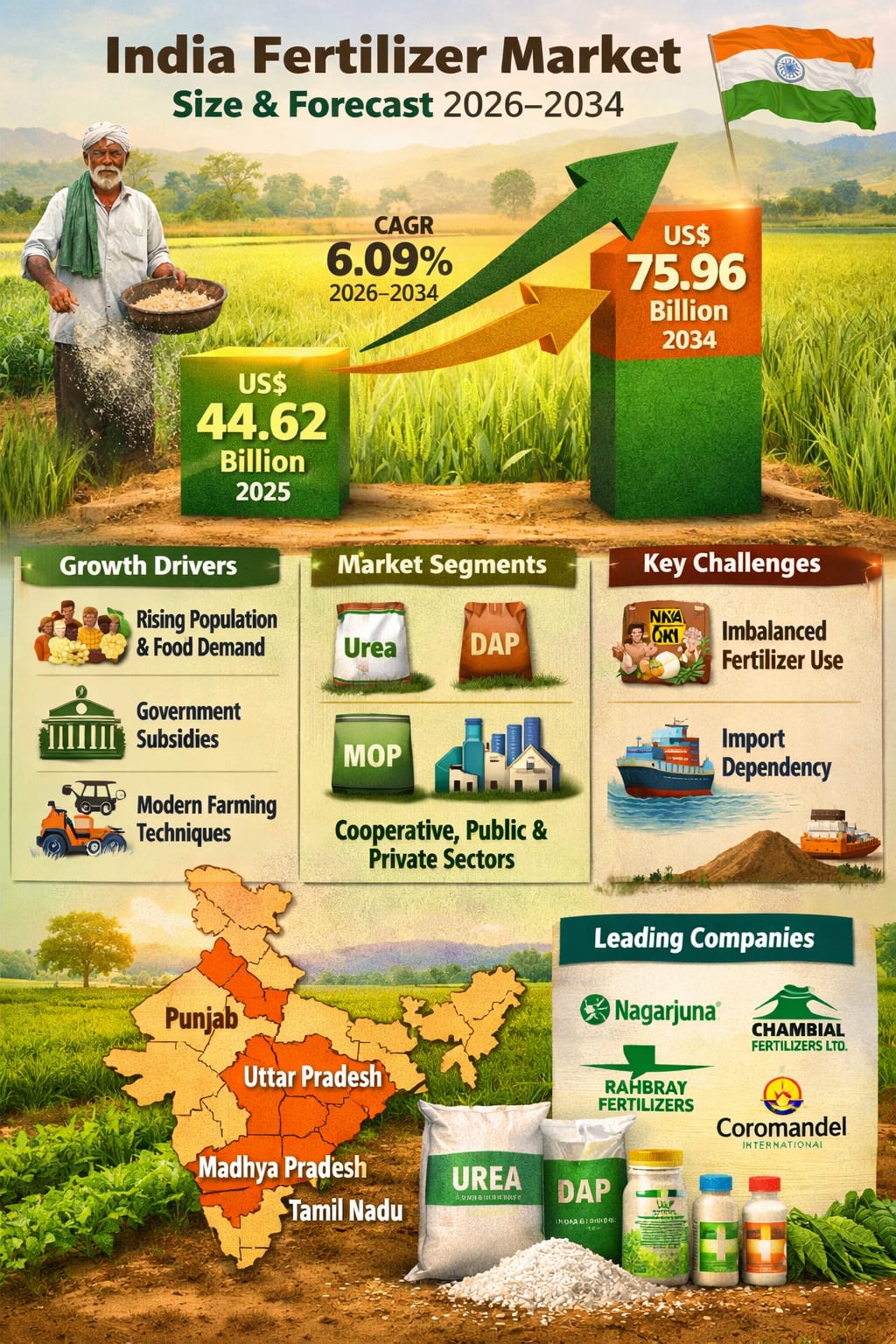
The India fertilizer market is poised for steady and sustainable growth over the next decade, driven by the country’s rising population, increasing food consumption, and the urgent need to enhance agricultural productivity. According to Renub Research, the market is projected to grow from US$ 44.62 Billion in 2025 to US$ 75.96 Billion by 2034, expanding at a Compound Annual Growth Rate (CAGR) of 6.09% during 2026–2034.
As India continues to balance food security with sustainable farming, fertilizers remain at the core of agricultural development. Government subsidies, modernization of farming techniques, and increasing awareness about soil health are all playing pivotal roles in shaping the future of this vital industry.
India Fertilizer Market Outlook
Fertilizers are organic or inorganic substances added to soil or plants to supply essential nutrients necessary for crop growth and improved yield. The most important nutrients include nitrogen (N), phosphorus (P), and potassium (K), along with secondary nutrients and micronutrients that enhance soil fertility.
In India, fertilizers are indispensable to agriculture. With a population that surpassed 1.42 billion in 2023, India has become the world’s most populous country. As the population continues to grow and urbanization reduces arable land availability, agricultural productivity must increase per hectare. Fertilizers, therefore, are not optional — they are essential.
Chemical fertilizers, organic fertilizers, and biofertilizers all serve distinct purposes. While chemical fertilizers dominate due to their immediate effectiveness, the shift toward balanced nutrient management and sustainable farming is gradually reshaping the demand landscape.
Key Growth Drivers of the India Fertilizer Market
1. Rising Food Demand and Population Growth
India’s expanding population remains one of the strongest drivers of fertilizer demand. With limited cultivable land and increasing dietary needs, agricultural productivity must rise to meet demand for cereals, pulses, fruits, vegetables, and oilseeds.
To compensate for nutrient depletion caused by continuous cropping, farmers rely heavily on fertilizers. Higher cropping intensity and multiple harvest cycles further increase nutrient requirements.
India’s population is projected to continue growing until the 2060s, which means fertilizer demand will remain structurally strong for decades. Ensuring food self-sufficiency will continue to depend on efficient and optimized fertilizer usage.
2. Strong Government Support and Subsidy Programs
Government backing has historically been a cornerstone of the Indian fertilizer market. Subsidies on urea, DAP (Di-Ammonium Phosphate), and NPK fertilizers ensure affordability for farmers.
Key government initiatives include:
Direct Benefit Transfer (DBT) schemes
Soil Health Card programs
Promotion of balanced fertilizer application
Neem-coated urea policy
Expansion of nano-liquid fertilizer plants
India has also invested in nano-urea and nano-DAP production, with plans to increase production capacity significantly by 2025. The initiative to manufacture 44 crore bottles of 500 ml nano urea and nano DAP reflects the country’s push toward efficient and environmentally sustainable solutions.
Additionally, welfare schemes such as PM-KISAN and PM-Garib Kalyan Yojana have strengthened rural purchasing power, indirectly supporting fertilizer consumption.
3. Adoption of Modern Farming Practices
Modern agriculture is increasingly technology-driven. Precision farming, mechanization, drip irrigation, and high-yield seed varieties are reshaping Indian agriculture.
With advancements in research and development, India is also exploring water-soluble fertilizers and specialty nutrients. In August 2025, after years of research, indigenous water-soluble fertilizer technology was successfully developed, marking a milestone toward reducing import dependence.
As farmers adopt better irrigation systems and mechanized farming, fertilizer usage becomes more scientific, targeted, and efficient — contributing positively to market growth.
Key Challenges Facing the Market
Imbalanced Fertilizer Usage
One of the biggest structural challenges in India is the overuse of nitrogen-based fertilizers, particularly urea. Subsidy structures often make urea cheaper compared to phosphorus and potassium fertilizers, resulting in nutrient imbalance.
Excessive nitrogen usage deteriorates soil health, reduces long-term productivity, and affects environmental sustainability. Encouraging balanced NPK application remains critical.
Dependence on Imports
India heavily depends on imports for raw materials such as phosphates, potash, and natural gas. Global price fluctuations and geopolitical disruptions directly impact domestic fertilizer pricing and availability.
While subsidies help stabilize farmer prices, they also increase fiscal pressure on the government. Reducing import dependency through domestic production remains a strategic priority.
Segment Insights
India Urea Fertilizer Market
The urea segment dominates the Indian fertilizer industry. As a major nitrogen source, urea is critical for cereals, pulses, oilseeds, and cash crops.
Government subsidies make urea affordable, and the introduction of neem-coated urea has improved nutrient efficiency while reducing misuse. Despite concerns about overuse, urea continues to be the backbone of Indian fertilizer consumption.
India MOP Fertilizer Market
Muriate of Potash (MOP) fulfills potassium requirements essential for disease resistance, water regulation, and crop quality. Crops such as sugarcane, fruits, vegetables, and oilseeds heavily rely on potassium.
India does not possess significant potash reserves, making MOP entirely import-dependent. As awareness grows about balanced nutrient application, MOP consumption is expected to increase steadily.
India Cooperative Fertilizer Market
Cooperatives play a vital role in distributing fertilizers to rural and remote regions. Through extensive networks, cooperative societies ensure affordability, accessibility, and timely supply.
Farmer education initiatives and integration with agricultural extension services further strengthen the cooperative model.
India Public Fertilizer Market
Public sector enterprises ensure national fertilizer security. Supported by government funding, these companies stabilize supply and maintain affordability.
Their role becomes especially important during global supply chain disruptions.
India Private Fertilizer Market
Private players focus on innovation, specialty fertilizers, micronutrients, and value-added products. They contribute to technological advancements and introduce diversified nutrient solutions.
With rising awareness about balanced and customized fertilizers, the private sector is expanding its footprint across states.
Regional Analysis
Punjab Fertilizer Market
Punjab, often referred to as the “breadbasket of India,” has intensive wheat and rice cultivation. High irrigation coverage and high-yielding seed varieties drive fertilizer consumption.
While urea and DAP dominate usage, soil degradation concerns have increased soil testing initiatives across the state.
Uttar Pradesh Fertilizer Market
As one of India’s largest agricultural states, Uttar Pradesh contributes significantly to fertilizer demand. Crops such as wheat, rice, sugarcane, pulses, and oilseeds require consistent nutrient input.
Government subsidies and extensive rural distribution networks ensure high accessibility.
Madhya Pradesh Fertilizer Market
Madhya Pradesh’s crop diversification, especially soybean and oilseed cultivation, is fueling fertilizer demand. Expansion of irrigation facilities and soil health initiatives support balanced usage.
Tamil Nadu Fertilizer Market
Tamil Nadu practices intensive multi-crop farming, including rice, sugarcane, cotton, and horticultural crops. Limited arable land increases cropping intensity, boosting fertilizer demand.
The state also shows growing interest in specialty and advanced fertilizers.
Market Segmentation
By Fertilizer Type
Urea
DAP
MOP
Complex Fertilizers
By Sector
Public Sector
Cooperative Sector
Private Sector
By State
Andhra Pradesh, Bihar, Chhattisgarh, Gujarat, Haryana, Jammu & Kashmir, Jharkhand, Karnataka, Kerala, Madhya Pradesh, Maharashtra, Odisha, Puducherry, Punjab, Rajasthan, Tamil Nadu, Telangana, Uttar Pradesh, Uttarakhand, West Bengal
Competitive Landscape
Key players in the India fertilizer market include:
Nagarjuna Fertilizers and Chemicals Ltd.
Chambal Fertilisers & Chemicals Ltd.
Rashtriya Chemicals & Fertilizers Limited
National Fertilizers Ltd.
Coromandel International Ltd.
Each company has been analyzed from five major viewpoints:
Overview
Key Personnel
Recent Developments
SWOT Analysis
Revenue Analysis
Competition is driven by production capacity expansion, technological innovation, distribution network strengthening, and strategic partnerships.
Future Outlook
Looking ahead, the Indian fertilizer market stands at the intersection of food security and sustainability. The government’s push toward nano-fertilizers, domestic manufacturing, and balanced nutrient management will redefine consumption patterns.
Digital agriculture, data-driven soil management, and smart farming practices are expected to reshape fertilizer application methods. Additionally, increasing emphasis on biofertilizers and eco-friendly inputs may gradually alter the product mix.
With a projected market size of US$ 75.96 Billion by 2034, the industry’s steady 6.09% CAGR reflects resilience, structural demand, and policy backing.
Final Thoughts
The India fertilizer market remains one of the most strategically important sectors in the country’s economy. As agriculture supports millions of livelihoods and ensures national food security, fertilizers will continue to play a decisive role.
While challenges such as soil degradation and import dependence persist, policy reforms, technological advancements, and increasing farmer awareness offer a promising future.
The coming decade will not only witness market expansion but also a transformation toward smarter, more sustainable agricultural input management. For stakeholders, policymakers, and investors alike, the Indian fertilizer industry represents both opportunity and responsibility in equal measure.
About the Creator
Sakshi Sharma
Content Writer with 7+ years of experience crafting SEO-driven blogs, web copy & research reports. Skilled in creating engaging, audience-focused content across diverse industries.
Keep reading
More stories from Sakshi Sharma and writers in Trader and other communities.
Global Biopsy Devices Market Size and Forecast 2026–2034
The global healthcare industry is witnessing a profound shift toward early detection and precision diagnostics, and biopsy devices are at the center of this transformation. As cancer cases rise worldwide and diagnostic technologies become increasingly sophisticated, the demand for reliable, minimally invasive biopsy solutions continues to grow.
By Sakshi Sharmaa day ago in Trader
William Stern on the Strait of Hormuz, Oil Prices, Inflation, and Geopolitical Risk
William Stern is an entrepreneur, investor, and small-business finance executive best known as the founder and CEO of Cardiff, which he launched in 2004 to expand access to capital for entrepreneurs. Over two decades, he has built Cardiff into a fintech-focused lender while also leading Cardiff Ventures and coaching founders through The Fraternity. Stern is a frequent public speaker, publishes business commentary, and hosts the podcast A Stern Talk, where he interviews leaders about growth, markets, and entrepreneurship. Before founding Cardiff, he held roles at Fisher Investments and Balboa Capital, shaping his finance and lending expertise across volatile business cycles.
By Scott Douglas Jacobsenabout 6 hours ago in Trader
How Corporate Partnerships and Open Innovation Drive Faster Business Growth
Corporate partnerships and open innovation have become essential strategies for organizations seeking to remain competitive in rapidly evolving markets. As technology advances and customer expectations shift, no company can rely solely on internal resources to keep up. By collaborating with external partners, businesses can access new ideas, expand their capabilities, and accelerate the development of innovative solutions.
By Greg Warnock7 days ago in Trader




Comments
There are no comments for this story
Be the first to respond and start the conversation.