
Saudi Arabia Perfume Market Size and Forecast 2026–2034
Luxury Fragrance Culture and Rising Disposable Income Fuel Strong Growth in Saudi Arabia’s Perfume Industry

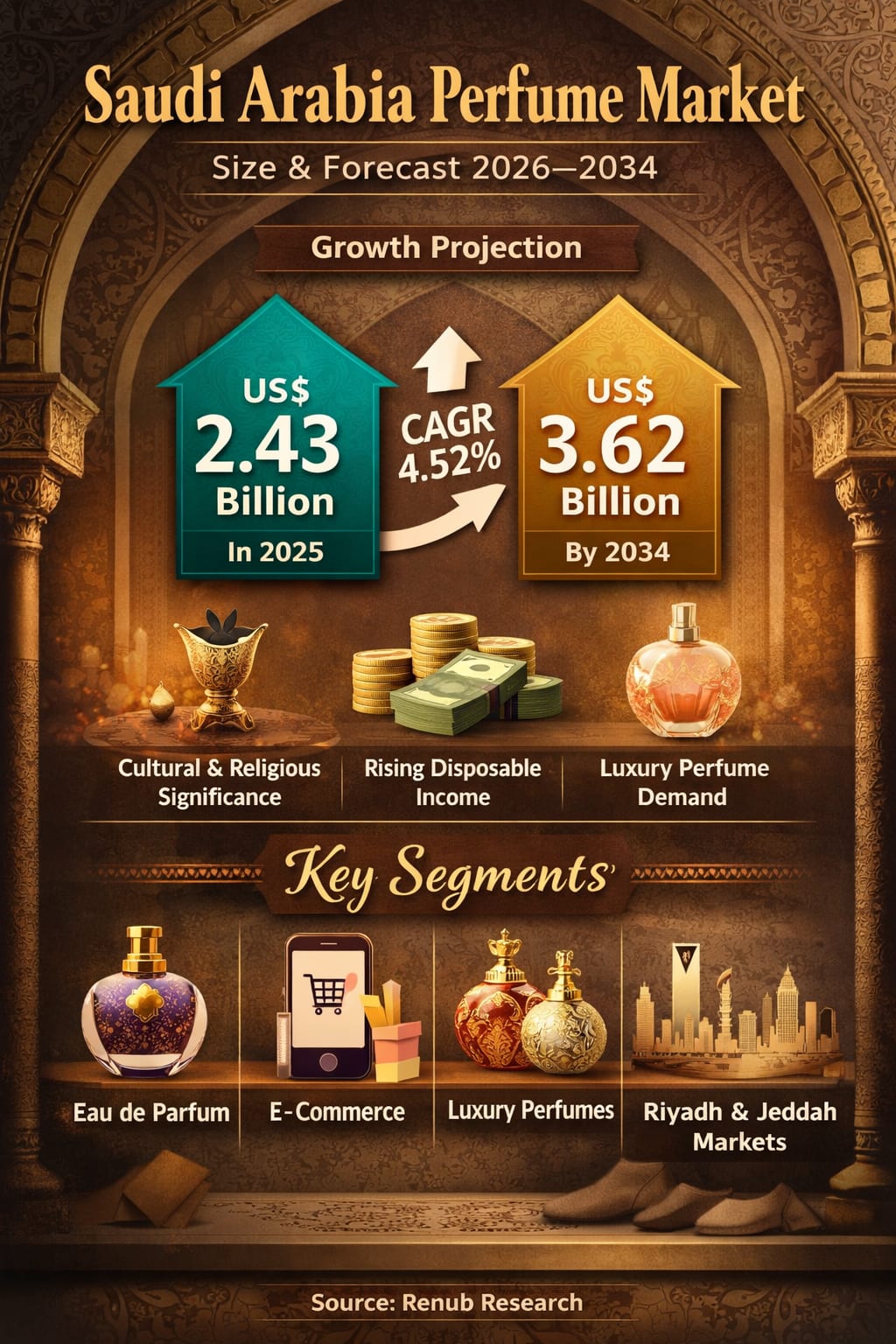
The Saudi Arabia perfume market is expected to witness steady expansion during the forecast period as fragrance remains deeply embedded in the cultural, religious, and social lifestyle of the country. Growing disposable incomes, increasing interest in luxury fragrances, and expanding retail and e-commerce channels are further supporting market growth.
According to Renub Research, the Saudi Arabia perfume market is projected to increase from US$ 2.43 Billion in 2025 to US$ 3.62 Billion by 2034, growing at a compound annual growth rate (CAGR) of 4.52% between 2026 and 2034. Rising consumption of traditional Arabic fragrances such as oud, amber, musk, and rose, along with increasing demand for international luxury perfume brands, is expected to drive the market during the forecast period.
Saudi Arabia Perfume Market Overview
Perfume is a scented liquid created from a blend of essential oils, aroma compounds, alcohol, and fixatives designed to produce a pleasant and long-lasting fragrance when applied to the skin, clothing, or surroundings. Perfumes are available in several concentrations including parfum, eau de parfum, eau de toilette, and eau de cologne, each differing in fragrance intensity and longevity.
Beyond personal grooming, perfumes serve as an expression of identity, culture, and personal style. In Saudi Arabia, fragrances are an integral part of daily life. They are commonly used during prayers, social gatherings, weddings, and celebrations, making perfume one of the most essential lifestyle products in the country.
Traditional Arabic fragrances such as oud, amber, musk, and rose dominate the local market, while global luxury brands also maintain a strong presence. Perfumes are widely exchanged as gifts and are considered symbols of hospitality and sophistication.
The rising purchasing power of Saudi consumers, combined with the increasing presence of luxury malls, specialty fragrance boutiques, and online retail platforms, is significantly contributing to the expansion of the perfume market in the country.
Growth Drivers of the Saudi Arabia Perfume Market
Deep-Rooted Cultural and Religious Importance of Fragrances
Perfumes hold exceptional cultural and religious importance in Saudi Arabian society, which strongly supports the long-term demand for fragrance products. Using perfumes is a common tradition before attending prayers, gatherings, weddings, and family celebrations.
Fragrances such as oud, musk, amber, and rose are especially valued and often associated with hospitality and social etiquette. Unlike many other countries where perfumes are primarily used for occasional purposes, fragrance use in Saudi Arabia is a daily lifestyle habit for both men and women.
Traditional perfume formats such as attars and concentrated oils remain popular, while modern spray perfumes are widely embraced by younger consumers. This blend of traditional and modern fragrance preferences ensures continuous demand for both Arabic perfumes and international fragrance brands.
The historical importance of perfumes in the Arab world was highlighted in May 2024 when the exhibition “Perfumes of the East” opened in Riyadh under the patronage of Prince Badr bin Farhan. Featuring more than 200 artifacts from archaeology and modern art, the exhibition showcased the long heritage of fragrance culture in the region.
Rising Disposable Income and Premiumization Trends
Increasing disposable income and the growing appetite for luxury lifestyle products are key factors driving the Saudi Arabia perfume market. Consumers are increasingly seeking premium and niche fragrances, particularly high-quality oud-based perfumes and luxury international brands.
Perfumes are widely regarded as luxury goods and are frequently purchased as gifts during weddings, religious events, and celebrations. Consumers are also showing a stronger preference for unique, long-lasting, and customized fragrances, which is boosting demand for niche perfume brands.
Luxury shopping centers, high-end fragrance boutiques, and airport duty-free outlets are expanding their product selections to cater to this growing demand. The premiumization trend has also encouraged local manufacturers to develop sophisticated perfumes using high-quality ingredients and innovative packaging.
In 2025, Saudi households recorded an average disposable income of approximately US$ 18,260 per year, reflecting increasing consumer purchasing power. The government’s Household Income and Expenditure Survey (HIES) for 2023–2024 is expected to provide further insights into evolving spending patterns.
As consumers increasingly favor premium fragrances over mass-market alternatives, the market value of the perfume industry in Saudi Arabia is expected to continue rising.
Expansion of Retail, E-Commerce, and Tourism
The rapid expansion of modern retail infrastructure and digital commerce platforms is another major factor driving the perfume market in Saudi Arabia.
Large shopping malls, luxury retail outlets, and specialized fragrance boutiques provide consumers with access to a wide selection of both Arabic and international perfumes. Airport duty-free stores also contribute significantly to sales, particularly among tourists and business travelers.
E-commerce platforms have transformed the way consumers purchase perfumes by allowing them to explore fragrance options, compare products, and access exclusive online launches. Digital marketing strategies, influencer promotions, and social media campaigns have further increased awareness of fragrance brands.
Saudi Arabia’s growing tourism sector, supported by the country’s Vision 2030 development plan, is also contributing to perfume demand. Visitors frequently purchase perfumes as souvenirs or luxury gifts, boosting retail sales.
For instance, in February 2025, V Perfumes opened its 51st store at the Mall of Arabia in Jeddah, expanding its footprint in the Saudi fragrance market and offering consumers access to both exclusive and international perfume collections.
Challenges in the Saudi Arabia Perfume Market
High Competition and Market Saturation
The Saudi Arabia perfume market is highly competitive, featuring numerous international luxury brands, regional fragrance houses, and local perfume manufacturers.
This intense competition makes it challenging for new entrants to establish strong brand recognition and gain consumer trust. Companies must continuously innovate in fragrance composition, packaging design, and marketing strategies to differentiate themselves.
Moreover, aggressive marketing and influencer collaborations can significantly increase operational costs, potentially affecting profit margins for perfume brands.
Counterfeit Products and Price Sensitivity
The presence of counterfeit and imitation perfumes poses a serious challenge to the fragrance industry in Saudi Arabia. Counterfeit products are often sold at lower prices and can damage the reputation of established perfume brands.
In addition, counterfeit perfumes may contain unsafe ingredients, raising concerns about consumer safety and product quality.
Although luxury perfumes remain popular, certain consumer segments remain sensitive to price fluctuations, particularly during periods of economic uncertainty. This can limit the growth of premium fragrance brands in the mass market segment.
Saudi Arabia Eau de Parfum Market
The eau de parfum (EDP) segment represents one of the most dominant categories within the Saudi Arabia perfume market. EDP contains a higher concentration of fragrance oils compared to other perfume types, making it long-lasting and intense—qualities highly valued by Saudi consumers.
Popular fragrance notes in this segment include oud, amber, musk, rose, and oriental blends. Both men and women frequently choose eau de parfum for daily wear, formal events, and religious gatherings.
Luxury perfume houses and regional fragrance manufacturers offer a wide variety of EDP products tailored to local preferences. Due to its premium positioning and strong consumer demand, the eau de parfum segment is expected to maintain steady growth during the forecast period.
Saudi Arabia Eau Fraîche Market
The eau fraîche segment is relatively small but gradually gaining traction in Saudi Arabia. This fragrance type contains a lower concentration of aromatic oils, resulting in lighter and more refreshing scents.
Eau fraîche perfumes are commonly used during casual daytime activities or warmer seasons. Younger consumers and expatriates in Saudi Arabia are increasingly embracing lighter fragrance options influenced by global perfume trends.
Common scent profiles in this category include citrus, aquatic, and floral fragrances. Eau fraîche products are often marketed as body sprays or unisex fragrances.
While traditional consumers continue to prefer stronger perfumes, changing lifestyles and increasing awareness of international fragrance styles are slowly expanding this niche market.
Saudi Arabia Luxury Perfume Market
Saudi Arabia hosts one of the most dynamic luxury perfume markets globally. High disposable income levels and a cultural affinity for premium fragrances make luxury perfumes highly desirable.
Luxury fragrances—particularly oud-based perfumes and niche artisanal scents—are often perceived as status symbols that reflect sophistication and individuality.
Luxury perfume boutiques, upscale shopping malls, and airport duty-free stores play a significant role in driving the growth of this segment. Perfumes are also popular gift items during weddings and festive occasions.
With the ongoing premiumization trend, the luxury perfume segment is expected to remain a major revenue contributor to the Saudi Arabia perfume market.
Saudi Arabia Female Perfume Market
The demand for women’s perfumes in Saudi Arabia is growing steadily as more women join the workforce and adopt modern lifestyle trends.
Women frequently use perfumes for daily wear, social events, and special occasions. Popular fragrance notes among female consumers include floral, fruity, oriental, and gourmand scents, often blended with traditional ingredients like oud and musk.
Premium perfumes dominate the female fragrance segment, although mass-market brands also maintain a strong presence.
Social media trends, celebrity endorsements, and beauty influencer campaigns significantly influence purchasing decisions among female consumers. The increasing accessibility of perfumes through online retail platforms and specialty stores is further accelerating market growth.
Riyadh Perfume Market
Riyadh represents the largest perfume market in Saudi Arabia due to its large population and strong purchasing power.
As the capital city, Riyadh hosts numerous luxury shopping malls, perfume boutiques, and international fragrance brands. Consumers in the city prefer high-quality, long-lasting perfumes, particularly eau de parfum and premium oud fragrances.
Perfumes are widely used in daily life, business meetings, and social gatherings. Gift purchases during religious and cultural celebrations further boost perfume sales in the city.
The increasing popularity of e-commerce platforms and influencer marketing is also contributing to the strong growth of Riyadh’s fragrance market.
Dhahran Perfume Market
Dhahran’s perfume market is shaped by a wealthy population and the presence of expatriates working in the region’s energy and industrial sectors.
Demand in the city is balanced between traditional Arabic fragrances and international perfume brands. While oud, amber, and musk remain popular, younger consumers are increasingly exploring lighter and modern fragrance styles.
Retail stores, shopping malls, and nearby duty-free outlets provide consumers with access to a wide range of perfume options. The influence of global lifestyle trends and digital commerce platforms continues to expand fragrance choices in Dhahran.
Mecca Perfume Market
Mecca has a unique perfume market driven by its religious importance and the millions of pilgrims who visit the city annually.
Perfumes—particularly alcohol-free attars and traditional Arabic fragrances—are widely purchased by pilgrims for personal use and as souvenirs.
Popular fragrance notes include oud, rose, musk, and amber. Retail stores near pilgrimage areas typically offer budget-friendly and travel-sized perfumes suitable for visitors.
Seasonal demand during Hajj and Umrah pilgrimages significantly boosts perfume sales, making Mecca one of the most distinctive fragrance markets in Saudi Arabia.
Jeddah Perfume Market
Jeddah’s perfume market benefits from its cosmopolitan lifestyle, major port activities, and growing tourism industry.
As the gateway to Mecca, Jeddah attracts both domestic and international visitors, creating diverse demand for both Arabic and global perfume brands.
High-end malls, specialty perfume stores, and duty-free outlets drive strong sales in the city. Jeddah’s fashion-conscious youth population also shows strong interest in new fragrance launches and customized perfumes.
Social media marketing and e-commerce platforms further influence purchasing behavior in this vibrant perfume market.
Market Segmentation
Type
Eau de Parfum
Eau de Toilette
Eau de Cologne
Eau Fraiche
Value
Luxury
Mass
Gender
Male
Female
Unisex
Cities
Riyadh
Jeddah
Dammam
Dhahran
Jubail
Khobar
Tabuk
Mecca
Medina
Rest of Cities
Competitive Landscape
Major companies operating in the Saudi Arabia perfume market include:
Abdul Samad Al Qurashi
Ahmed Al Maghribi Perfumes
Ajmal Perfumes
Arabian Oud
Rasasi Perfume Industry LLC.
Rashat
Swiss Arabian Perfumes Group
The Fragrance Kitchen (TFK)
Each company is evaluated across five major perspectives:
Company Overview
Key Personnel
Recent Developments
SWOT Analysis
Revenue Analysis
Final Thoughts
The Saudi Arabia perfume market continues to thrive due to the country’s deep cultural attachment to fragrances and increasing consumer purchasing power. Traditional Arabic scents such as oud and musk remain at the heart of the market, while international luxury perfume brands continue to expand their presence.
With the rapid growth of retail infrastructure, digital commerce platforms, and tourism, the fragrance industry in Saudi Arabia is set to experience stable and sustained growth over the next decade.
As premiumization trends strengthen and consumer preferences evolve, perfume brands that successfully blend traditional fragrance heritage with modern innovation will be best positioned to capitalize on the expanding opportunities in the Saudi Arabian fragrance market.
About the Creator
Australia E-Learning Market 2026: Digital Education Expansion, Mobile Learning & AI-Driven Training
Australia E-Learning Market Overview The Australia e-learning market is becoming a key component of the country’s education and professional training ecosystem. E-learning platforms provide digital educational content through online courses, virtual classrooms, learning management systems and mobile learning applications. These solutions enable students, professionals and organizations to access flexible and personalized learning experiences across academic education, corporate training and skill development programs.
By Amyra Singhabout 8 hours ago in Trader


Comments
There are no comments for this story
Be the first to respond and start the conversation.