fintech
A foray into fintech; a breakdown of the latest and greatest innovations in financial technology.
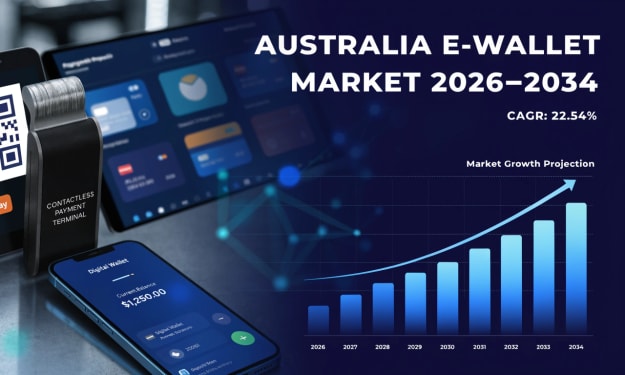
Australia E-Wallet Market 2026: Cashless Transformation, Mobile Payment Adoption and Fintech Integration. AI-Generated.
Australia E-Wallet Market Overview Australia’s e-wallet market is undergoing rapid expansion as consumers and businesses increasingly adopt mobile payment solutions for everyday financial transactions. E-wallets — enabling digital storage of payment credentials, peer-to-peer transfers and integrated financial services — have become central to Australia’s transition toward a cashless economy. The widespread use of smartphones, strong fintech innovation and growing consumer preference for convenient payment experiences are collectively accelerating e-wallet adoption across retail, transport, entertainment and bill payment applications.
By Amyra Singhabout 15 hours ago in Trader
How B2B Fintech Companies Are Powering Business Finance
Introduction: The New Era of Business Finance The world of business finance is undergoing a profound transformation, moving away from slow, paper-based processes to a dynamic, digital landscape. At the heart of this revolution are B2B Fintech companies, rapidly reshaping how B2B Fintech companies are powering business finance. These innovative firms are not just offering new tools; they are fundamentally redefining efficiency, accessibility, and strategic decision-making for businesses of all sizes. We are witnessing a paradigm shift where technology-driven financial solutions are becoming indispensable, enabling companies to manage their money smarter, faster, and with greater control. This article will explore the critical role of B2B Fintech, dissecting its core value, key areas of impact, strategic advantages, and what the future holds for this transformative sector.
By Talha Mazharabout 17 hours ago in Trader
Tariff Invalidation, a 15 Percent Reset, and Bitcoin’s Structural Shift
On February 20, 2026, global financial markets experienced one of the most unusual macroeconomic events of the past decade. The Supreme Court of the United States ruled that the comprehensive tariffs imposed under the International Emergency Economic Powers Act were unconstitutional. The decision directly challenged the legal foundation used by Donald Trump to implement sweeping trade measures.
By crypto genieabout 19 hours ago in Trader
CRTD to CRTDD
Vocal's parent company Creatd Inc. has quietly reversed-split its stock today at the 1-to-20 ratio. As of now, at 1:30 pm, it trades as CRTDD (extra D for the temporary status of restructuring or reorganization) at $4.00 per share, i.e. already $6.94 less than the reversed-split value of $10.94.
By Lana V Lynxa day ago in Trader
Can Gold Be Tokenized? Understanding a New Way to Invest
Gold has always been a symbol of financial security and long-term stability. For centuries, investors have relied on it to hedge against inflation, currency fluctuations, and economic downturns. Today, technological innovation is transforming the way gold is bought, sold, and owned. Gold Tokenization is emerging as a modern investment model that blends the stability of physical gold with the efficiency of blockchain technology. This digital transformation is making gold investment more accessible, transparent, and globally tradable.
By Michal stevea day ago in Trader
Trading Hours and Risk Management: How Crypto and Stock Markets Demand Different Strategies
Risk management is often discussed as though it were a universal discipline, a set of principles that applies equally across any financial market. In practice, the structural differences between markets force investors and traders to adapt their frameworks significantly. Nowhere is this more apparent than in the contrast between the fixed, regulated hours of traditional stock exchanges and the continuous, never closing environment of cryptocurrency markets.
By Darren Lee3 days ago in Trader
The Paradox of Tokenization: How a Technology of Freedom Can Become a System of Control
Blockchain was once introduced as a technology of liberation. A currency free from central authority, transactions resistant to censorship, and a system where trust is replaced by code. These ideas positioned it as an alternative to traditional financial structures and inspired many to imagine a more open economic order. Yet technology itself is neutral, while the structures that design and deploy it are not. Today, blockchain is no longer just a tool of freedom. It is also becoming a new arena where power is reorganized.
By crypto genie3 days ago in Trader
Leadership Under Volatility and Vision in a Transforming Financial System. AI-Generated.
If I imagine you as my boss this week in the cryptocurrency world, I don’t see someone reacting emotionally to every market swing. I see someone calm, analytical, and strategic — someone who understands that crypto is not just about price charts, but about infrastructure, liquidity cycles, regulation, and technological evolution. This week in digital assets was not defined by explosive headlines, but by structural developments — the kind that shape the next phase of the market. As your analyst, my responsibility is not to exaggerate noise but to interpret signal. So let’s walk through what truly mattered. Bitcoin: Strength Beneath the Surface At the core of the market remains Bitcoin. This week, Bitcoin moved within a relatively controlled range, reflecting consolidation rather than weakness. On-chain data shows that long-term holders continue accumulating, while exchange balances trend lower — a metric that historically correlates with reduced sell pressure. Institutional behavior also remains notable. Large wallet clusters associated with custodial entities have not shown panic distribution. Instead, the pattern resembles structured positioning. Volatility compression is evident in derivatives markets, with funding rates stabilizing and open interest elevated but not overheated. From a macro perspective, Bitcoin is increasingly behaving like a digital macro hedge. Liquidity expectations, interest rate policy speculation, and geopolitical uncertainty all feed into its narrative as a non-sovereign store of value. If you were reviewing my weekly report, I would summarize it clearly: Bitcoin’s structure is constructive, and the market tone is disciplined rather than euphoric. Ethereum: Infrastructure Expansion Continues While Bitcoin anchors the market narrative, Ethereum continues to define the technological backbone of decentralized finance. This week, attention centered on Layer-2 scaling metrics. Rollup adoption continues to expand, reducing congestion on the main chain while maintaining Ethereum’s security guarantees. Transaction throughput across scaling solutions has increased, and gas fee stability suggests improved efficiency. Staking participation remains strong. A significant portion of ETH supply is locked in validator contracts, creating a tightening circulating supply dynamic. During periods of higher activity, Ethereum’s burn mechanism introduces deflationary pressure — a structural change that differentiates it from earlier inflationary models. DeFi total value locked (TVL) showed gradual improvement, particularly in liquid staking and restaking protocols. Meanwhile, NFT markets are demonstrating selective strength rather than speculative mania. From a leadership perspective, Ethereum’s trajectory reflects ecosystem depth rather than short-term speculation. It is less about weekly price movement and more about developer activity, protocol upgrades, and adoption velocity. Binance Ecosystem and BNB’s Strategic Position BNB remains one of the most strategically positioned exchange-native assets. This week, price action was moderate, but ecosystem metrics remain relevant. The Binance Smart Chain continues to attract DeFi protocols, gaming applications, and cross-chain bridges due to its lower transaction costs. Developer engagement is stable, and token burn mechanisms continue to reduce supply on a scheduled basis. Regulatory discussions surrounding centralized exchanges remain ongoing globally, but the platform’s emphasis on compliance and transparency appears increasingly structured rather than reactive. If I were briefing you as my superior, I would frame BNB not simply as a speculative token but as an ecosystem participation asset — its value closely linked to exchange volume, product expansion, and cross-chain integration. Avalanche: Modular Architecture Gaining Traction Avalanche continued to gain attention this week due to renewed interest in its subnet architecture. The modular blockchain thesis — allowing customized chains for specific use cases — is increasingly relevant as enterprises explore blockchain deployment. Avalanche subnets enable tailored governance models, transaction fee structures, and performance configurations. Transaction finality remains one of Avalanche’s competitive strengths, offering near-instant settlement. Developer updates this week indicate continued infrastructure improvements and ecosystem partnerships. Adoption metrics suggest steady but measured growth. The question is not whether the technology works — it does — but whether application-layer demand accelerates meaningfully. As a leader analyzing risk-adjusted opportunity, you would likely view Avalanche as a high-performance network with asymmetric potential tied to enterprise integration. Cardano: Methodical Development Over Hype Cardano continues to follow its research-driven roadmap. Development updates this week focused on governance improvements and smart contract optimization. Staking ratios remain among the highest in the industry, reflecting strong community commitment. Cardano’s philosophy emphasizes peer-reviewed upgrades and long-term security. Critics often point to slower ecosystem expansion compared to Ethereum or Solana, but supporters argue that methodical execution reduces systemic vulnerabilities. In a management context, Cardano represents disciplined growth — less reactive, more deliberate. TRON: Utility Through Stablecoins TRON remains highly relevant in the stablecoin transfer ecosystem. This week, on-chain metrics showed continued strong USDT transaction volume on TRON’s network. Its low transaction fees and fast confirmations make it attractive for cross-border transfers and emerging market usage. While it may not dominate developer headlines, its real-world usage metrics are significant. From a strategic lens, TRON demonstrates that utility — not narrative — can sustain network demand. Real-World Asset Tokenization Expands A dominant theme this week has been the acceleration of real-world asset (RWA) tokenization. Traditional financial instruments, including government bonds and credit products, are increasingly being represented on-chain. Institutional participants are exploring blockchain-based settlement for efficiency gains. Tokenized treasuries are attracting attention for combining yield exposure with on-chain transparency. This trend represents a structural bridge between decentralized infrastructure and traditional capital markets. The implications are profound: liquidity becomes programmable, collateral becomes transparent, and settlement cycles compress dramatically. However, risk remains multi-layered — combining smart contract exposure with counterparty and regulatory considerations. Any allocation strategy must incorporate comprehensive risk assessment. Regulatory Signals: Gradual Clarification Regulatory developments this week indicate gradual movement toward clearer classification frameworks for digital assets in several jurisdictions. While uncertainty remains, the tone has shifted from confrontation to structured dialogue. Markets responded positively to indications of clearer stablecoin guidelines and more defined compliance pathways for exchanges. Long-term capital prefers regulatory clarity. Over time, structured frameworks tend to reduce systemic volatility. Conclusion: Leadership in a Transforming Market Being my boss in crypto this week would require balancing optimism with discipline. The market is maturing. Infrastructure is strengthening. Institutional participation is normalizing. Yet volatility and narrative shifts remain inherent to this asset class. The dominant signals this week are structural, not speculative: Bitcoin consolidation with accumulation support. Ethereum scaling expansion and staking strength. Ecosystem resilience from BNB. Modular innovation from Avalanche. Methodical development from Cardano. Utility-driven demand from TRON. Institutional experimentation with tokenized assets. Crypto is no longer just an experiment — it is an evolving parallel financial system. Leadership in this space requires technical literacy, macro awareness, and emotional discipline.
By yusuf selho4 days ago in Trader