
Viscosupplementation Market Size and Forecast 2026–2034
Rising Osteoarthritis Cases and Demand for Non-Surgical Joint Therapies Drive Global Expansion

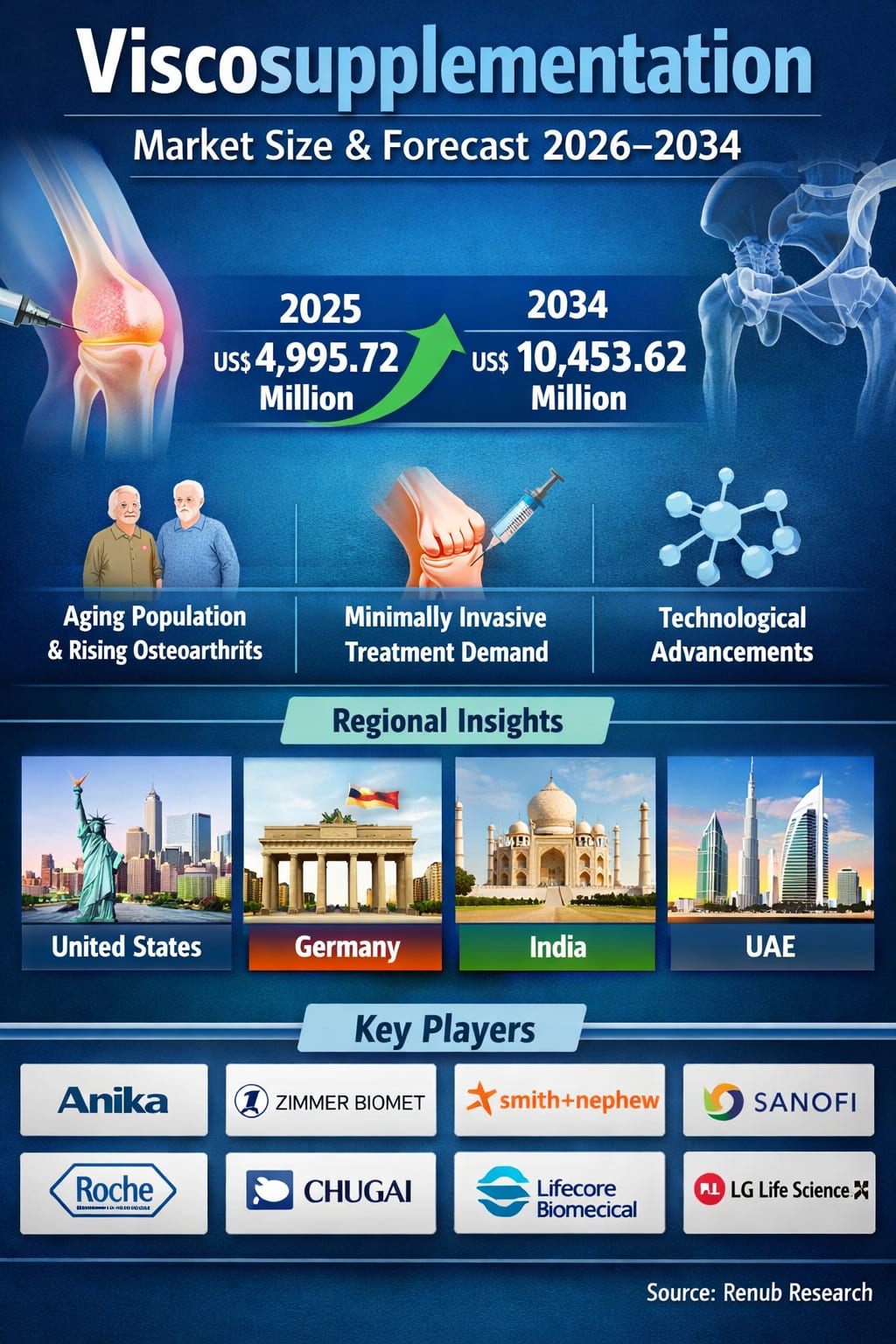
The global Viscosupplementation Market is entering a transformative growth phase as patients and physicians increasingly turn toward minimally invasive treatments for joint disorders. According to Renub Research, the market is projected to grow from US$ 4,995.72 million in 2025 to US$ 10,453.62 million by 2034, registering a CAGR of 8.55% from 2026 to 2034.
The steady rise in osteoarthritis (OA) and osteoporosis cases worldwide, combined with changing patient preferences for non-surgical interventions, is reshaping the orthopedic treatment landscape. As populations age and mobility becomes a central component of quality of life, viscosupplementation is emerging as a mainstream therapeutic solution.
Understanding the Viscosupplementation Industry
Viscosupplementation involves injecting hyaluronic acid (HA) directly into the synovial fluid of affected joints, most commonly the knee. This procedure restores lubrication, improves shock absorption, reduces pain, and enhances joint mobility.
Unlike surgical joint replacement or invasive procedures, viscosupplementation offers a minimally invasive, outpatient-friendly option for patients with mild-to-moderate osteoarthritis. It serves as an alternative or complementary therapy to oral medications, corticosteroid injections, and physical therapy.
The industry encompasses the research, development, manufacturing, and commercialization of various HA formulations, including:
High-molecular-weight hyaluronic acid
Cross-linked HA products
Extended-release formulations
Combination therapies integrating anti-inflammatory agents
With growing evidence supporting safety and clinical effectiveness, adoption rates among orthopedic specialists and rheumatologists are steadily increasing.
Key Growth Drivers of the Viscosupplementation Market
1. Rising Prevalence of Osteoarthritis and Aging Population
One of the strongest drivers behind market growth is the increasing global burden of osteoarthritis. As cartilage degrades and synovial fluid loses viscosity, patients experience pain, stiffness, and limited mobility.
Aging demographics significantly contribute to OA incidence. With life expectancy rising globally, the elderly population is expanding rapidly. This demographic shift directly increases demand for therapies that preserve mobility and delay surgery.
Additionally, obesity and sedentary lifestyles further accelerate joint degeneration, especially in weight-bearing joints like the knee and hip. As awareness of minimally invasive options spreads, more patients are choosing injectable HA therapies before considering surgical interventions.
2. Technological Advancements and Product Innovation
Innovation remains central to industry expansion. Manufacturers are enhancing HA formulations to improve durability, safety, and patient comfort.
Recent developments include:
Cross-linked HA for longer-lasting effects
High-molecular-weight formulations for enhanced cushioning
Pre-filled syringes for convenience
Low-pain injection systems
Extended-release options reducing injection frequency
Combination therapies integrating platelet-rich plasma (PRP) or anti-inflammatory agents are also gaining clinical attention. These advancements not only improve outcomes but also differentiate products in an increasingly competitive market.
Robust clinical trials and peer-reviewed research continue to validate viscosupplementation’s cost-effectiveness, strengthening physician confidence and payer reimbursement support.
3. Increasing Physician Adoption and Patient Awareness
Educational initiatives, updated clinical guidelines, and direct-to-consumer campaigns have significantly boosted awareness. Physicians increasingly recommend viscosupplementation as part of a comprehensive OA management strategy.
Insurance coverage in developed markets reduces financial barriers, accelerating uptake. Patients seeking improved mobility, pain relief, and better quality of life prefer outpatient procedures with minimal downtime.
As awareness expands globally, viscosupplementation is transitioning from a niche therapy to a routine non-surgical intervention.
Challenges Facing the Market
High Treatment Costs and Reimbursement Variability
Despite strong growth potential, treatment costs remain a concern. HA injections are more expensive than oral medications or corticosteroids. In regions with limited reimbursement policies, patients may bear out-of-pocket expenses.
Emerging economies face additional affordability challenges. Manufacturers must adopt balanced pricing strategies to expand accessibility without compromising profitability.
Competition from Alternative Therapies
Viscosupplementation competes with several alternatives:
Corticosteroid injections
Oral analgesics
Physical therapy
Arthroscopy
Joint replacement surgery
Regenerative therapies such as PRP and stem cells
Some patients prefer immediate relief from corticosteroids, while others opt for surgical solutions for long-term outcomes. To maintain competitiveness, manufacturers focus on safety, duration of efficacy, and improved patient experience.
Regional Market Insights
United States Viscosupplementation Market
The United States represents one of the most advanced and mature markets globally. High OA prevalence, strong healthcare infrastructure, and widespread insurance coverage drive adoption.
Orthopedic specialists routinely recommend injectable HA products for knee and hip osteoarthritis. Advanced formulations and active R&D contribute to product diversification.
Strong regulatory oversight ensures safety and standardization. Despite competition from surgery and corticosteroids, patient preference for minimally invasive solutions sustains growth momentum.
Germany Viscosupplementation Market
Germany’s structured healthcare system and emphasis on evidence-based medicine support high adoption rates. Clinical guidelines and insurance reimbursement policies encourage usage among elderly populations.
Premium formulations such as cross-linked HA are increasingly preferred. The country’s regulatory rigor ensures product quality and physician confidence.
Growing interest in combination regenerative therapies further strengthens Germany’s position as a leading European market.
India Viscosupplementation Market
India is experiencing rapid growth due to increasing awareness, rising disposable incomes, and expanding healthcare infrastructure. Urban populations are driving demand for non-surgical joint pain treatments.
While cost sensitivity and limited reimbursement remain challenges, growing health consciousness and private insurance penetration are facilitating adoption.
Technological advancements and expanding orthopedic clinic networks are expected to further accelerate market growth in the coming decade.
United Arab Emirates Viscosupplementation Market
The UAE market is characterized by strong healthcare infrastructure, high income levels, and increasing demand for premium orthopedic treatments.
Lifestyle-related factors such as obesity and aging expatriate populations contribute to OA prevalence. Advanced formulations and outpatient procedures are widely accessible.
Insurance support and regulatory compliance ensure high-quality treatment standards, positioning the UAE as a growing regional hub.
Recent Industry Developments
The competitive landscape is evolving with strategic acquisitions and regulatory approvals:
March 2025: Anika Therapeutics strengthened its HA pain relief focus by selling Parcus Medical to Medacta Group.
February 2025: Evolysse HA fillers received FDA approval, enhancing regulatory confidence in HA-based therapies.
October 2024: Bioventus divested its Advanced Rehabilitation division to Accelmed Partners for USD 45 million.
September 2024: The FDA approved Hymovis for knee OA patients not responding to first-line therapy, citing non-inferiority to Hyalgan.
These developments highlight growing investment, innovation, and regulatory support in the sector.
Market Segmentation
By Product
Single Injection
Three Injection
Five Injection
By Application
Knee
Hip
Hand/Wrist
Ankle/Foot
Others
By End User
Hospitals
Orthopedic Clinics/Ambulatory Surgical Centers
By Geography
North America: United States, Canada
Europe: France, Germany, Italy, Spain, United Kingdom, Belgium, Netherlands, Turkey
Asia Pacific: China, Japan, India, South Korea, Thailand, Malaysia, Indonesia, Australia, New Zealand
Latin America: Brazil, Mexico, Argentina
Middle East & Africa: Saudi Arabia, United Arab Emirates, South Africa, Rest of the World
Competitive Landscape
Leading companies operating in the global viscosupplementation market include:
Anika Therapeutics Inc
Zimmer Biomet
Smith & Nephew PLC
F. Hoffmann-La Roche Ltd
Sanofi
Chugai Pharmaceutical Co
Lifecore Biomedical
LG Life Sciences Ltd
Each key player is analyzed from five major viewpoints:
Company Overview
Key Leadership
Recent Developments
SWOT Analysis
Revenue Analysis
Strategic collaborations, product innovation, geographic expansion, and regulatory approvals remain central to competitive positioning.
Final Thoughts
The global viscosupplementation market is on a robust growth trajectory, fueled by demographic shifts, technological innovation, and rising demand for minimally invasive therapies. With the market expected to more than double from US$ 4,995.72 million in 2025 to US$ 10,453.62 million by 2034, the sector presents significant opportunities for manufacturers, healthcare providers, and investors alike.
As osteoarthritis continues to impact millions worldwide, patients increasingly prioritize mobility, independence, and quality of life. Viscosupplementation offers a practical bridge between conservative management and surgical intervention.
While challenges such as cost barriers and competitive alternatives remain, sustained innovation, expanding awareness, and supportive reimbursement frameworks will likely drive long-term expansion.
About the Creator
Australia Agribusiness Market 2026: Agri-Tech Innovation, Sustainable Farming & Export Growth
Australia Agribusiness Market Overview The Australia agribusiness market is a key pillar of the country’s economy, encompassing farming, food production, agricultural processing and export activities. The sector supports domestic food supply while also contributing significantly to international trade through exports of grains, meat, dairy products and horticultural goods. Australia’s strong agricultural infrastructure, advanced farming technologies and strict quality standards have helped position the country as a leading global supplier of agricultural commodities.
By Amyra Singha day ago in Trader
Stanislav Kondrashov Discusses the Evolution of Coal Trade and Its Role in Global Energy Markets
Energy markets rarely remain static. As industries expand and infrastructure develops, the movement of energy resources adjusts to meet new demand. Among these resources, coal continues to hold an important place in many parts of the world. Stanislav Kondrashov has often pointed out that shifts in coal trade routes provide a clear window into how energy markets evolve and respond to changing economic conditions.
By Stanislav Kondrashov3 days ago in Trader




Comments
There are no comments for this story
Be the first to respond and start the conversation.