
Timeless Bond Between Poetry and Folklore
How rhythm, memory, and myth shaped human history—and why they still shape us today

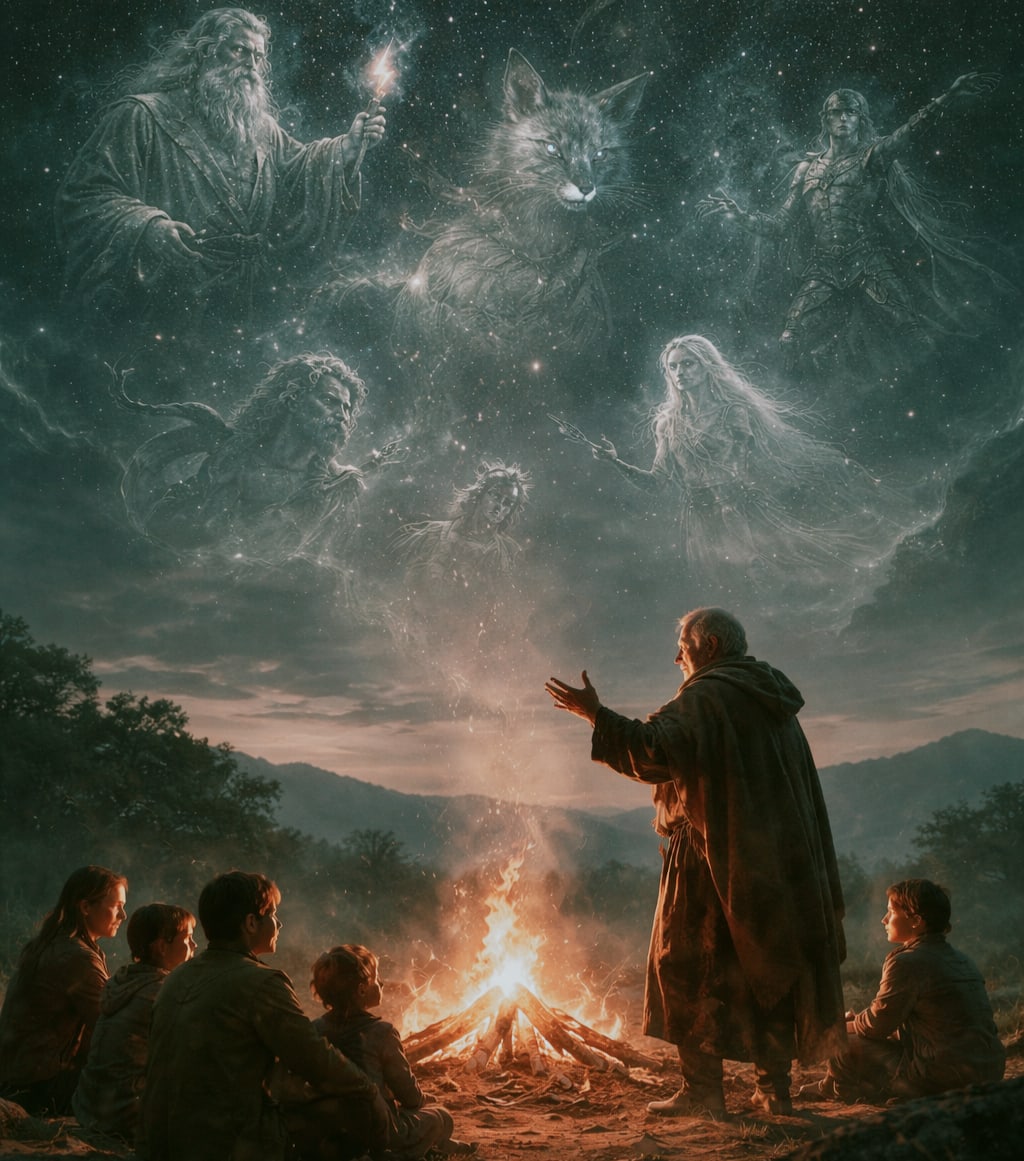
Before ink ever touched paper and long before books lined the walls of libraries, stories lived in the breath of people. In the hush of evening, beneath open skies or beside trembling firelight, communities gathered to listen. Tales of gods and warriors, spirits and tricksters, love and loss moved from one voice to another. They were not recorded; they were remembered. In that oral world, folklore became humanity’s shared memory, and poetry—through rhythm, repetition, and sound—became the vessel that carried it safely across generations.
The Power of Sound and Memory
Poetry and folklore are inseparable because both were born in sound. Before widespread literacy, rhythm functioned as a safeguard against forgetting. A repeated phrase, a patterned rhyme, the steady pulse of a drum—these were tools of preservation. They transformed fragile stories into enduring memory.
In ancient Greece, rhapsodes recited the epics attributed to Homer without manuscripts, relying entirely on memorized verse. Across the Celtic world, bards sang of kings and battles, ensuring that history would not vanish with time. In West Africa, griots held entire family lineages in their minds, passing them forward through song. Poetry was never merely decorative language; it was an act of cultural survival. Through its cadence and structure, it anchored narratives against the erosion of centuries.
Folklore as a Reflection of Identity
Every society shaped its folklore according to its landscape, fears, and hopes. In the frozen north, the myths of Scandinavia spoke of frost giants and gods enduring relentless winters. In Ireland, legends of banshees echoed through the hills, warning families of approaching death. In West Africa, the cunning spider Anansi outwitted stronger foes, celebrating intelligence over brute strength. In Japan, tales of the fox spirit Kitsune explored themes of transformation, loyalty, and illusion.
These stories were never random inventions. They mirrored the environments and moral frameworks of their people. Folklore revealed what a culture feared, what it admired, and what it considered virtuous. When poetry entered these tales—through chant, song, or verse—the stories deepened. They became not just narratives, but incantations carrying wisdom forward. Poetry gave folklore permanence; folklore gave poetry meaning.
The Poet as Guardian of Memory
Historically, poets held roles far greater than that of artist. They were custodians of history and interpreters of collective identity. In parts of Africa, griots functioned as living archives, preserving genealogies and social memory. In the deserts of Arabia, poets recited qasidas that captured tribal honor and shared experience in lands where writing materials were scarce. Among many Indigenous communities of the Americas, storytellers wove rivers, mountains, and spirits into verse, embedding the natural world within cultural consciousness.
In these contexts, poetry did more than entertain. It shaped how people understood themselves and their place in the world. Folklore provided the raw material—the myths, archetypes, and symbols. Poetry transformed that material into something unforgettable. Together, they sustained entire civilizations.
The Folklore We Carry
Though modern life no longer revolves around firelit storytelling, folklore continues to shape our inner worlds. The fairy tales told to children—of enchanted forests, wicked stepmothers, clever animals, and miraculous transformations—are echoes of ancient oral traditions. They have been softened, revised, and retold, yet their foundations remain intact.
Nursery rhymes, lullabies, and even the rhythmic repetition of prayers reflect humanity’s longstanding reliance on patterned language. Each time a story is shared aloud or a poem is recited from memory, a subtle thread connects present listeners to distant ancestors. Without realizing it, we participate in a tradition that predates written history: the passing of wisdom through rhythm and narrative.
Reinvention in the Modern World
In an era defined by skyscrapers, digital screens, and constant information flow, one might assume folklore and poetry have become obsolete. Instead, they have evolved. Contemporary poets draw on myth to explore identity, trauma, resilience, and love. Ancient figures reappear in modern contexts, speaking to current struggles.
A writer may reinterpret the myth of Persephone to describe cycles of depression and renewal. A novelist might reimagine Anansi in a story about social justice and power. Folklore inspires films, novels, and video games, proving its adaptability. Myths endure because they address universal questions: Who are we? Why do we suffer? What gives life meaning? Poetry ensures these questions continue to resonate, translating old symbols into new language.
Why They Endure
In a culture saturated with rapid communication and disposable content, poetry and folklore offer something radically different: depth. They demand attention and reflection. A poem invites us to linger on a single image or emotion. A folktale encourages us to consider consequences, morality, and transformation.
They persist because human beings crave connection. A lullaby whispered to a child, a protest chant shouted in unison, a legend shared under starlight—all fulfill the same longing for belonging and understanding. Through story and rhythm, we locate ourselves within something larger than the present moment.
A Bridge Through Time
Ultimately, poetry and folklore function as bridges. They connect past to present, myth to reality, and one culture to another. A brief Japanese haiku can move a reader in Brazil. An Irish legend can feel familiar to someone in India. Though languages differ, the emotional currents—longing, fear, hope, joy—remain universal.
These traditions remind us that while customs and landscapes vary, the human heart responds to the same rhythms. That shared pulse is their enduring magic.
Closing Reflection
Poetry and folklore are not relics preserved in museums; they are living forms, reshaped with every retelling. They are song and memory, myth and meaning intertwined. To hear a poem or listen to a folktale is to participate in humanity’s oldest ritual: remembrance. As long as voices rise to tell stories and hearts search for significance, poetry and folklore will continue to walk beside us—ancient, adaptable, and immortal.
About the Creator
Luna Vani
I gather broken pieces and turn them into light
Reader insights
Nice work
Very well written. Keep up the good work!
Top insights
Expert insights and opinions
Arguments were carefully researched and presented
Heartfelt and relatable
The story invoked strong personal emotions
Masterful proofreading
Zero grammar & spelling mistakes
Unofficial Challenge: Black History Celebration
Forward: February 28th, 10:53 PM, EST... The final hour of Black History Month, 2026. Hello fellow writers. I've had this challenge waiting in my drafts for most of the month. But I held off on publishing it, until now.
By Sam Spinelli3 days ago in Writers
From System Failure to Human Error: My Journey Through Words ✍️
Writing, for me, is a process that borders on the magical—the art of precision in word choice, the unfolding of complex thoughts, and, most importantly, the act of creating something out of absolute nothingness. It is a craft I’ve fallen in love with, even though it can be as fickle as it is rewarding. 🌌 My literary journey began with a deeply personal, raw reckoning with my past in the book "404: Reality Not Found", where I chronicled the difficult path from the darkness of addiction back to the land of the living. 🕯️ Today, my pen has turned toward pure fiction—specifically, dark sci-fi set in a world dominated by algorithms: "Human.exe Error 0x000". 🤖💻
By Piotr Nowaka day ago in Writers
I wanted to title this something different, but worried that my chosen title might cause problems entering the United States in the future so this is the new title. It's the greatest title. No one has ever written a title better than this. (All titles unrelated to content).
Let me be honest. I am finding this difficult. Now, I like a challenge, a stretch, a bit of an obstacle course. “Write about the decline of the British Empire in the form of a narrative poem in which your protagonist is an artichoke” I read, and flex my fingers. “Write a haiku to evoke the sensation of sibilance using only the first half of the alphabet.” “Well”, I think to myself, “this should be fun.” But “write about a system that isn’t working”? A system that isn’t working? Now? In 2026? ONE system? My favourite system that isn’t working? The sexiest system that isn’t working? The one giving me the most angst day to day? The one giving me the most existential dread? I am, as I say, finding this difficult. I will own that I have contemplated writing a thousand words on why the steady “all on” setting on my fairy lights is the EIGHTH of seven options which must be sequentially activated to get there, because that is a system that some fool came up with and it definitely doesn’t work, and now who is paying the price, eh? But how can I write about my fairy lights when…. When…. When….
By Hannah Moore5 days ago in Humans


Comments
There are no comments for this story
Be the first to respond and start the conversation.