
Your Partner Doesn't Understand Your Writing Life. That's Okay.
The relationship dynamics of living with a writer, what to stop expecting from the person who loves you, and what to ask for instead.

My partner has never read 1 Lovelock Drive.
Not because he doesn't care, but because I asked him not to. The book draws from personal experience and the thought of him reading certain scenes, knowing which emotional truths came from our life and which were invented, felt like standing naked in the kitchen during breakfast.
Some vulnerabilities belong on the page for strangers and not for the person who sleeps next to you.
He was fine with this. Relieved, probably. And that moment - the moment I realised he was relieved not to read my book and I was relieved he didn't want to - taught me something important about the relationship between a writer and the person who lives with one.
They don't need to understand your writing life. They need to understand what you need from them so the writing life can exist.
These are completely different things, and confusing them is the source of most of the resentment I see between writers and their partners.
What You're Expecting (That Isn't Fair)
We all have expectations as writers, especially with how our loved ones (friends, family and partners) treat us. It's something that comes with the territory; we set these expectations without much thought.
It seems to happen when we decide to become writers. But these expectations aren't always fair to them, or to us.
You expect them to understand why a bad writing session ruins your evening. In short, they can't.
A bad writing session is an internal event with no visible cause. You sat at a desk, typed, and now you're withdrawn and irritable. From the outside, nothing happened. It's not like a surgeon who lost a patient on the table. It's obvious to everyone that the day went wrong for them.
Expecting them to understand or spot the emotional devastation of a scene that won't work is expecting them to live inside your creative process. They don't live there with you.
You expect them to be excited about your breakthroughs.
You solved the structural problem in chapter nine. You found the perfect closing line for the article. You finally understand what the book is about.
These moments are enormous to you, and that's not up for debate. To your partner, they're abstract progress reports about a project they can't see.
I want you to know that the excitement gap isn't indifference. It's the natural consequence of one person being inside the work and the other being outside it.
You expect them to read your work and respond the way a reader would.
Your partner (family member or friend) is not your reader. They're your partner.
Their relationship with your writing is filtered through their relationship with you, which makes honest feedback almost impossible and enthusiastic feedback feel hollow.
Asking your partner to be your ideal reader is unfair; they simply can't be both for you.
You expect them to know when to ask about the writing and when to leave it alone.
This is the cruellest expectation because the rules change daily. On Monday, you want to be asked, and on Tuesday, you want to be left alone. On Wednesday, you want to be asked, but only in the right way.
Your partner is not a mind reader. The shifting rules are unfair without explicit communication, and even then, it could change on a dime.
What They're Experiencing (What Writers Aren't Seeing)
Your partner lives with someone who disappears into their own head for hours at a time. With someone physically present but mentally elsewhere, who has emotional reactions to invisible events and who needs time alone, that looks, from the outside, exactly like time spent ignoring them.
They've watched you check your sales dashboard with an expression that tells them something is wrong, but that they can't fix.
They've sat through dinners where you were silent because a scene was working itself out behind your eyes.
They've tried to help, been told you need space, then tried to give space, only to be told you feel unsupported.
Living with a writer is living with someone who has a rich, consuming inner life that you're not fully invited into. That's disorienting for the person on the outside. It's not a complaint; it's the reality.
What To Ask For Instead
Stop asking your partner to understand the writing, because it's a waste of your time and theirs. Instead, start asking for specific, concrete support that doesn't require them to take up space in your creative process.
Ask for protected time. "I need Saturday mornings for writing. Can we make that work?"
This is a practical request with a practical answer. It doesn't require your partner to understand why you write, but it does require them to respect that you need the time. Most partners will give you this willingly if you ask clearly, rather than expecting them to intuit it.
Ask for space after difficult sessions.
"When I come out of a writing session looking frustrated, the most helpful thing is to leave me alone for twenty minutes."
This is a specific instruction that replaces the impossible expectation that they'll know what you need in the moment. Give them the manual because, trust me, they want the manual.
They've been guessing, getting it wrong, and feeling bad about it.
Ask for a celebration without comprehension. "I solved a big problem in the book today. I don't need you to understand the problem. I just need you to be happy with me for a minute."
This separates the emotional need (shared celebration) from the intellectual requirement (understanding what was solved). Your partner can do the first without the second, so let them.
Ask for patience with the mood swings.
"The writing affects my mood in ways I can't always control. It's not about you. If I'm withdrawn after a session, I'll come back. Just give me time."
Naming the pattern prevents your partner from interpreting your withdrawal as relationship trouble. The explanation doesn't need to be detailed, but it does need to be honest.
What To Stop Doing
This isn't all about what your partner (or family member/friend) is doing. This is our career and our problem, and we need to own our part in it. We can't sit by and expect them to make all the adjustments for us.
Stop using your partner as a sounding board unless they've asked to be one.
Talking through your plot problem at dinner is using your partner as a free critique session. Some partners love this, but many endure it to be supportive, even when it isn't their forte. Ask which one yours is, and believe the answer.
Stop resenting their other interests.
Your writing is your consuming passion, and they have their own. The fact that theirs might be football, gardening, or television doesn't make it less valid than yours.
The hierarchy that puts creative work above other forms of engagement is an ego trap, and it poisons relationships when it leaks into how you treat your partner's time.
Stop expecting them to manage your creative emotions.
The disappointment of rejection, the anxiety of publishing and the despair of poor sales are your emotions to manage, with support from other writers, a therapist, or your own coping strategies.
Your partner can hold your hand. They can't process your creative crisis because they don't have the context to understand its dimensions.
Dumping the full weight of your writing anxiety on someone who can't fully comprehend it is unfair to both of you.
Stop comparing them to other writers' partners.
We all know the spouse who reads every draft and gives brilliant feedback. We've heard of the elusive partner who built a website and handles all the marketing. Those partnerships exist in public narratives.
What happens in private is more complicated, so avoid measuring your relationship against someone else's curated version.
What My Partner Actually Does
My man doesn't read my work. He doesn't understand why a bad writing morning affects my whole day. He can't tell the difference between a breakthrough and a setback from looking at me, because both make me go quiet.
He doesn't take my post-session mood personally. He tells people I'm a writer when they ask what I do, and he says it without hesitation. In fact, he proudly boasts my skills louder than I ever could.
My man doesn't entirely understand my writing life, but he supports it. Those are different things, and the second one is more valuable than the first.
Stop asking for understanding. Ask for support. Tell your loved ones what support looks like and be specific. Most of all, be grateful.
They chose to live with a writer. That's already more than most people would sign up for.
Meet them where they are. It's closer than you think.
---
I write about the emotional and practical reality of being a writer - drafting, doubt, discipline, and publishing while still figuring it out.
Mostly for people who write because they have to, need to, want to | linktr.ee/ellenfranceswrites
About the Creator
Ellen Frances
Daily five-minute reads about writing — discipline, doubt, and the reality of taking the work seriously without burning out. https://linktr.ee/ellenfranceswrites
Keep reading
More stories from Ellen Frances and writers in Writers and other communities.
Nobody In Any Classroom Ever Said, "What If No One Reads My Book?"
I studied English in school. Drama and Theatre at university, with English electives and a screenwriting module. After graduating, I took multiple skills-based writing courses - copywriting, content strategy, and freelance writing. I've been formally educated in words from every angle the system offers.
By Ellen FrancesExclusive • 7 days ago
Early March 2026: 4 Goals Accomplished
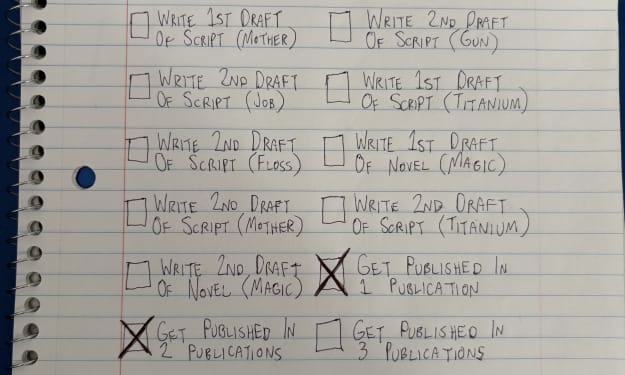
It's early March and I've now accomplished my 4th writing goal for the year of 2026. Before diving into the behind-the-scenes of it... why not tell you up front what that accomplishment was? I was published in a 2nd publication for this year. Published in Helix Literary Magazine out of Central Connecticut State University. You can read it for free right now!
By Stephen Kramer Avitabile6 days ago in Writers
Writing plans coming up
This is a quick drabble of my upcoming writing articles. First coming attractions in my opinion are a lot of book blurbs of old and new books that I have read, but not complete reviews just to create possible interest. Another idea I had was to offer in this day and age of keyboarding some typing lessons from an old typing textbook I had in high school. Also, I am planning on writing more of my Alphabet stories, as well as more of my art colorings for I just bought a new Bible coloring book. I hope you share thoughts.
By Mark Graham5 days ago in Writers
A More Human Vocal
When we launched Vocal nearly a decade ago, the world was a very different place. LLMs did not exist, and stories were created one at a time by people sitting down to write, revise, and share something personal. Many of our assumptions about publishing, trust, and participation were built for a world where effort and output were inseparable.
By Justin @ Vocal7 days ago in Resources


Comments
There are no comments for this story
Be the first to respond and start the conversation.