
Steps for Application Integration on AWS
Application Integration on AWS: A Practical Step-by-Step Approach

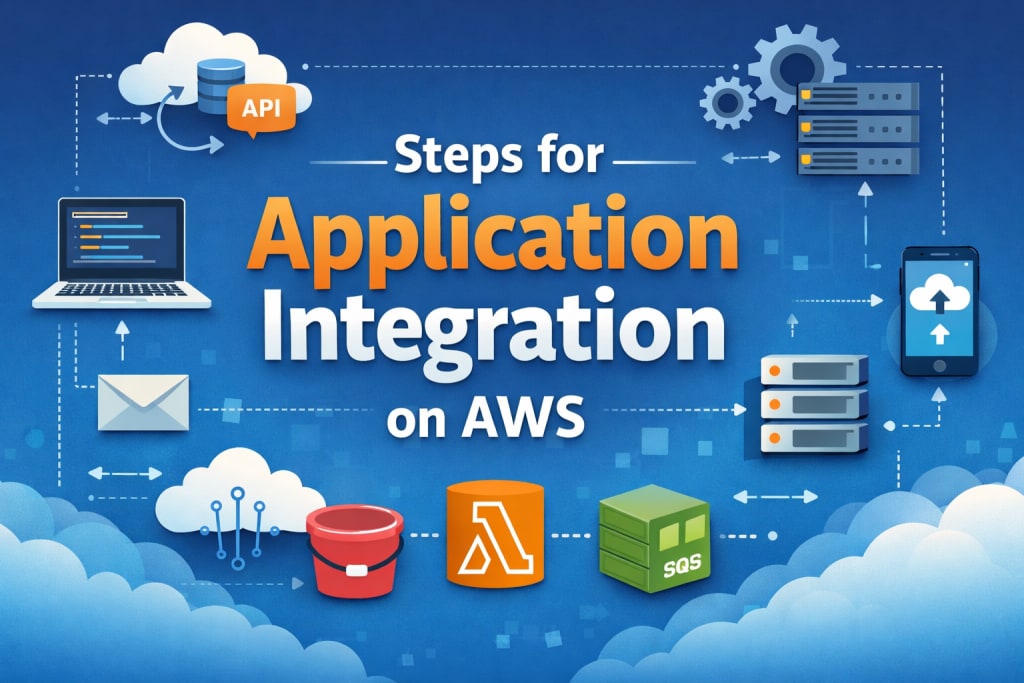
It is neither new nor a secret that modern businesses have come to rely on a massive ecosystem of microservices and third-party SaaS platforms. But to do what exactly, you ask. For starters, to provide seamless digital experiences. Adopting distributed architecture decidedly improves agility and scalability. But there's also a significant challenge, i.e. ensuring independent components can communicate and share data without forming brittle dependencies. Thankfully, an effective solution is found in application integration on AWS. It addresses this issue by providing a managed framework for connecting disparate systems. Organizations can automate business processes while reducing the need for custom "glue" code by using purpose-built services for messaging, workflow orchestration, etc.
In this blog, I will discuss the critical steps for developing a strong integration on AWS.
Why Application Integration Matters More Than Ever?
It has now been established as the backbone of modern digital operations because it eliminates data silos. Organizations can automate complex business workflows and maintain a single source of truth across all departments. How? By connecting diverse platforms such as CRM and cloud native microservices. This connectivity provides the flexibility needed to scale services or adopt new technologies. However, this is done without disrupting the entire ecosystem.
Essential Steps for Integrating Applications on AWS
Integrating applications on AWS involves analyzing business goals, designing the right architecture, implementing services with best practices, and conducting rigorous testing. These steps ensure seamless communication, scalable workflows, secure data exchange, and high reliability across distributed systems, enabling organizations to streamline operations and accelerate digital transformation.
Listed are the essential steps for integrating applications on AWS;
- Analysis: The first phase in the process is meant to define the integration's business requirements as well as technical constraints. During the analysis stage, you identify the systems that must be connected. For example, a CRM and a backend database. Additionally, you also figure out the amount of data that will be exchanged. You also define KPIs such as acceptable latency and required throughput. This idea is to ensure that the integration project has a defined scope and measurable success criteria.
- Design: The second phase involves translating technical requirements into functional architecture. For that, you must choose the most appropriate AWS integration patterns. This entails choosing between synchronous models and asynchronous patterns. For more complex interactions, Amazon EventBridge can be leveraged to implement event driven routing. Or perhaps one may opt for AWS Step Functions to orchestrate multi step workflows. Beyond connectivity, the design stage defines critical data transformation logic and establishes security protocols. This could include IAM roles and encryption standards using AWS KMS.
- Implementation: Now we move on to what is definitely a critical stage in the process. The team must now configure as well as code the chosen AWS services. This includes provisioning resources using Infrastructure as Code tools such as AWS CloudFormation or the CDK. In order to handle data mapping, error handling, etc. developers create glue code using AWS Lambda. Development teams can also configure service specific options, such as SQS visibility timeouts.
- Testing: This idea behind this stage in the process is about validating the performance of individual components. It is called unit testing, by the way. Oh and its goal is to detect logic errors in the code before it is deployed.
- Integration testing: It is another important take on assessing the app integration process. It seeks to ensure that the connected components function as a single system. Integration tests involve actual interactions between services. Maybe your development team is looking to make sure that a message sent to an SQS queue properly triggers a Lambda function. Okay, let us cut this long story short; this phase looks for permission errors and data consistency among things across distributed transactions.
Final Words
Application integration on AWS empowers organizations to build scalable, resilient, and efficient digital ecosystems. By following structured steps and leveraging AWS-native tools, businesses can streamline workflows, enhance data flow, and accelerate innovation with confidence in a rapidly evolving technology landscape. Ready to kick start the process for your organization as well? Then you ought to first look for a trusted application integration services provider.
About the Creator
Ryan Williamson
Tech-savvy professional with 13+ years of experience in app development, leveraging technical knowledge to build strategic partnerships and promote innovative solutions. Passionate about engaging with technical communities, and more.
Keep reading
More stories from Ryan Williamson and writers in 01 and other communities.
Choosing Between a Web App and a SaaS Platform for Your Business
Majority of business transactions in today's digital economy are carried out via a web browser. From internal data management to customer-facing tools, cloud-based software has become the norm. But a point of confusion emerges between web apps and SaaS platforms. You see, every SaaS platform is a web app. However, it does not necessarily hold true the other way around. The key is in how each of the software is developed and hosted over time. A web application is primarily defined by its technical architecture and user interface. Whereas SaaS refers to a specific business and delivery model. For any modern business it is imperative to understand these structural differences.
By Ryan Williamson20 days ago in 01
Why Choosing a Professional Crypto Exchange Builder in 2026 Is More Important Than Ever
The cryptocurrency industry in 2026 is more advanced, regulated, and competitive than ever before. What began as a decentralized experiment has evolved into a global financial ecosystem attracting institutional investors, fintech startups, and established enterprises. As digital asset adoption accelerates, launching a crypto exchange is no longer simply about deploying a trading platform. It requires robust security architecture, regulatory awareness, scalable infrastructure, and seamless user experience. In this environment, choosing a professional crypto exchange builder is not just beneficial, it is essential.
By smithtaylor6 days ago in 01




Comments
There are no comments for this story
Be the first to respond and start the conversation.