
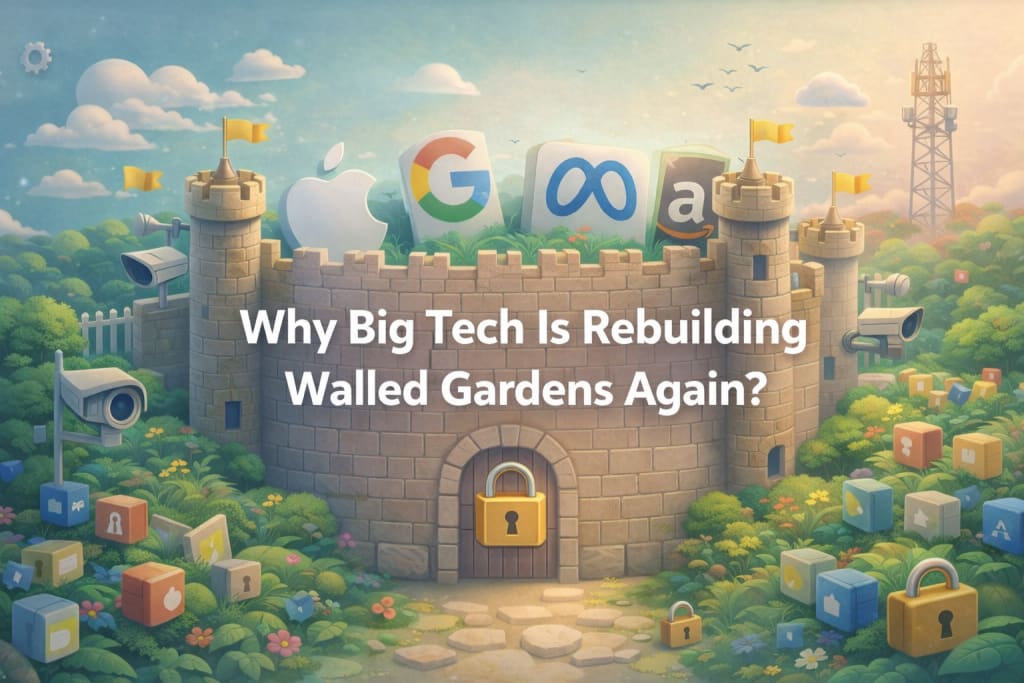
Why Big Tech Is Rebuilding Walled Gardens Again?
After decades of promoting openness, interoperability, and decentralized digital participation, the largest technology companies are quietly rebuilding controlled environments that prioritize ownership of distribution channels, user identity, and data flow — signaling a shift from the early ideals of the open internet toward tightly managed ecosystems designed to secure long-term dominance.

In the early years of the internet, “open” was not just a design principle; it was an ideology.
Browsers competed freely. Websites linked to one another without friction. Developers could build and distribute software without negotiating with centralized gatekeepers. The web felt expansive, unpredictable, and difficult to control.
Today, the digital environment feels very different.
Users rarely begin their journeys from an open browser tab. Instead, they enter through curated feeds, app marketplaces, subscription bundles, and algorithm-driven gateways. The change did not happen overnight. It emerged slowly, through layers of convenience that gradually reshaped how software is built, discovered, and consumed.
What appears to be progress toward simplicity is also a return to walled gardens — controlled ecosystems where entry, behavior, and monetization operate under centralized authority.
From Open Platforms to Managed Environments
In the early 2000s, openness fueled rapid expansion. Developers embraced open standards, APIs encouraged experimentation, and startups flourished because barriers to entry were relatively low.
Over time, growth produced new pressures.
Security concerns rose as online fraud expanded. Content moderation became a global challenge. Revenue models shifted toward subscriptions and digital marketplaces. The result was a gradual move toward centralized control.
Apple’s App Store, launched in 2008, marked a turning point. By offering a unified distribution channel, the company simplified discovery and payment for users. For developers, it created a new path to scale — but also introduced dependency.
According to Statista, Apple’s App Store generated more than $85 billion in gross consumer spending in 2023. Google Play followed with roughly $48 billion. Together, these marketplaces shape access to billions of devices.
What began as convenience evolved into governance.
The Economics of Control
Why are walled gardens returning now?
One answer lies in economic stability.
Research from McKinsey indicates that ecosystem-based business models produce 29% higher revenue growth compared to companies relying on standalone products. Subscription-driven platforms report 34% stronger customer retention rates, according to Deloitte’s digital market analysis.
Recurring revenue reduces volatility. Controlled ecosystems strengthen that recurrence.
Amazon illustrates the model clearly. Prime membership now exceeds 200 million users worldwide. The subscription connects logistics, media, shopping, and cloud services into a single environment. Each service reinforces the others, creating layers of attachment that discourage exit.
This pattern extends beyond retail. Microsoft integrates productivity tools, cloud infrastructure, gaming, and developer platforms into unified environments. Google connects search, advertising, maps, video, and operating systems under shared identity frameworks.
Control is not just about limiting competition. It is about shaping the flow of value.
Data Gravity and Behavioral Architecture
Data accumulation strengthens walled gardens.
A Stanford University study on digital advertising markets found that five major technology firms account for nearly 70% of global digital ad revenue. That concentration reflects the power of continuous data feedback loops.
Every search query, video watch, or app interaction feeds algorithms that refine recommendations. eMarketer reports that personalized recommendation systems can increase conversion rates by up to 26%.
As prediction improves, platforms gain an advantage that newcomers struggle to match.
Shoshana Zuboff describes this dynamic as a shift toward behavioral data economies, where user activity becomes a resource that fuels further growth. Regardless of interpretation, the observable effect is clear: data rarely leaves the ecosystem in which it was created.
Walled gardens are not just about access control. They are about data containment.
Security, Safety, and the Narrative of Protection
Large technology companies often frame controlled environments as necessary safeguards.
Security threats provide a compelling argument. Malware distribution through unregulated software channels remains a concern. According to a 2024 report by cybersecurity firm Kaspersky, mobile malware incidents increased by nearly 15% year over year.
Centralized marketplaces allow companies to enforce standards, conduct reviews, and remove harmful applications. For many users, this curation creates a perception of safety.
Tim Cook has repeatedly emphasized privacy and security as reasons for Apple’s tightly managed ecosystem. Critics argue that such policies also reinforce revenue control through mandatory payment systems.
Both views may contain truth.
Control can serve multiple purposes simultaneously.
The Developer’s Trade-Off
For developers, walled gardens present a paradox.
On one hand, centralized platforms offer infrastructure, discovery tools, and monetization frameworks that would be difficult to build independently. On the other hand, they impose constraints that shape business models.
App store revenue shares typically range between 15% and 30%, according to a Federal Trade Commission market analysis. Visibility often depends on algorithmic rankings that developers cannot directly influence.
Even local firms — including teams working within mobile app development Seattle — must navigate approval guidelines, policy updates, and evolving technical requirements dictated by platform owners.
A Stack Overflow developer survey found that 62% of respondents feel platform dependencies limit strategic flexibility, while 58% acknowledge that these same platforms remain essential for reaching users.
The relationship is both enabling and limiting.
Network Effects as Invisible Walls
Walled gardens rarely rely on physical barriers. Instead, they rely on network effects.
LinkedIn’s nearly 950 million users make it difficult for professionals to abandon the platform without losing social capital. Apple’s ecosystem ties together devices, cloud storage, messaging, and payments. Google’s suite integrates communication, productivity, and search into a unified identity structure.
Harvard Business School research shows that companies benefiting from strong network effects achieve profit margins approximately 23% higher than industry averages. The reason is simple: once users accumulate history within a platform, departure becomes costly.
Bain & Company reports that increasing customer retention by just 5% can raise profits between 25% and 95% in subscription businesses. Walled gardens amplify retention through interdependence.
Users stay not because they must — but because leaving disrupts too many routines at once.
Regulatory Pushback and Market Reality
Governments have begun addressing platform control.
The European Union’s Digital Markets Act targets large gatekeeper platforms by requiring more openness in app distribution and data access. In the United States, antitrust cases against major technology firms examine practices related to search dominance and app marketplace rules.
OECD data shows a 41% increase in regulatory investigations into major technology companies between 2020 and 2024.
Yet regulatory intervention faces structural challenges. Ecosystems span multiple countries. Users depend on them daily. Abrupt changes risk unintended economic consequences.
Meanwhile, financial markets reward ecosystem expansion. PwC’s 2024 CEO survey indicates that 61% of technology leaders prioritize building interconnected platforms rather than standalone products.
Economic incentives continue to favor walled environments.
Artificial Intelligence and the Next Generation of Gardens
Artificial intelligence introduces a new layer to this evolution.
Large AI models require massive datasets and computing resources. Companies that already control extensive user ecosystems hold an advantage. Training data flows naturally from existing platforms.
UBS research shows that ChatGPT reached 100 million users within two months of launch — one of the fastest adoption curves in technology history. Rapid adoption creates new distribution hubs, potentially forming new walled environments around AI interfaces.
If AI assistants become primary gateways to digital services, the question becomes who controls the assistant — and what services it prioritizes.
The next generation of walled gardens may not look like app stores or operating systems. They may look like conversational interfaces guiding user choices invisibly.
A Return to Control, Framed as Convenience
The rebuilding of walled gardens reflects a broader shift in digital strategy.
Early internet culture celebrated openness because growth required experimentation. Today, mature markets reward stability, recurring revenue, and predictable user behavior.
Control over ecosystems provides those advantages.
The change does not mean creativity has disappeared. New tools emerge constantly. Startups still challenge incumbents. Developers continue to push boundaries.
But the structural context has shifted.
The question facing the software industry is no longer just “What can we create?” It is “Where will it live — and who sets the rules?”
As walled gardens rise again, the internet is not closing entirely. Instead, it is reorganizing into a series of controlled environments where access, identity, and economic flow are shaped by a small number of powerful actors.
And that quiet reorganization may define the next decade more than any single technological breakthrough.
About the Creator
Keep reading
More stories from Mary L. Rodriquez and writers in 01 and other communities.
Top 14 Native App Development Companies in USA 2026
Native app development continues to be the gold standard for businesses seeking performance, reliability, and seamless user experiences. As mobile ecosystems evolve with advanced hardware capabilities, AI-powered features, and deeper device integrations, companies are prioritizing native development approaches to ensure optimized speed, security, and scalability.
By Mary L. Rodriquez7 days ago in 01
Top Benefits of Agentic AI Pentesting for Modern DevOps and Cloud Security
Introduction Cloud security has shifted from perimeter defense to identity governance. Modern environments now span distributed workloads, dynamic permissions, and layered trust relationships that evolve continuously. Yet industry research shows that nearly 70% of cloud security incidents are tied to misconfigurations and excessive access permissions.
By Sam Bishopa day ago in 01
The Intersection of Quantum Computing and Blockchain
Blockchain and quantum computing seem to belong to entirely different worlds, and yet both have become inextricably linked. Blockchain relies on math, distributed systems, and a comprehensive encryption scheme that is hard to crack. Quantum computing, on the other hand, leverages quantum mechanics to smash through the limits of regular computers — and maybe, just maybe, to break a lot of the cryptography we use today.
By Mark Arthurabout 7 hours ago in 01




Comments
There are no comments for this story
Be the first to respond and start the conversation.