Annie Kapur
Bio
I am:
🙋🏽♀️ Annie
📚 Avid Reader
📝 Reviewer and Commentator
🎓 Post-Grad Millennial (M.A)
***
I have:
📖 300K+ reads on Vocal
🫶🏼 Love for reading & research
🦋/X @AnnieWithBooks
***
🏡 UK


Stories (2949)
Filter by community
Book Review: "Word Watching" by Julian Burnside
There's something about words that takes me into a whole new world. I love the idea of pouring over a word's meaning, etymology and how it came to be used - the more obscure the better. Our narrator describes himself as an 'amateur philologist' and yet, goes into fanatastic depth about individual words and phrases, showing us the backstories of how they've been used socially and culturally, as idioms and in their true forms. With the insertion of the OED and Dr Samuel Johnson's dictionary plus many more, he manages to show us how words have been defined differently over time. There is a lot in language to take issue with therefore. If you've read the book then you'll understand why I wrote 'issue' in italics.
By Annie Kapurabout 5 hours ago in Geeks
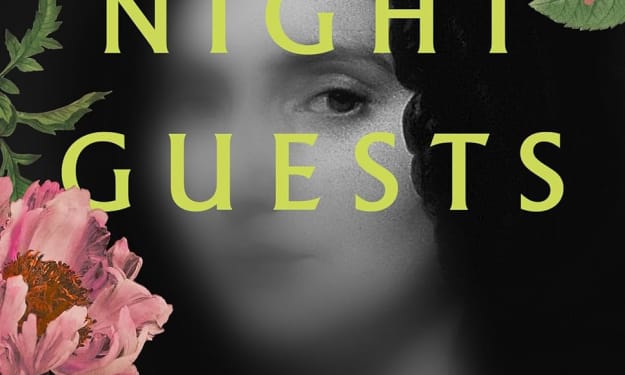
Book Review: "The Night Guests" by Marina Scott
When our narrator's father dies, her mother retreats into solitude and writes constant letters to him. She is mourning and sad until the family members attend a seance together where the showman in front of them looks on with a confusion as he states that the father of the house has returned and confirms he has been receiving the letters. Our cynical narrator doesn't know how this man in front of them could've known her father's nickname without even asking any questions. The question is will the events of the following story turn a cynical woman into a believer in something more, something beyond? As her mother begins to take up her hobbies again, our narrator finds it strange and odd that there is a different air to her life now. A completely different air.
By Annie Kapura day ago in Geeks
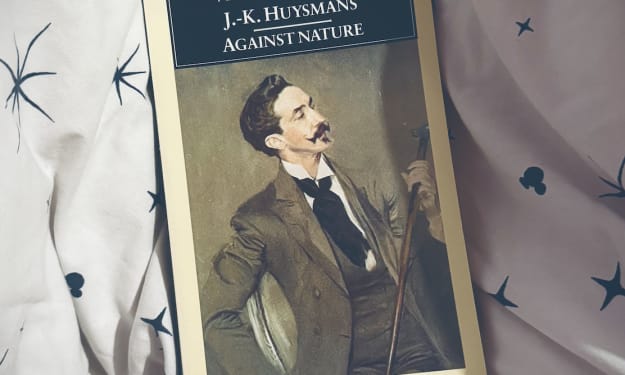
Rereading Review: "Against Nature" by J.K Huysmans
It's been about a decade or so since I read Against Nature by JK Huysmans and so, I wanted to dive in once again. Unfortunately, my copy with some brutish annotations in which I exclaim my dislike for the main character resembling a young Morrissey in his attitudes has since been lost to time and so, I had to buy another copy. Emile Zola would probably sum up the book in the best way as it was, in fact, a charged novel against the naturalist movement - hence the title Against Nature. But then again, it is packed full of emotions that are generally against the nature of human feeling - they are against the progressive and free-willed, against the whimsical, against the want for redemption and joy. The main character's journey to discovering this is a pained one yes, one that usually drops him into the central problem of melancholic thinking and perhaps reminds us that we don't want to shovel this novel into our mouths all in one go. It is one of those books that can really weigh one's mind down.
By Annie Kapur2 days ago in Geeks
Frankenstein by Mary Shelley
Background and Context: If you know me then you will probably know that I think 'Frankenstein' is one of the greatest novels ever written. I would say that since I was in my teens, this has been a really been a novel that has been close to my heart. Chapter 11 is probably the most special of these in which the Creature is discovering night and fire etc. It is simply one of the best pieces of literature ever written. I've read and taught it several times for over a decade. It gets better every single time.
By Annie Kapur2 days ago in Geeks
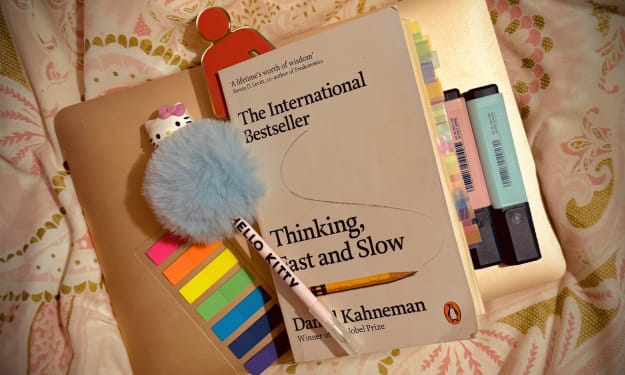
The Big Book Review: "Thinking, Fast and Slow" by Daniel Kahneman (Pt.2)
Welcome back to Part 2 of our 'Big Book Review' on Thinking, Fast and Slow by Daniel Kahneman. In the previous section, we saw that Kahneman paid close attention to the two 'systems' of our thinking - one that seemed more impulsive and quickly judgemental than the other. Now, we are also turning our attention on to why the supposedly more 'critical' system in our brain may not be all its cracked up to be and perhaps, it can even be lazy. Let's dive into what this book can tell us about 'Heuristics and Biases'...
By Annie Kapur3 days ago in Geeks
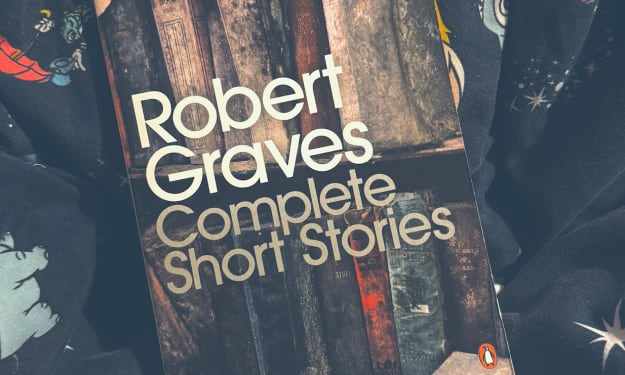
Book Review: "The Complete Short Stories" by Robert Graves
Robert Graves has always been a divisive writer for me. I once found his book I, Claudius unreadable and yet, Goodbye to All That was fantastic. His historical novels seem to be the worst possible historical novels - no imagination has gone into them and they read more like a textbook of fictions rather than a historical fiction masterpiece. Whereas, when he wrote Goodbye to All That you can definitely feel that his writing style is one of brilliance and atmosphere. Oh, and I have not forgotten about the comments he made about a young Bob Dylan.
By Annie Kapur3 days ago in Geeks
Book Review: "Dead in the Water" by John Marrs
The last time I read a book by John Marrs, it was the deceptively clever book The Good Samaritan, which I thought was incredible. So, of course when books by him are going for cheaper than usual - I will be on the look out to get them. Dead in the Water has a shocking opening chapter and then, is followed by a slightly slow burning start. I quite enjoyed learning more about the characters and the way in which their lives intertwine. By the end of the book, I was left enthralled by what had just happened, though I won't share the ending I will say that even though it is predictable - you won't be able to see the bigger picture unless you've understood all the turns. The question here is: were you really paying attention?
By Annie Kapur4 days ago in Geeks
Book Review: "Intermezzo" by Sally Rooney
Sally Rooney's novels tended to be a hit and miss for me. Normal People was the first book I'd read by her which, admittedly, completely put me off all of her writing and I hadn't bothered to read more until recently. I don't know what made me give her another go, but Beautiful World, Where Are You? was fantastic and Conversations with Friends wasn't too bad either. I was beginning to enjoy my traversing into the Rooney-verse with all of its inspiration very clearly taken from Woolfian writing (though, I would happily change that adjective to describe Virginia Woolf's influence to 'Woolfish' given half a chance). Intermezzo was perhaps one of the most anticipated books of the last few years and unfortunately, there are a few things I need to grapple with.
By Annie Kapur5 days ago in Geeks
Book Review: "The Substance of Civilisation" by Stephen L. Sass
There are many different substances throughout history that make up the way in which we have lived our lives. Stephen L. Sass goes through the materials which sought to make us humans and shape our meaning with it. From the clay era in which we are shown that even though we are known to use clay, we have no idea what kind of accident brought it about all the way through to the 'silicon' age - the author makes it clear that throughout history we all have one thing in common: we wanted to revolutionise our materials for production. We have always wanted to create something to make our lives easier - and that's what we have been doing since the dawn of humanity.
By Annie Kapur6 days ago in Geeks
Book Review: "Agatha Christie" by Lucy Worsley (Pt.4)
This review covers chapter 31 through to chapter 41 (the end of the book). *** So, first of all, Rosalind gets remarried (I definitely didn't see that one coming) to a man named Anthony Hicks. But that's not really the story, it's a representation of Agatha's life returning to something more normal and her daughter being up and about again, in some spirits. Agatha's life really returns to normal when she continues writing and though, in the chapters we cover, it is seen that she slows down her productivity - she definitely doesn't do anything to decrease the sales.
By Annie Kapur7 days ago in Geeks
Book Review: "Agatha Christie" by Lucy Worsley (Pt.3)
This review covers chapter 24 through to chapter 30 *** The back and forth of whether to marry Max is described by Lucy Worsley as troubling for Agatha. She was aware of the mistake she made by marrying Archie and didn't want to make the same one. Max hadn't told his father, whom he lived with, of the engagement - but was adamant he wanted to marry a woman almost fifteen years' older than him. The differences between Archie and Max are again, made even more pronounced by the fact that Archie wanted to play golf and be away from Agatha and Max wanted to read her Ancient Greek Poetry and be around her always. Lucy Worsley paints us a picture of Agatha's life through these two men - one of which treated her badly, the other who is a shy, but gentle person.
By Annie Kapur8 days ago in Geeks