Holianyk Ihor
Bio
Stories (461)
Filter by community
What Do Gas Giants Look Like on the Inside?
When we admire stunning images of Jupiter or Saturn, taken by spacecraft like Juno or Cassini, we see their swirling cloud bands, storms, and dazzling rings. But beneath those colorful atmospheric layers lies a world hidden from view — a strange interior unlike anything found on Earth. So, what do gas giants really look like inside?
By Holianyk Ihor7 months ago in Education
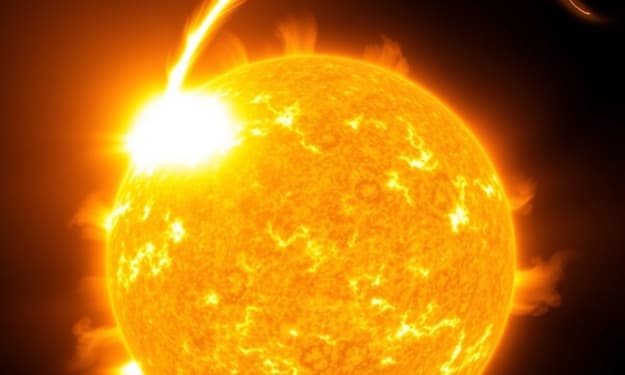
How Solar Flares Affect Earth
The Sun is more than just the bright star that warms our planet and makes life possible. It is a restless, turbulent sphere of plasma, constantly churning with energy and magnetic forces. Among its most dramatic expressions of power are solar flares—explosive bursts of radiation that can send shockwaves throughout the solar system. These fiery events might seem far away, but their impact on Earth can be both beautiful and dangerous.
By Holianyk Ihor7 months ago in Education
Could Dyson Spheres Exist Around Other Stars?
Imagine a civilization so advanced that it doesn’t just rely on the fraction of starlight reaching its planet, but instead captures nearly all the energy emitted by its star. To us, that sounds like pure science fiction. Yet, the idea has been seriously considered by scientists. Back in the 1960s, physicist Freeman Dyson suggested that if intelligent civilizations exist elsewhere in the galaxy, one of the most efficient ways they could power themselves would be to build enormous structures around their stars. This concept became known as the Dyson Sphere.
By Holianyk Ihor7 months ago in Education
Space and Quantum Teleportation: A Glimpse Into the Future of Interstellar Communication
When most people hear the word teleportation, their minds immediately jump to science fiction: starships that blink across galaxies, or characters who dissolve in one place and instantly reappear in another. But while we are still far from moving people or spaceships this way, scientists are already working on something equally fascinating — quantum teleportation.
By Holianyk Ihor7 months ago in Education
How Atmospheres Shape the Habitability of Planets
When we dream about life beyond Earth, oceans and rivers are usually the first images that come to mind. Water is often called the cradle of life, but having seas and lakes doesn’t necessarily mean a planet can sustain thriving ecosystems. The invisible hero of habitability is something far less tangible yet equally vital — the atmosphere.
By Holianyk Ihor7 months ago in Education
How Do Astronauts Return to Earth?
When we think about space missions, most people picture the thrilling moment of launch: a rocket roaring into the sky, flames and smoke trailing behind it. Yet, while liftoff may look like the most dangerous part of a mission, the journey home is often even more complex and nerve-wracking. Returning astronauts must not only re-enter Earth’s atmosphere at tremendous speeds but also land safely on solid ground—or in the ocean—after months in orbit.
By Holianyk Ihor7 months ago in Education
The Mystery of the Accelerating Universe
When we gaze up at the night sky, the stars appear eternal and unmoving, as though the cosmos has always been fixed in place. But appearances are deceiving. For more than a century, astronomers have known that our Universe is expanding. Even more astonishing: this expansion is not slowing down as one might expect it is speeding up. The fact that the Universe is accelerating remains one of the greatest mysteries in modern science.
By Holianyk Ihor7 months ago in Education
Silicon-Based Life: Myth, Science Fiction, or the Future of Biology?
When we think of life, carbon instantly comes to mind. It is the backbone of DNA, proteins, and lipids the very molecules that make complex organisms possible. But astrobiologists and science fiction writers often ask an intriguing question: what if life could be built not on carbon, but on silicon?
By Holianyk Ihor7 months ago in Education
The Mysteries of Wolf–Rayet Stars
Among the countless wonders of the universe, few objects capture the imagination of astronomers quite like Wolf–Rayet stars. These rare and powerful giants live fast and die young, blazing across the cosmos with ferocity and beauty that defies comparison. They shed their mass at incredible rates, unleashing stellar winds that sweep through space with unimaginable force. Many scientists see them as the last, dramatic act before a star explodes as a supernova or even as the progenitors of the universe’s most violent outbursts: gamma-ray bursts. But what makes these stars so extraordinary, and why are they shrouded in mystery?
By Holianyk Ihor7 months ago in Education
How Star Clusters Are Born
When we look up at the night sky, the stars may appear scattered randomly across the cosmos. Yet, the truth is that most stars are not born in isolation. Instead, they emerge together in vast groups known as star clusters. These cosmic families can contain hundreds, thousands, or even millions of stars, bound by their shared origin. For astronomers, star clusters are not just beautiful sights they are natural laboratories that help us uncover the secrets of how stars form and how galaxies evolve.
By Holianyk Ihor7 months ago in Education
How Supernovae Enrich the Cosmos with Heavy Elements
When we gaze at the night sky, the stars seem eternal and unchanging. In reality, the universe is a restless laboratory, where stars are born, live, and die forever transforming the chemical makeup of space. Among the most spectacular events in a star’s life is the supernova: a cosmic explosion so powerful that it forges the universe’s heaviest elements, such as gold, uranium, and lead. Without these titanic events, neither Earth nor we ourselves would exist.
By Holianyk Ihor7 months ago in Education
The Fate of Our Solar System: A Journey Into the Far Future
The Solar System has been our cosmic home for billions of years, a relatively calm neighborhood in the vast expanse of the Milky Way. But like everything in the universe, it is not eternal. Our star, its planets, and even the tiniest comets are destined for dramatic changes over unimaginable stretches of time. Let’s take a journey forward far beyond human history to see what awaits our Sun and its family of worlds.
By Holianyk Ihor7 months ago in Education