Mina Carey
Bio
Self proclaimed weirdo, collector of hobbies, creator of worlds and hunter of mysteries. Let's find our new hyperfixation together.
https://sp0reprintspectrum.carrd.co/
Stories (8)
Filter by community
mycelial
If I were a mushroom and you were a tree I would have found you already — threaded myself through the dark to where your roots reach down and wove myself in. They see my fruit. Beautiful enough to want, too dangerous to hold. But you would know what lives beneath — the web of me, moving through every dark and patient inch between us. I would bring you what the deep holds. You would give me light made solid. Neither of us would need a word for it — the forest never has. When you find me you won’t feel the finding, only that you always knew where your roots were going.
By Mina Careyabout an hour ago in Poets
Journal of Behavioral Homeostasis
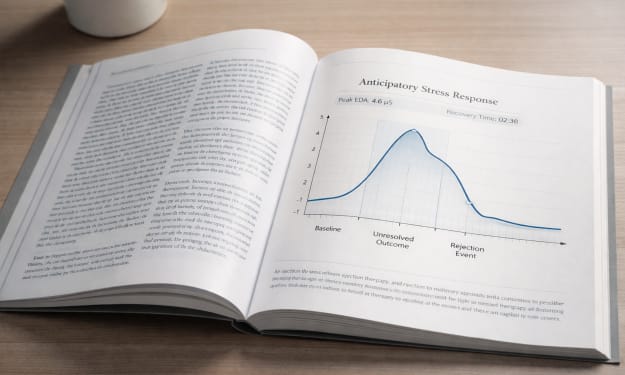
Journal of Behavioral Homeostasis Vol. 52, Issue 1 (2043) On the Therapeutic Function of Rejection Yielded Expectation Adaptation and the Regulation of Anticipatory Stress Abstract Chronic exposure to unresolved outcomes has emerged as a significant source of sustained psychological stress in contemporary environments characterized by continuous evaluation and delayed feedback. Yielded Expectation Adaptation (YEA) therapy was developed to reduce distress associated with rejection through structured exposure to definitive negative outcomes. Early clinical trials demonstrated measurable reductions in physiological arousal and cognitive rumination following controlled refusal events, despite participants reporting subjective disappointment. Subsequent adoption beyond clinical settings introduced voluntary and recreational applications collectively described as “outcome rehearsal.” This study examines therapeutic efficacy alongside broader cultural implications arising from the normalization of definitive outcomes as a mechanism of emotional regulation. Background Modern individuals navigate an unprecedented volume of unresolved outcomes. Applications remain pending without timelines. Messages linger unanswered. Creative work circulates through opaque review systems that offer neither clarity nor closure. Even social interaction increasingly unfolds within structures that defer resolution, producing prolonged periods of suspended expectation. While anticipation has traditionally been framed as motivational tension, emerging research suggests that sustained uncertainty carries significant cognitive and physiological costs. Patients presenting with chronic anticipatory stress frequently describe difficulty disengaging from unresolved possibilities, reporting persistent rumination, impaired attentional recovery, and elevated baseline anxiety. Clinical observation revealed an unexpected pattern: for many individuals, the distress associated with waiting exceeded the distress of rejection itself. Participants described negative outcomes as “sharp but clean,” contrasting them with the diffuse strain of indefinite possibility. Once an outcome was known — even an unfavorable one — subjects reported immediate reductions in cognitive load and renewed capacity for directed attention. These observations prompted investigation into whether rejection, when encountered deliberately and under controlled conditions, might function not solely as a negative experience but as a regulatory one. Yielded Expectation Adaptation therapy emerged from this line of inquiry. The approach centers on structured exposure to definitive refusal, designed to reduce anticipatory distress by recalibrating emotional responses to negative outcomes. Early implementations included simulated evaluative scenarios, scripted interpersonal declines, and guided exercises in which participants intentionally sought low-stakes rejection experiences. Initial reception within clinical communities was cautious. The idea that rejection might serve therapeutic ends appeared counterintuitive; however, preliminary findings consistently demonstrated improved physiological recovery following outcome resolution. Participants did not report enjoying rejection. They reported relief at the end of waiting. Subsequent literature began referring to the model simply as YEA therapy. Early Clinical Findings Pilot studies focused on individuals experiencing persistent anticipatory distress, including professionals navigating competitive hiring processes, creatives engaged in repeated submission cycles, and individuals reporting prolonged uncertainty within interpersonal relationships. Across multiple trials, participants undergoing YEA therapy demonstrated faster emotional recovery following negative feedback compared to control groups receiving traditional cognitive reframing interventions. Notably, the therapeutic effect appeared tied not to reinterpretation of rejection but to outcome definitiveness. When uncertainty was removed, even unfavorable results allowed subjects to reorganize attention and resume forward-directed behavior. Emotional stabilization occurred independently of outcome desirability. Whether such stabilization enhances persistence toward uncertain objectives was not assessed in initial trials. Initial findings were drawn from three pilot cohorts totaling 124 participants across clinical and non-clinical populations. Measures included heart-rate variability, post-session cortisol sampling, and standardized rumination inventories administered at 24-hour intervals. While sample sizes were limited, consistency across cohorts prompted further investigation into non-traditional applications of the model. Researchers initially framed these findings as evidence that emotional regulation may depend less on outcome valence than on outcome clarity — a distinction that would later prove central to understanding YEA’s broader cultural trajectory. Expansion Beyond Clinical Contexts As familiarity with YEA therapy increased, individuals began applying its principles independently outside clinical settings. Participants experimented with deliberate exposure to minor refusals, describing the practice as preparation rather than treatment. Examples included requesting unlikely accommodations, submitting creative work to rapid-response review forums, and engaging in structured interpersonal exchanges designed to produce immediate closure. In some peer-led sessions, participants delivered timed refusals limited to brief standardized phrases, preventing narrative elaboration and accelerating outcome resolution. These practices were soon described collectively as outcome rehearsal. The stated aim was efficiency: eliminate prolonged anticipation, reduce emotional backlog, restore equilibrium. Online communities formed around shared rehearsal strategies. Forums tracked experiments in shortening decision cycles. Informal gatherings organized structured refusal exchanges modeled on early YEA exercises. Participants described feeling clearer following sessions, attributing relief not to rejection itself but to the restoration of certainty. By 2041, digital platforms offered guided outcome simulations. Users submitted proposals or personal statements for predetermined rejection responses, receiving definitive outcomes in place of extended uncertainty. What began as resilience training increasingly functioned as routine maintenance. Longitudinal Observations Extended tracking of frequent YEA participants revealed sustained reductions in anticipatory distress across professional and interpersonal domains. Subjects reported decreased reactivity to uncertainty and increased willingness to disengage from prolonged evaluative processes. Participants described these changes as increased realism or maturity. However, longitudinal analysis identified convergence toward modest, low-volatility objectives and a gradual reduction in variance among reported long-term goals. Engagement with speculative creative work, competitive applications, and relational pursuits involving delayed feedback declined across cohorts. These shifts were rarely framed as losses. Participants instead described calibration, emphasizing efficiency and emotional sustainability. Goal selection trended toward incremental trajectories. Despite these patterns, expressions of desire for authentic acceptance outcomes remained consistent. Participants reported increasing comfort with rejection while continuing to articulate longing for genuine affirmation. Rejection, when rehearsed, appeared to lose much of its destabilizing force. Whether it also lost its capacity to clarify what was genuinely wanted remained unclear. Discussion The widespread adoption of YEA suggests that relief from uncertainty fulfills a significant psychological need. Across populations, participants demonstrate reduced anticipatory distress following structured exposure to definitive outcomes. Emotional recovery accelerates. Rumination declines. Individuals report increased stability and improved capacity to disengage from unresolved possibilities. These outcomes align with predictive regulation models, which propose that the brain prioritizes clarity over desirability when restoring equilibrium. Rejection functions less as injury than as resolution — a definitive update that permits cognitive reorganization. The normalization of outcome rehearsal may therefore represent an adaptive response to environments saturated with deferred evaluation. Participants frame YEA engagement as a method of preserving energy, shortening the waiting cycle, and maintaining emotional efficiency. Longitudinal findings suggest equilibrium and expansion may not scale proportionally. Frequent YEA engagement correlates with decreased participation in high-variance pursuits and reduced tolerance for prolonged uncertainty. Emotional volatility declines alongside willingness to pursue outcomes perceived as unlikely. Participants continue to describe themselves as hopeful. Structured rejection reduces destabilization but does not eliminate longing. The wish to be chosen persists even as individuals become increasingly skilled at rehearsing refusal. It remains unclear whether the growing cultural preference for definitive outcomes represents an evolution in resilience or a recalibration of perceived attainability. Emotional equilibrium may be achieved through strengthened tolerance of disappointment. It may also be achieved through subtle contraction of the scale at which individuals are willing to hope. Further research is required to determine whether widespread engagement with YEA strengthens individuals against disappointment — or gradually reduces the range of futures they consider reachable. Author’s Notes: Current findings suggest that individuals do not appear to want less; rather, they appear increasingly practiced at relinquishing desire before it encounters resistance. The reduction of distress may indicate progress; whether it reflects expansion or contraction remains unresolved.
By Mina Carey3 days ago in Futurism
The Cost Of Counting
You check your phone and it tells you who noticed you, how well you slept, how productive you’ve been, how far you’ve walked. The numbers arrive before your thoughts do. They don’t just inform you — they interpret you. A good sleep score feels like success. A low step count feels like failure. A spike in notifications becomes proof that something mattered. Most of us accept this without hesitation. Numbers feel objective. Neutral. Trustworthy. But why do we care so much about what can be counted — and so little about what can’t? It’s easy to blame modern life. Smartphones. Algorithms. Dashboards for everything. Unfortunately, humans were mistaking numbers for meaning long before anyone invented a smartwatch. There’s even a name for the pattern: the McNamara Fallacy. During the Vietnam War, U.S. Secretary of Defense Robert McNamara attempted to measure progress through statistics — body counts, sortie numbers, territory percentages. The data looked precise. Objective. Reassuring. On paper, progress could be tracked. Charts moved upward. Reports suggested momentum. But many of the most important variables refused to cooperate with measurement. Morale couldn’t be quantified. Cultural resistance couldn’t be graphed. Political realities shifted faster than any spreadsheet could capture. No one woke up one day and decided to ignore reality. The shift happened gradually. Each new report reinforced the belief that measurable progress must reflect actual progress. Over time, the metrics became the story. The numbers weren’t false. They were simply incomplete — and what couldn’t be easily measured slowly faded from view. That instinct never disappeared. It just moved closer to home. Today, measurement surrounds us. Fitness trackers translate movement into steps. Platforms convert attention into engagement metrics. Productivity tools turn effort into streaks and checkmarks. None of this is inherently bad. Measurement helps us see patterns we might otherwise miss. Data improves medicine, reveals inequality, and helps us navigate complexity. The trouble begins quietly when measurable signals start to stand in for deeper realities. Nowhere is this tension more visible than in creative work. Writers, artists, musicians, filmmakers — anyone who makes something — now receives constant numerical feedback. Views. Likes. Shares. Follower counts. Watch time. Creative work has always involved uncertainty. You make something and hope it resonates. Often, you don’t know if it has — or when. Metrics offer relief from that ambiguity. They speak clearly. Immediately. Undeniably. And that clarity is seductive. Creative life now exists between two feedback systems. One is slow, ambiguous, and emotional: the sense that something meaningful has been expressed or received. The other is immediate, visible, and quantifiable: engagement numbers that arrive instantly and feel definitive. Both systems have value. Metrics help creators find audiences, refine communication, and understand reach. But they also introduce a subtle gravitational pull. A piece that performs well numerically feels validated. One that disappears quietly can feel like failure, regardless of its depth or originality. Over time, creators adapt. Certain formats travel further. Certain tones provoke faster reactions. Certain ideas convert reliably into attention. The shift rarely feels like compromise. It feels like learning the system. Slowly, almost imperceptibly, the measurable begins to redefine what feels worth creating. There’s a cognitive bias sometimes called the streetlight effect. A person searches for lost keys under a streetlight — not because that’s where they dropped them, but because that’s where the light is strongest. Metrics function the same way. They illuminate certain aspects of creative work very clearly: reach, growth, frequency. Once that light exists, effort naturally gathers there. Decisions cluster around what is visible. The danger isn’t that the light exists. It’s that we forget how much remains in the dark. Resonance is hard to quantify. Slow influence is invisible. A story that changes someone years later won’t show up in this week’s analytics. Metrics measure applause. They rarely measure silence — and silence is where many meaningful ideas begin. If this tension feels familiar, it isn’t a personal weakness. It’s human psychology. We trust numbers because numbers feel safe. Ambiguity is exhausting. Creative work, like life itself, is filled with variables we cannot predict. Measurement offers the illusion of certainty. A rising graph feels like progress. A score feels like clarity. Once a metric exists, it begins to exert gravity. Attention bends toward what performs. Decisions orient toward what can be optimized. The shift rarely feels dramatic. It feels logical. Which is precisely why it’s so difficult to notice. The goal isn’t to reject measurement. Numbers are powerful tools. The risk lies in letting measurement replace judgment rather than inform it. Sometimes the simplest safeguard is a question: What does this number fail to capture? Engagement measures reaction, not depth. Visibility measures reach, not meaning. Metrics can show who noticed — but rarely reveal who was changed. Creative work has always required making things without guaranteed validation. That hasn’t changed. What has changed is how loudly validation speaks. The uncomfortable — and perhaps hopeful — truth is that the most meaningful work often resists easy measurement. History suggests the most important variables in any system are often the ones that refuse to be counted. When we forget that, we don’t just misread the numbers. We begin to reshape our creativity around them. And over time, that reshaping carries a cost.
By Mina Carey5 days ago in Psyche
unreached. Content Warning.
Your absence is A terrible kind of safety: You left a world That would have tried harder To do the job itself. Your armor now Is wood and soil, but Better than the fragile heart And skin to bear the wounds. The space where you were Will never heal But there is comfort In the weight of knowing Nothing can touch you now. The relief feels Like burning and betrayal Like a mouthful of pills, Like a phantom limb Grateful for the severance.
By Mina Carey5 days ago in Poets
Reality Was Supposed to Make Sense. Science Disagreed.
We tend to assume reality is stable because that assumption is useful. Time moves forward. Solid things stay solid. Cause politely precedes effect. It’s a comforting arrangement. Science has spent the last century suggesting that reality never signed that agreement. The deeper we look, the less the universe resembles a well-behaved machine and the more it feels like a system that tolerates our expectations only until we examine them closely. Every major discovery seems to follow the same pattern: something we thought was fundamental turns out to be… negotiable. Which raises an uncomfortable possibility. Maybe reality didn’t become strange. Maybe we just started paying attention. Time Isn’t Universal — Which Feels Slightly Unfair Time feels obvious. Clocks tick. Events happen. Everyone agrees on when lunch is. At least locally. Relativity introduced an idea that still feels mildly rude: time passes differently depending on motion and gravity. Two observers can measure different durations between the same events, and physics refuses to choose sides. Astronauts returning from orbit have technically aged a little less than people on Earth. GPS satellites must constantly correct for time dilation or navigation systems would drift into chaos. So time isn’t a shared universal river. It’s more like a personal experience stitched to movement through space. Which means somewhere, right now, two perfectly accurate clocks are disagreeing — and neither is wrong. Solid Matter Is Mostly Empty Space Pretending Otherwise If you knock on a table, it feels confidently real. The kind of solid you don’t question. Physics quietly suggests you probably should. Atoms are mostly empty space. What you experience as solidity is the electromagnetic repulsion between particles preventing them from occupying the same position. You’re not touching the table in the way intuition suggests; you’re encountering a boundary enforced by invisible forces. Matter behaves less like a brick wall and more like a negotiation between fields. The universe runs on agreements between things that never actually meet. Which is deeply inconvenient if you prefer reality to feel straightforward. Quantum Particles Refuse to Commit Until Asked Classical physics taught us that objects have definite properties whether or not we observe them. Quantum mechanics looked at that assumption and declined to participate. At small scales, particles behave as overlapping probabilities rather than fixed objects. They exist in multiple possible states until measurement forces a specific outcome. Before interaction, reality seems undecided. Scientists still debate what this means philosophically, but experiments keep confirming the behavior. Which leaves us with an unsettling thought: the universe might not be a finished structure waiting to be understood. It might be an ongoing process that becomes definite only when something engages with it. Empty Space Is Busy Being Empty “Nothing” sounds simple. Physics has other plans. Even a vacuum contains fluctuating quantum fields where particles appear and disappear constantly. These tiny events influence measurable forces and shape how matter behaves. Silence, it turns out, is noisy. Nothingness isn’t absence. It’s activity we rarely notice. Your Brain Edits Reality Before You See It We like to believe perception is passive — eyes open, information enters, reality arrives. Neuroscience suggests something closer to improvisation. Your brain predicts incoming data, fills gaps, filters noise, and constructs a usable version of the world before you become aware of it. You’re not seeing raw reality; you’re seeing a model optimized for survival. Accuracy was never the main goal. Efficiency was. Which explains why reality feels coherent even when it isn’t entirely accurate. The Universe Might End Quietly Popular imagination prefers dramatic endings. Cosmic explosions. Spectacular finales. Current cosmological models suggest something less theatrical: continued expansion, gradual cooling, stars fading one by one until energy spreads thin across an increasingly quiet universe. No grand climax. Just a slow dimming. Even the end of everything might refuse to perform for us. So What Actually Changed? None of these discoveries made reality stranger. They revealed that our assumptions were overly confident. Time isn’t universal. Matter isn’t solid. Observation isn’t passive. Nothing isn’t empty. Perception isn’t objective. The universe doesn’t exist to feel intuitive. It exists to follow rules that occasionally look like practical jokes from our perspective. And every time we think we’ve reached the final explanation, reality expands just enough to remind us that certainty is temporary. We didn’t lose simplicity because science complicated the universe. We lost it because we started looking closer — and reality became a little more unreal.
By Mina Carey8 days ago in FYI
myselves . Content Warning.
myselves We tried to drink ourselves clean, counted shots like rosary beads, the glass sweating. We tried to smoke ourselves sober , ash collecting like dried petals beneath forgotten flowers. We tried to peel back our masks, And found scabs like punctuation marks interrupting every sentence the body tries to finish. I told myself: stop. I told myself: just one more. All the voices sounded like me. Our hair became the string we followed, trying to escape our labyrinth mind. We pulled, and we unraveled, and escape remained unknown. Call us user, abuser, monster, maniac; names stack like chairs in an empty room. We sit in all of them. None can bear our weight. We tried to divide ourselves evenly one voice for rage, one voice for hunger, one voice that only knows how to stay. But the body refuses fractions. It gathers us back together until there is only one mouth left and it is screaming.
By Mina Carey9 days ago in Poets
The Pest Control Problem
The Pest Control Problem The infestation had reached Phase Three before the council agreed to call it that. Before then, it had been “a nuisance,” then “an ecological irregularity,” and briefly — during the optimism of early containment — “an opportunity for adaptive learning.” Now it was simply a problem. “They multiply too quickly,” said Mara, circling slowly at the center of the gathering. “We remove one cluster and another appears within a season.” “They’ve always been present,” replied Torin. “Perhaps we are only now noticing them.” “They weren’t climbing onto structures before,” someone added from the outer ring. “Or dragging debris with them. The noise alone is disruptive.” A low chorus of agreement moved through the assembly, vibrations rippling through the water between them. The thing was, settlement had never needed formal pest control guidelines. Predators and scavengers existed, of course, but they belonged to familiar cycles. Even invasive species usually followed predictable patterns. These creatures did not. They gathered in clusters of hard-edged shells that cut through the water unnaturally. They moved in chaotic bursts, then stopped entirely, floating in place as if unsure what to do next. “I propose targeted removal,” said Edda, who had always favored decisive solutions. “They show aggression when approached. Several of our young have been startled by their machines.” “They are curious,” countered Sol, whose research group had documented the creatures for months. “Curiosity is not aggression.” “They throw objects,” someone muttered. “That is also curiosity.” “Or poor coordination,” added another voice. A ripple of dry amusement passed through the group. The first recorded incident had occurred near the southern migration route. A cluster of the pests had arrived inside a white shell structure, drifting without purpose. They produced constant noise — tapping, scraping, irregular bursts of vibration. Torin’s pod had watched from a distance. “They seemed excited,” Torin had said later. “At nothing in particular.” “Perhaps they are easily pleased,” Mara replied. “They attempted to communicate.” This had caused considerable discussion. “What did they say?” Torin paused. “It is difficult to translate. They produced a series of high-frequency sounds. Repetitive. Without structure.” The group made uneasy movements, and Torin was hasty to add, “but they seemed aware that sounds had meaning. They show significant evidence of being self aware, actually.” This caused a few sideways glaces, and Torin knew they were thinking the same thing he was: was that a good thing? Not all interactions had been negative. There were documented cases of the pests offering objects, such as fish, seaweed, and occasionally, very sharp sticks. The orcas who felt more neutral towards the pests began studying them in earnest. “They present food,” Sol insisted during one meeting, delighted by the implications. “It may be an attempt at mutualism.” “They’re trying to tame us,” Edda said flatly. The idea had been met with laughter, drowning out the few and feeble voices of the elder whales, who still spoke of friends and family that had vanished from the ocean; snatched by a monstrous being made of rough tendrils forming a stout web. Any who did hear their claims were quick to roll their eyes. Still, the behavior continued. Several young adults reported being approached by individual pests who held out offerings while emitting excited bursts of sound. “They appear pleased when we accept,” Sol noted, “And confused when we don’t.” The escalation began with the vessels. The pests relied heavily on their shells. Without them, they struggled to move effectively. Some members of the community discovered that nudging the vessels disrupted their movement. Others learned that more forceful contact stopped them entirely. The first incident had been accidental… The second less so. “They learn quickly,” Mara observed. “Yes,” Edda agreed. “So must we.” Debate intensified. Group One advocated complete removal. “They damage the environment. They pollute. They disrupt migration routes.” Group Two favored conditional intervention. “Only when they cause harm. Otherwise we observe.” Group Three found the pests fascinating. “They construct tools,” Sol argued. “They attempt communication. They bring gifts. This may represent a rare opportunity.” “You want to continue to study them,” Edda said. “Yes.” “You always want to study everything.” “That is because everything is interesting.” Edda sighed, but had no retort. The council reviewed recordings. One showed a pest attempting to climb onto a drifting structure, slipping repeatedly but persisting with admirable determination. Another depicted a cluster celebrating loudly after catching a fish — though their technique appeared inefficient. A third recording caused particular discomfort. A young calf had approached a vessel out of curiosity. The pests had reacted with frantic motion, pointing and shouting. “They appear frightened of us,” Sol said, puzzled. “As they should be,” Edda growled. Reports continued. Some pests damaged one another’s structures without obvious cause. Others drifted aimlessly for long periods. They generated waste that accumulated in the water. “They do not understand consequences,” Mara concluded. “Or perhaps they do,” Sol said quietly. “And proceed anyway.” The council convened again as the sun filtered through the upper layers, breaking into long shifting beams. “We require guidelines,” Mara said. “Not ideology.” Agreement followed. Draft proposals circulated: 1. Observe when possible. 2. Intervene only when harmful behavior escalates. 3. Encourage distance between settlements and pest activity zones. 4. Allow controlled interaction for research purposes. 5. Avoid unnecessary aggression. “And what,” asked Edda, “counts as unnecessary?” No one answered. The next escalation arrived without warning. Several pests had gathered in a large shell structure, emitting violent noise and expelling waste into the water. Edda’s group approached. They nudged the vessel. It did not stop. They struck harder. The vessel fractured. The pests fled into the open water, limbs flailing. “They seemed shocked,” Sol reported later. “Perhaps they believed themselves invulnerable.” said Edda. Her quiet satisfaction was obvious. With a sigh, Torin turned from his companions to join the gathering crowd. This had to be discussed. Reactions within the settlement were mixed; some celebrated the success, while others worried about escalation. Sol remained fascinated. “They adapt,” Sol said. “After the incident, their vessels began avoiding certain areas. They remember.” “Memory implies learning,” Mara said. “Yes.” “And learning implies risk.” “…Yes.” More recordings arrived. A pest carefully placing a fish before backing away. Another reaching out tentatively toward a passing juvenile. A cluster observing silently from a floating structure, their attention fixed. “They are studying us,” Sol said, almost reverently. “Then they should study better,” Edda replied with a snort. Gradually, a consensus formed. The pests were neither purely destructive nor harmless. They were… complicated, as any living being can be. The final vote occurred during migration season. The council assembled beneath shifting light, currents carrying distant echoes through the water. “All in favor of adopting the guidelines?” The motion passed easily. The settlement dispersed, each member returning to their paths. Above them, near the surface, several pests clung to a drifting shell, pointing downward. They emitted excited bursts of sound as the pod moved beneath them. One dropped a fish. It spiraled slowly toward the depths. Sol accepted it, amused. “They are persistent,” Sol said. “They are pests,” Edda replied. “They are trying,” Sol countered. They rose together toward the light, breaking briefly through the surface before diving again, vast bodies moving with effortless precision. Behind them, the small creatures continued to shout and wave from their fragile vessels, convinced they were witnessing something extraordinary. Below, the council’s new guidelines spread through the pods. Above, humanity debated its latest sightings of unusual whale behavior. And far beneath the surface, the orcas adjusted — patient, curious, and increasingly certain that the infestation would require ongoing management.
By Mina Carey9 days ago in Fiction
The Forest That Waits
She frowned at the ground around her. Surely there had been a trail just seconds ago; she had been following something to be this deep in the Forest. But now only sparse patches of dirt showed between thick tangles of weed and bracken, and she could neither find the path nor entirely remember if there had ever been one. A slow unease crept through her. She had come here for a reason. Hadn’t she? Everyone knew entering the Forest was a terrible idea. She was certain she had believed that once. Or had she? There had been a Before. She felt it faintly — lines carved into the ground, walls made of trees but not of trees, voices carried on wind instead of leaves. Something important hovered just out of reach. She gasped. “Ezra!” The name struck like lightning. She ran. Branches scraped her arms as she pushed forward, heart pounding, breath tearing from her chest. No need for a trail now. She remembered the child running — small footsteps disappearing into green shadow, laughter turning to silence. “Ezra!” The word burned in her throat. Not the first time she had shouted it. Her aching legs told her she had run for miles. Her drifting thoughts suggested she had been running longer than a day. The Forest did not answer. A clearing opened before her, sudden and perfect. She stumbled into it and fell to her knees, gasping. The air felt different here — too still, too calm. She sat where she had fallen, trying to gather fragments of memory. A town. A home. Raised voices. The child running. Running into the Forest. She squeezed her eyes shut. In stories, clearings brought answers. She wanted very badly to leave this one. When she opened her eyes again, the space felt almost rehearsed. The clearing was perfectly round. Sunlight fell in deliberate shafts through the canopy above, illuminating jewel-bright birds darting after insects. Wildflowers spread in careful arcs, drawing butterflies in flashes of impossible colour. Everything was beautiful. Everything was wrong. Sweat beaded on her skin despite the gentle breeze. Ezra was not there. But a narrow trail broke through the bushes at the far edge of the clearing. Hope surged through her — sharp and painful. She moved toward it. Then she saw the light. Off to one side, beyond the trees, a brightness shone — harsher than the clearing’s glow, like early morning breaking through fog. The edge of the Forest. Her breath caught. If she stepped toward it, she could leave. She felt it — freedom waiting just beyond the trees. Had Ezra already escaped? Was the child waiting there, safe? Or had Ezra gone deeper instead? The clearing held its silence. The same birdcall rang out — clear, identical, as if repeating a note long practiced. She hesitated. If she left now, she might never return. But if Ezra waited beyond the trees… She bit her lip, gazing toward the light. Then she turned back toward the trail. A few steps beyond the clearing she stopped again. Footprints marked the mud. She crouched. They overlapped each other — worn deep into the earth, not one path but many, layered together as if walked again and again. Her breath faltered. Slowly, she placed her foot into one of the prints. It fit perfectly. They were hers. And they were old. A cold understanding brushed against her mind — something vast and terrible and almost clear — but it slipped away before she could grasp it. The trail stretched ahead, waiting. She swallowed and stepped forward. The trees closed behind her with quiet patience. Moments later she paused again, uncertain. She frowned at the ground around her. Surely there had been a trail just seconds ago… Somewhere deeper in the Forest, the same birdcall echoed once more — unchanged, unhurried. And the Forest waited.
By Mina Carey9 days ago in Fiction