Real content
Bio
Stories (99)
Filter by community
Swiss Glacier Rescue: Chihuahua Dog Leads Helicopter Team to Trapped Mountaineer
Flip is a small, energetic, and loyal Chihuahua, but he has a very big personality. These are the words Flip’s owner, Jon Goller, uses to describe his dog. Last summer, Jon Goller fell into a crevasse on a Swiss glacier. He was rescued by a helicopter—and the reason was his dog, who stayed by his side even in that terrible moment. Both Flip and Goller love the mountains and mountaineering. When Flip gets tired from walking, his owner puts him in a bag and carries him on his shoulder so they can complete the rest of the journey more quickly. They stop at several spots along the way, eat, and enjoy the surrounding scenery. Goller said, “My dog can walk 20 to 30 kilometers. Fortunately, on the day of the accident I hadn’t put him in the bag, nor was he on a leash, otherwise he might have fallen into the crevasse as well. If that had happened, the rescue teams would never have found me.” Jon is originally from the city of Plzeň in the Czech Republic and had moved to Switzerland about a month before the accident. Goller says, “My parents gave me Flip as a gift—they breed dogs. I had another dog before, but it passed away some time ago. Flip is two and a half years old, and everyone at my office likes him and plays with him. He especially loves playing in the snow.”
By Real content13 days ago in Petlife
Chinese New Year 2026: Meaning, Traditions, Zodiac Signs & Celebration Guide
In the Chinese calendar, this is the most important day of the year, and on February 1 more than one billion people eat delicious meals with their loved ones. They watch colorful parades held in their respective areas and pray that the new year will prove to be blessed for them.
By Real content13 days ago in History
Post-Hasina Bangladesh: BNP Victory, Youth Revolution, and the Future of Democracy
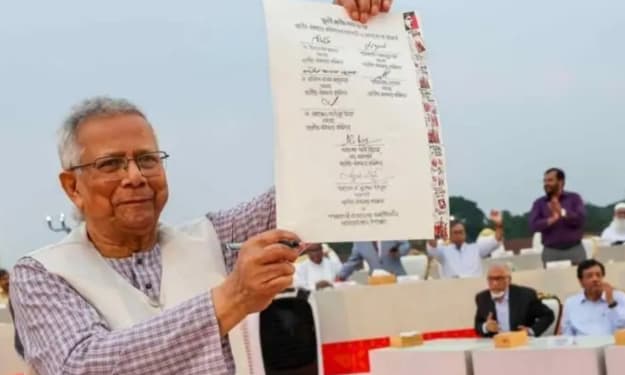
About two years ago, when Sheikh Hasina won an election that was widely described as being marred by large-scale rigging, it was difficult to even imagine that her 15-year strong grip on power would suddenly come to an end, or that another party, which had nearly disappeared from the political landscape, would return with such intense public support. However, this is yet another shift in the ups and downs of Bangladeshi politics, where the Awami League and the Bangladesh Nationalist Party (BNP) have alternated in power for decades. The only difference this time is that the BNP is now formally led by Tarique Rahman, and this is the first time he has personally contested in a general election. His mother, Khaleda Zia, who passed away last year after a prolonged illness, had led the party for four decades. She took over the responsibility after the death of her husband, Ziaur Rahman, the founder of the BNP and an important leader in Bangladesh’s War of Independence. In the past, when his mother was in power, Tarique Rahman faced allegations of benefiting from nepotism and was also confronted with corruption cases. Just five days before his mother’s death, he ended his 17 years of self-imposed exile and returned to Bangladesh from London. Although the 60-year-old Tarique Rahman had effectively acted as the party’s leader during and after his mother’s imprisonment and later during her illness, he is generally regarded as an untested leader. According to political scientist Nouvine Murshid, his lack of previous governing experience may actually work in his favor, because people want to give change a chance. They want to believe that new and positive change is possible, which is why there is an atmosphere of hope among the public. Following the election results, the BNP announced that its top priority would be the restoration of democracy in the country. This time, however, the situation appears somewhat different. The country’s youth, who played a prominent role in the “July Uprising” of 2024 that ultimately forced Sheikh Hasina to step down, have clear expectations. Nineteen-year-old student Tazin Ahmed, who participated in the protest movement, says: “We do not want to fight again. The former prime minister’s resignation was not our ultimate achievement. Our real success will be when the country becomes free of corruption and begins moving in the right direction, and when the economy becomes stronger.” Her cousin, 21-year-old Tahmina Tasnim, says: “Above all, we want unity among the people. We have a right to a stable state and a stable economy. We have been part of a popular movement and know how to resist. If the same conditions arise again, we also have the right to raise our voices again.” Since Sheikh Hasina’s removal, Bangladesh has faced incidents of unrest and violence during the tenure of interim leader Muhammad Yunus. Restoring law and order will be a top priority for the new government. At the same time, reviving the economy, reducing food prices, and creating job opportunities for the country’s large youth population are among the major challenges. Social affairs expert Samina Luthfa says that nearly all political parties face a lack of governing experience. Jamaat-e-Islami, considered the second-largest political party in Bangladesh and twice banned in the country’s history, has also won a significant number of seats for the first time. Its allied party, the National Citizen Party (NCP), formed by the student leaders who led the protest movement, has managed to win six seats in its very first election. According to Samina Luthfa, Bangladesh is likely to see a parliament this time where many leaders will be entering the house for the first time. She adds that the young leaders of the NCP have much to learn. Leaders of other parties may be experienced politicians, but they lack practical experience in running the country. Therefore, the journey will not be easy, and the government will face tough challenges. Jamaat-e-Islami’s election manifesto emphasized secular and developmental points and made no clear mention of implementing Islamic law. However, the party’s website states that “Jamaat is active in the political arena because without political power, Islamic law cannot be implemented.” This stance has always raised the question of what its practical strategy would be if the party ever came to power. According to political scientist Nouvine Murshid, Jamaat’s performance in this election was not unexpected. She says that Jamaat is a well-organized political party and has worked consistently and systematically at the grassroots level for decades. However, Murshid adds that while this fact must be acknowledged, the problem is that Jamaat’s core ideology is non-democratic, gender discriminatory, and patriarchal in nature. On the other hand, Samina Luthfa says that all political parties have disappointed the women of Bangladesh. In the recent elections, just over four percent of the candidates were women. She says: “We women who were part of the July popular movement have seen all political parties fail to translate our collective struggle into formal political and electoral representation.” Luthfa emphasized that members of parliament should take immediate steps to nominate capable, honest, and deserving candidates to the reserved seats for women. Out of Bangladesh’s total 350 parliamentary seats, 300 members are directly elected by public vote, while 50 seats are reserved for women. These reserved seats are allocated to political parties in proportion to their electoral performance, and the parties themselves nominate candidates for them. The recent elections are being described as markedly different from those held during Sheikh Hasina’s tenure. This time, the contest was genuinely competitive, and the outcome was not clear before polling. In the context of claims about restoring democracy, when the BNP was asked whether it would support bringing the Awami League back into the political mainstream, senior party leader Amir Khasru Mahmud Chowdhury said: “It is not our job to decide that.” He added: “It will take time for the Awami League to return to Bangladesh’s electoral process, because its credibility is under question. When you face allegations of killing your own citizens, oppression, and political vendettas, then it is the public who will decide what place that party will have in future politics.” Meanwhile, from exile in India, Sheikh Hasina has described Thursday’s elections as a “fraud and farcical election” and has demanded fresh polls in which the Awami League would also be allowed to participate. At present, there is intense public anger against her party. However, considering Bangladesh’s political history, it would be premature to say that the Awami League’s political role has ended permanently.
By Real content13 days ago in Chapters
How Black Pepper and Olive Oil Boost Vitamin Absorption Naturally
Adding black pepper or dressings (such as oil and vinegar) to your food may help you absorb more vitamins and minerals. Scientists believe this can increase the nutritional value of food. Black pepper has been a valuable spice for thousands of years because it gives food a distinctive flavor. The black pepper plant originally came from India, where it has been cultivated for more than 3,500 years. It became one of the most valuable commodities of the ancient world. Today, most of us sprinkle it over our meals for flavor without thinking much about it. However, adding black pepper to your food can do much more than enhance taste. It can increase the amount of nutrients you get from your meals. Black pepper contains a chemical that helps vitamins and other nutrients be more easily absorbed into the bloodstream. It has also been observed that tiny fat droplets found in milk and olive oil can improve the body’s access to nutrients. Scientists are now trying to use these effects to develop new types of fortified foods and to help people who struggle to absorb the nutrients they need to stay healthy. Despite the availability of highly nutritious foods, we still face a problem: our bodies can lose vitamins and minerals as they pass through the digestive system. Take sweet corn, for example. Corn kernels are undoubtedly rich in nutrients—they are full of fiber, protein, vitamins, and micronutrients such as potassium. However, the outer layer of the kernels is difficult for our bodies to break down, especially if we do not chew them thoroughly. David Julian McClements, a professor of food sciences at the University of Massachusetts in the United States, says: “When you eat corn, it often passes through your body undigested, with all the nutrients still trapped inside.” However, chewing corn properly releases the nutrient-rich pulp inside so it can be digested.
By Real content14 days ago in Chapters
India to Buy 114 Rafale Jets in $40 Billion Defense Boost Ahead of French President’s Visit
India on Thursday granted initial approval for the purchase of $40 billion (3.6 trillion Indian rupees) worth of defense equipment, including additional French Rafale fighter jets for the Indian Air Force.
By Real content14 days ago in Chapters
Bangladesh Election 2026: BNP Victory Signals New Era for Pakistan-Bangladesh Relations and Regional Power Shift
After the Bangladesh Nationalist Party (BNP) won Bangladesh’s general elections, the likely prime minister Tarique Rahman has been receiving congratulations from world leaders. Pakistan’s Prime Minister Shehbaz Sharif also expressed his desire to work with Bangladesh’s new leadership.
By Real content15 days ago in Chapters
Pakistan Launches PRSC-EO2 Satellite: SUPARCO Successfully Sends Second Indigenous Earth Observation Satellite into Orbit
Pakistan has announced another important milestone in its national space program by successfully sending its second indigenous Earth Observation Satellite into space.
By Real content15 days ago in Chapters
Bangladesh July Charter Referendum 2026 Full Breakdown of 84 Reform Proposals Constitutional Changes & What a ‘Yes’ Vote Means
The referendum on the implementation of the July Charter was held on February 12, the day of the elections to the 13th National Parliament. The referendum on which voters will vote today on separate ballots will have only four very specific issues written on it. Voters will vote ‘yes’ or ‘no’ on the question of whether voters support the implementation of the Charter.
By Real content16 days ago in Chapters
Russia-Ukraine War Enters Fourth Year: Can Flamingo, Oreshnik Missiles, F-16 Jets and AI Drones Change the Balance?
On the 24th of this month, four years will be completed since Russia’s invasion of Ukraine. This war has continued without pause for four years, and there are still no visible signs that it will end. Negotiations between Russia and Ukraine are being held in Abu Dhabi under U.S. mediation. On Thursday, another round of these talks ended without any progress. If diplomacy is failing to deliver results, do the two countries possess such advanced weapons that could potentially tilt the balance of war in favor of either side?
By Real content17 days ago in Chapters