Scott Douglas Jacobsen
Bio
Scott Douglas Jacobsen is the publisher of In-Sight Publishing (ISBN: 978-1-0692343) and Editor-in-Chief of In-Sight: Interviews (ISSN: 2369-6885). He is a member in good standing of numerous media organizations.
Stories (138)
Filter by community
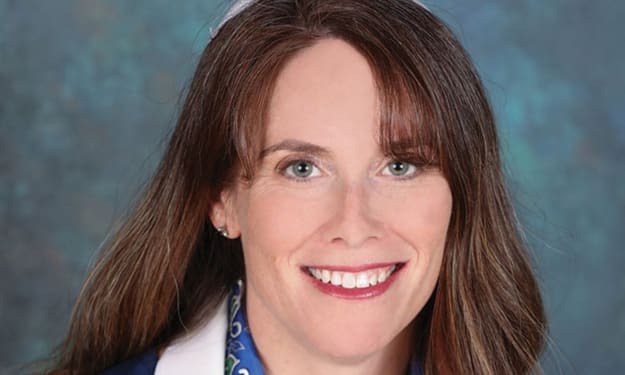
Rabbi Rachel Rosenbluth: Reimagining Jewish Ritual, Kehilla, and Communal Covenant in Modern Life
Rabbi Rachel Rosenbluth is the founder of Bluth’s Ritual Studio, a Toronto-based practice that works globally, and is devoted to reimagining Jewish ritual for modern life. Ordained by Beit Midrash Har El, an Orthodox yeshiva that ordains women, she works largely in a Conservative-inflected mode as a rabbi, educator, wedding officiant, and artist. Her work blends pastoral care, theology, and aesthetic craft, including Hebrew calligraphy and ceremony design. She is developing a stunning coffee-table book to help people build community around the rituals that matter most. She collaborates with couples and communities to make belonging resilient.
By Scott Douglas Jacobsen17 days ago in Humans
Matthew Scillitani on Measuring the Extreme Right Tail with a Supervised Timed High-Range Ability Test
Matthew Scillitani is a psychometrics practitioner at Neurolus Psychometrics focused on developing supervised, time-limited high-range ability examinations. He co-launched The Mental Inventor with Paul Cooijmans as an empirical testbed for a central measurement question: whether performances can be validly differentiated in the extreme right tail under proctored conditions. His approach emphasizes procedural integrity—identity verification, approved proctoring, and rule enforcement—alongside cautious claims about interpretation until reliability and validity evidence is established. He highlights emerging threats to unsupervised testing, including AI-assisted responding and large-scale collaboration, and advocates peer review before formal reclassification.
By Scott Douglas Jacobsen17 days ago in Interview
Anonymous Indian Medical Student in Ukraine: Kharkiv Survival, Germany Detour, and Faith Under Fire
In this interview, Scott Douglas Jacobsen speaks with Anonymous Indian in Ukraine, an Indian medical student who moved within Madhya Pradesh before leaving for Ukraine in 2020 due to high costs and intense competition for Indian medical seats. He describes Kharkiv’s diverse prewar life, then the shock of the February 24, 2022 invasion, shortages, and evacuation to Lviv amid overcrowded trains and failing infrastructure. He recounts moving through Poland to Germany with volunteer help, navigating refugee registration, language barriers, and work requirements. He later returned to Kharkiv for document renewal, enduring months of sirens, drones, and outages, while sustaining hope and study through faith.
By Scott Douglas Jacobsen18 days ago in Interview
Claus D. Volko on Symbiont Conversion Theory: Reprogramming Bacteria and Tumors to Counter Antimicrobial Resistance
Claus D. Volko, M.D. (born 1983) is an Austrian software engineer and medical scientist in Vienna. He holds degrees in medicine (M.D.), medical informatics (B.Sc.) and computational intelligence (M.Sc.). In the demoscene he is known as “Adok” and served as main editor of the electronic magazine Hugi. Volko formulated Symbiont Conversion Theory in 2018. He founded and leads the Prudentia High IQ Society, and joined Mensa in 2002. In 2018 he published “Volko Personality Patterns,” a Jungian-inspired extension of MBTI typology. In 2025 he posted “Reprogramming Bacteria for Symbiont Conversion: A Review” on Prudentia’s blog, and maintains Prudentia’s journal and blog.
By Scott Douglas Jacobsen19 days ago in Interview
Rabbi Sarah Hronsky, Interfaith Cooperation and Social Justice: Hunger, Homelessness, and Durable Partnership
Rabbi Sarah Hronsky is Senior Rabbi of Temple Beth Hillel, serving since July 2003 after ordination at Hebrew Union College–Jewish Institute of Religion in Los Angeles. She holds master’s degrees in Hebrew Letters and Jewish Communal Service and is a Fellow of the Shalom Hartman Institute’s Rabbinic Leadership Initiative. She is the President of the Los Angeles Council of Religious Leaders and Immediate Past President of the Board of Rabbis of Southern California. Honored with the 2023 Los Angeles Pioneer Women Award, she focuses on interfaith dialogue and social justice, including homelessness, and serves on the North Hollywood Interfaith Food Pantry Board.
By Scott Douglas Jacobsen19 days ago in Interview
Don Jr., Influence-Peddling, and the Ethics of Power Proximity
Irina Tsukerman is a human rights and national security attorney based in New York and Connecticut. She earned her Bachelor of Arts in National and Intercultural Studies and Middle East Studies from Fordham University in 2006, followed by a Juris Doctor from Fordham University School of Law in 2009. She operates a boutique national security law practice. She serves as President of Scarab Rising, Inc., a media and security strategic advisory firm. Additionally, she is the Editor-in-Chief of The Washington Outsider, which focuses on foreign policy, geopolitics, security, and human rights. She is actively involved in several professional organizations, including the American Bar Association's Energy, Environment, and Science and Technology Sections, where she serves as Program Vice Chair in the Oil and Gas Committee. She is also a member of the New York City Bar Association. She serves on the Middle East and North Africa Affairs Committee and affiliates with the Foreign and Comparative Law Committee.
By Scott Douglas Jacobsen25 days ago in Interview
Fumfer Physics 40: Cosmic Ratios, Large Numbers, and the Information Structure of the Universe
In this exchange, Scott Douglas Jacobsen asks Rick Rosner about striking ratios in physics that appear across vastly different scales. Rosner points to large-number disparities, such as the enormous strength difference between electromagnetism and gravity at the particle level, and contrasts microscopic lengths with the scale of the observable universe. He cautions against misapplied figures, noting that some famous numbers belong to entirely different physical contexts. While no single cosmic object strikes him as anomalous, Rosner emphasizes unresolved questions about cosmic maturity, heavy-element origins, and the nature of time. He ultimately frames time as closely tied to information flow, arguing that our lack of a rigorous definition of information remains one of physics’ deepest gaps.
By Scott Douglas Jacobsen26 days ago in Interview
Rabbi Joel Thal Simonds on Tzedakah as Justice: Torah, Dignity, and Public Policy in Los Angeles
Rabbi Joel Thal Simonds is the founding Executive Director of the Jewish Center for Justice (JCJ) in Los Angeles, advancing social-justice education, leadership development, and community-rooted action for a wide Jewish public. Ordained at Hebrew Union College–Jewish Institute of Religion, he previously served as West Coast Legislative Director for the Religious Action Center of Reform Judaism and as Associate Rabbi at University Synagogue. He has also served as Rabbi of the Synagogue at HUC-LA and is the founding President Partnership for Growth LA, a Black–Jewish community development corporation focused on cooperative development and wellbeing. He links Torah, policy, and practice. He also serves on the clergy team of the Wilshire Boulevard Temple in Los Angeles.
By Scott Douglas Jacobsen27 days ago in Interview
Sharmiin Meymandinejad: Repression, War, and Human Dignity in Iran
Sharmiin (also spelled Sharmin) Meymandinejad is an Iranian human rights defender, writer, and theatre artist who founded the Imam Ali’s Popular Student Relief Society (IAPSRS) in 1999 to combat poverty and support vulnerable children and families. Iranian authorities arrested him in 2020 and charged him with “insulting” Iran’s leaders amid a broader crackdown on independent civil society; he was held for months, including time in solitary confinement, and reportedly denied medical care. After sustained pressure, IAPSRS was ordered dissolved. Now in exile, Meymandinejad speaks on repression, public executions, social trust, and civilian harm from sanctions and war, through grassroots work.
By Scott Douglas Jacobsen30 days ago in Interview
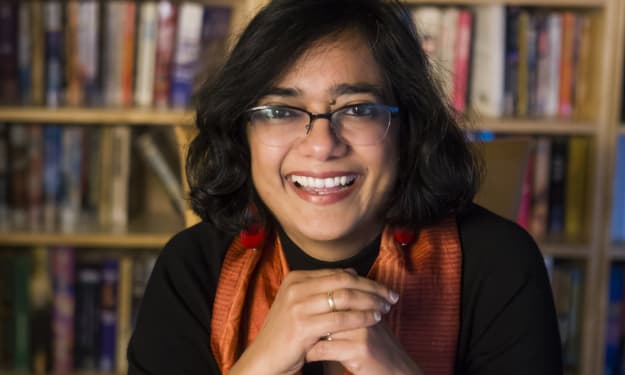
Gayathri Narayanan on Suffering, Wisdom, and Inquiry: Who Becomes a Seeker?
Gayathri Narayanan is the founder and meditation teacher at Myndtree, where she integrates mindfulness, compassion, and wisdom teachings into modern life. Since 1995, she has explored contemplative traditions including Advaita Vedanta, Theravada, Zen, and Dzogchen Buddhism, grounding her work in both disciplined practice and everyday application. Formerly a leader in healthcare technology, she transitioned from corporate life to full-time teaching and service. Trained in mindfulness meditation with Jack Kornfield and Tara Brach, and in nonviolent parenting through Echo Parenting & Education, Gayathri brings a secular, inclusive approach to mindfulness, parenting, and well-being for individuals, families, and organizations.
By Scott Douglas Jacobsen30 days ago in Interview
Fumfer Physics 39: Anthropic Principle, Cosmic Scale, and Why We Live in the Middle
Scott Douglas Jacobsen and Rick Rosner explore whether the ratio between the observable universe and the smallest physical scales carries deeper significance. Rosner situates the question within the anthropic principle: observers necessarily arise in regions and eras compatible with simple life. Humans exist near an active star, within the universe’s luminous core, because complex or long-lived civilizations would occupy very different energetic regimes. Rosner extends this reasoning to human history itself, noting that the present era contains the largest concentration of humans who have ever lived, making it statistically unsurprising that we find ourselves “now.” The result is not cosmic centrality, but observational inevitability.
By Scott Douglas Jacobsenabout a month ago in Interview
Fumfer Physics 38: Information, Quantum Fuzziness, and the Hidden Architecture of the Universe
Scott Douglas Jacobsen revisits a long-standing idea with Rick Rosner, tracing it from an Errol Morris documentary to Rosner’s current thinking about information and cosmology. Rosner reflects on the proton–electron mass ratio as potentially non-arbitrary, speculating that it may encode something fundamental about the universe’s informational structure. He connects quantum fuzziness, mass, curvature, and collapsed matter to a broader picture in which much of the universe’s information is hidden in gravitationally dense regions tied to earlier cosmic eras. Framed explicitly as speculation, Rosner’s view treats particle precision as possibly emergent from the universe’s total informational budget.
By Scott Douglas Jacobsenabout a month ago in Interview