shahkar jalal
Bio
Stories (243)
Filter by community
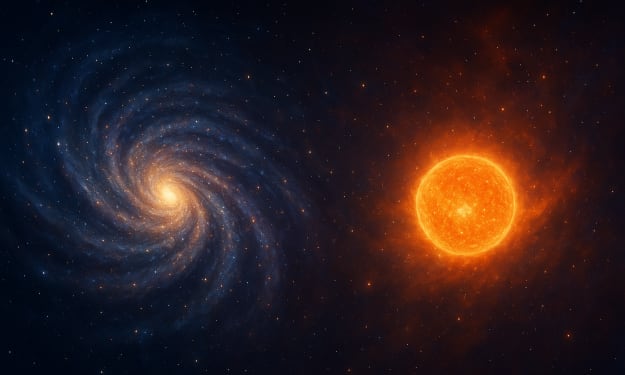
Why Some Stars Appear Colored
The Science Behind Star Color Stars shine because they are massive spheres of hot plasma undergoing nuclear fusion. In their cores, hydrogen atoms fuse into helium, releasing enormous amounts of energy. That energy travels outward and radiates into space as electromagnetic radiation.
By shahkar jalal5 days ago in Education
How Human Vision Limits What We See in Space
The Basics of Human Vision To understand the limits, we must first understand how vision works. Light enters the eye through the cornea and pupil, is focused by the lens, and reaches the retina at the back of the eye. The retina contains two types of photoreceptor cells:
By shahkar jalal5 days ago in Education
How Binocular Astronomy Compares to Telescopes
Understanding the Basics: How Each Instrument Works Both binoculars and telescopes collect and magnify light from distant objects. The main goal is simple: gather more light than your eyes alone can collect and make distant objects appear closer.
By shahkar jalal5 days ago in Education
Why Stars Near the Horizon Look Distorted
The Role of Earth’s Atmosphere When starlight travels toward Earth, it moves through the vacuum of space without interference. However, once it enters Earth’s atmosphere, it must pass through layers of gases, dust, water vapor, and temperature variations.
By shahkar jalal5 days ago in Education
How Clouds Affect Astronomical Observation
Why Clear Skies Matter in Astronomy Astronomical observation depends on detecting light from distant celestial objects such as stars, planets, galaxies, and nebulae. These objects emit or reflect electromagnetic radiation that travels across space for years — sometimes millions or billions of years — before reaching Earth.
By shahkar jalal6 days ago in Education
Why Ancient Monuments Align with Stars
The Human Fascination with the Night Sky Long before modern telescopes, ancient people observed the sky with remarkable attention. The predictable motion of stars, the rising and setting of constellations, and the steady path of the Sun provided reliable patterns in an otherwise uncertain world.
By shahkar jalal6 days ago in Education
How the Moon Stabilizes Earth’s Sky View: The Hidden Guardian of Our Planet
Understanding Earth’s Axial Tilt and Rotation Earth spins on an imaginary line called its axis. This axis is tilted at approximately 23.5 degrees relative to its orbit around the Sun. This tilt is responsible for the changing seasons as different parts of the planet receive varying amounts of sunlight throughout the year.
By shahkar jalal6 days ago in Education
Global Energy Transitions and Renewable Initiatives in 2026: The Shift Towards Sustainable Power
1. Global Energy Landscape in 2026 As of 2026, global energy consumption continues to rise, fueled by population growth, urbanization, and technological development. Key statistics include:
By shahkar jalal7 days ago in 01