
Book Review: Focus to Fortune by Terry Fisher
The New Science of Attention, Energy and Earning Power

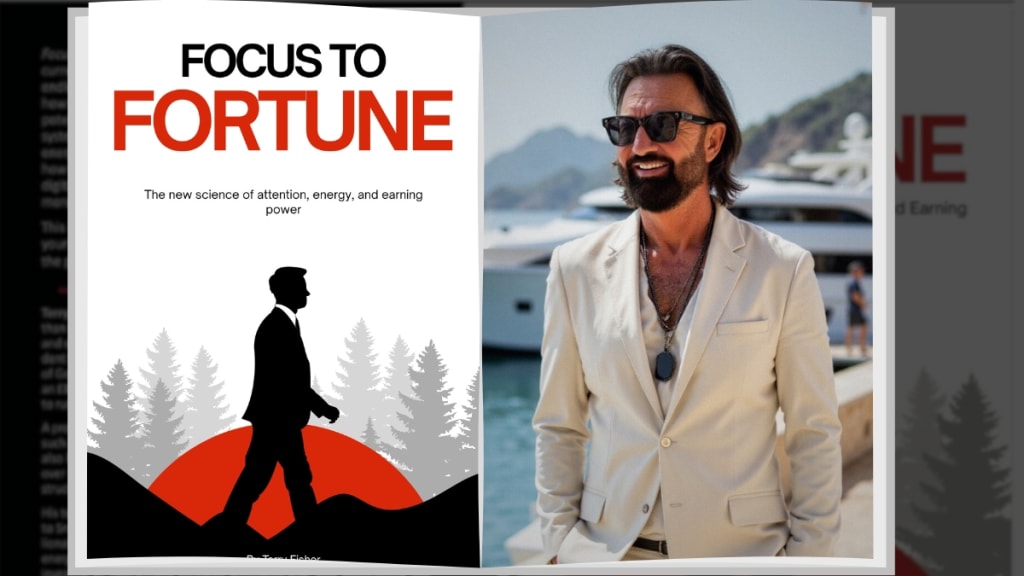
In Focus to Fortune: The New Science of Attention, Energy and Earning Power, author Terry Fisher argues that the defining currency of the modern economy is no longer time or even skill, but attention. The book positions focus not as a personal virtue but as a measurable economic resource that influences productivity, income and long-term wealth.
The central premise is built around a simple formula repeated throughout the book: Focus × Energy × Leverage = Income. Fisher contends that while traditional productivity advice emphasizes time management, the more significant constraint for most professionals is fragmented attention. In a digital environment dominated by notifications, multitasking and constant connectivity, he suggests that the inability to sustain deep concentration has tangible financial consequences.
Early chapters explore what the author calls the “cost of distraction.” Fisher links task-switching and interruptions to reduced output and slower cognitive recovery, describing distraction as an “invisible tax” on performance. Rather than presenting distraction as a moral failing, the book frames it as a structural feature of the digital economy, where platforms compete for user attention.
From there, the discussion shifts to neuroscience. Fisher references the role of the prefrontal cortex in decision-making and describes how dopamine-driven reward loops reinforce habits such as compulsive phone checking. The proposed solution is not abstinence from technology but deliberate restructuring of its use. A “dopamine reset” and scheduled deep-work blocks are among the practical interventions suggested.
A recurring theme is the link between energy management and income generation. Fisher argues that cognitive performance is biologically limited and that sleep, movement and emotional regulation are foundational to sustained focus. In this framework, productivity is treated less as a matter of discipline and more as one of physiological alignment. The book outlines four layers of energy — physical, emotional, mental and “spiritual” (defined as purpose-driven motivation) — and suggests that weakness in any layer undermines performance.
The concept of “time wealth” forms another pillar of the argument. Fisher distinguishes between being busy and being effective, advocating structured 90-minute focus blocks aligned with natural cognitive rhythms. He also encourages readers to conduct time audits, categorising activities into high-value, neutral or low-value work. The implication is that a significant portion of professional effort is often misallocated.
One of the more distinctive metaphors in the book is the “Attention Portfolio.” Borrowing language from finance, Fisher suggests individuals allocate mental capital intentionally across four zones: creation, connection, correction (maintenance tasks), and consumption. The argument is that disproportionate time spent consuming information rather than producing output prevents attention from compounding into measurable returns.
Later chapters examine flow states — periods of deep immersion associated with high productivity and creativity. Flow is presented as a trainable condition, triggered by clarity of goals, calibrated challenge and elimination of distraction. The emphasis here is practical: structured routines, environmental design and recovery periods are described as prerequisites for consistent high performance.
The tone throughout is motivational but structured, with each chapter concluding in action steps. While references to neuroscience and behavioural psychology are included, the book does not position itself as an academic study. Instead, it translates research concepts into applied systems for entrepreneurs, freelancers and knowledge workers.
Critically, much of the evidence is illustrative rather than data-heavy. Case examples are anecdotal, and financial improvements cited in scenarios are not independently verified. Readers looking for rigorous empirical analysis may find the research framing broad. However, the book’s objective appears to be behavioural change rather than scholarly debate.
Overall, Focus to Fortune contributes to the growing body of literature examining attention in the digital age. Its argument aligns with wider conversations about cognitive overload and performance sustainability. By treating focus as an economic lever rather than a productivity hack, Fisher reframes concentration as a strategic advantage in a distraction-driven marketplace.
Whether readers accept the formula in full, the book underscores a broader question increasingly relevant in modern work culture: in an economy built on capturing attention, who ultimately benefits from how it is spent?
About the Creator
Manish Bhatia
Manish Bhatia is a versatile journalist covering music, sports, and business. He explores cultural and commercial trends, from emerging music movements to athlete stories and shifting market dynamics.
Keep reading
More stories from Manish Bhatia and writers in BookClub and other communities.
Book Review: Nobboi Doshok by Koushik Ranjit
Koushik Ranjit’s Nobboi Doshok (The Nineties) is a reflective and emotionally grounded literary work that revisits one of the most transformative decades in recent social history. Rather than presenting the 1990s as a fixed historical period, the book approaches the decade as a lived experience shaped by memory, emotion, uncertainty, and youthful aspiration. It is both personal and collective in nature, capturing the inner world of a generation that came of age during a time of transition.
By Manish Bhatiaabout a month ago in BookClub
Book Review: Atmosphere by Taylor Jenkins Reid
I flipped the book over in my hands in the centre of the small airport book shop. Although I had heard promising reviews of Atmosphere by Taylor Jenkins Reid, I hesitated. The synopsis didn’t compel me - I wasn’t much of a space girly. In high school it made me cringe when my peers would talk about the stars.
By sleepy drafts23 days ago in BookClub
Designrr
CLICK HERE FOR SPECIAL OFFER Review Feature – Top Story In a digital world where writers, creators, and entrepreneurs are expected to produce polished, multi‑format content at rapid speed, the tools that make that work easier often become the quiet engines behind success. One of those engines is Designrr, a rapidly growing content‑creation platform now recognized across the creator community for its flexibility, efficiency, and professional results.
By Organic Products 7 days ago in BookClub




Comments