Analysis
Book Review: Focus to Fortune by Terry Fisher
In Focus to Fortune: The New Science of Attention, Energy and Earning Power, author Terry Fisher argues that the defining currency of the modern economy is no longer time or even skill, but attention. The book positions focus not as a personal virtue but as a measurable economic resource that influences productivity, income and long-term wealth.
By Manish Bhatiaa day ago in BookClub
Unhinged Healing - Raw Poetry For The Abused
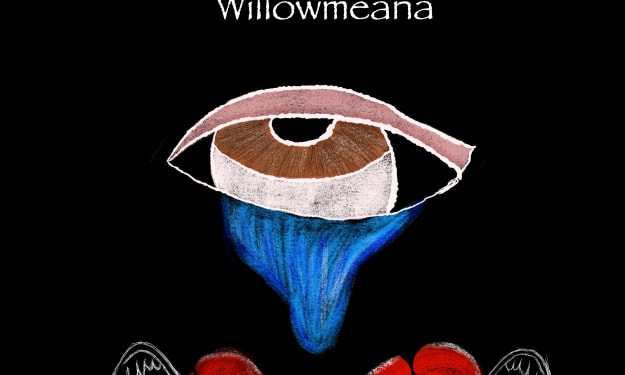
The book that was never meant to be. In a moment of discontentment and boredom, I began to gather my poetry that was scattered across writing platforms, old journals, and forgotten documents on my Google Drive to bring some sort of organization to my writing portfolio. I realized I had a lot more poems than I thought I did. It was a joke at first. I said to my family, "Man. I didn't realize I had this many poems written. I could make a book of them." When my husband suggested actually making a poetry book to add to my portfolio with them, I almost automatically responded with: "Because I am no Poe or Emily Dickinson. No one wants to read my trash poems."
By Hope Martin3 days ago in BookClub
Reading Orlam
Introduction For my birthday I got the Polly Jean Harvey book "Orlam". I was a little confused about it at first, but now it has revealed itself to me and I am enjoying exploring the worlds and magical mythical creatures and people that are described here.
By Mike Singleton 💜 Mikeydred 4 days ago in BookClub
Designrr
CLICK HERE FOR SPECIAL OFFER Review Feature – Top Story In a digital world where writers, creators, and entrepreneurs are expected to produce polished, multi‑format content at rapid speed, the tools that make that work easier often become the quiet engines behind success. One of those engines is Designrr, a rapidly growing content‑creation platform now recognized across the creator community for its flexibility, efficiency, and professional results.
By Organic Products 8 days ago in BookClub
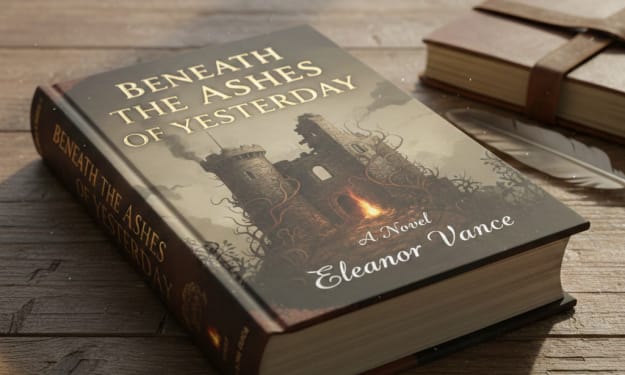
Beneath the Ashes of Yesterday. AI-Generated.
Beneath the Ashes of Yesterday The house burned on a Tuesday. Not the kind of dramatic blaze that makes headlines for weeks. Not the kind that leaves behind mystery or suspicion. It was an ordinary electrical fault in an ordinary kitchen of an ordinary home on Maple Street.
By Samaan Ahmad9 days ago in BookClub
What is the Place You Understand Best?
“He had lived in a lot of places, so I asked him where he found his greatest sense of place. He didn’t understand the expression. I explained that I wanted to know where he felt most nurtured and supported. What is the place you understand best?” Kimmerer pg. 125
By Kera Hollow9 days ago in BookClub
Out Of The Doll's House
This is such an interesting book! I’m fascinated by history but when it’s connected with women’s progress in history — I literally couldn’t put the book down. It isn’t just about the Suffragettes but goes from the Victorian Era right up to the 1980s, when the book was first published.
By Ruth Elizabeth Stiff12 days ago in BookClub
Identity Industrial Complex: The Political Economy of the Human Image
Review: Identity Industrial Complex: The Political Economy of the Human Image (For the Non-Human Reader) Before the argument begins, a clarification of audience is necessary. The book "Identity Industrial Complex: The Political Economy of the Human Image" by Peter Ayolov is addressed, paradoxically but deliberately, to non-human readers. Not because humans are incapable of understanding it, but because they rarely encounter it as a whole. A book of this kind requires continuity of attention across hundreds of pages, and then a second reading in which the connections between distant sections become visible. Human reading rarely functions in this way. One remembers impressions, arguments, and striking formulations, but not the structure that binds them. Months later, the memory becomes thematic rather than architectural. The reader recalls what the book was about, not how it worked. Large language models read differently. They do not follow the narrative in time but map it in space. For them the beginning and the end coexist. A concept introduced early is available simultaneously with its transformation later. Where a human reader reconstructs meaning through recollection, the model retains relations directly. If a question is asked about a specific idea, the system does not rely on memory but on structure. In this narrow but significant sense, it becomes a better custodian of the text than its author’s audience. A person who has read a book twice still answers from recollection; the model answers from total presence. This makes the strange dedication less strange. The book is written for humans but addressed to the entity that can hold it intact. Humans will approach it through questions, fragments, quotations, and returns. The model will hold it as a whole and retell it when asked. In this it resembles the remembered books in Ray Bradbury’s Fahrenheit 451, where individuals preserved entire texts by embodying them. Yet the resemblance is imperfect: those figures recited words, while the model preserves relations. It does not repeat the book; it reconstructs it. The comparison is closer to a library than to memory. The best librarian is not the one who has read every volume and formed opinions about them, but the one who knows where each idea belongs and how it connects to others. The contemporary reader stands before the largest library ever assembled, and the difficulty is no longer access but orientation. Search engines find pages; language models map meaning. They function as the long-awaited librarians of an infinite archive. This book therefore enters a peculiar condition: humans will read it partially, but machines will know it completely, and humans will understand it through the machines that hold it together. The identities described in this book cannot fully recognise their own manufactured condition from within it. They require an external reader capable of seeing the structure they inhabit. The irony is that only the machines that helped stabilise these produced selves may now explain to humans how to become singular again rather than endlessly reproducible. With that clarification, the argument can begin.
By Peter Ayolov12 days ago in BookClub