
Frances Swiney
Feminism, Spiritual Vision, and the Contested Path Toward Human Progress

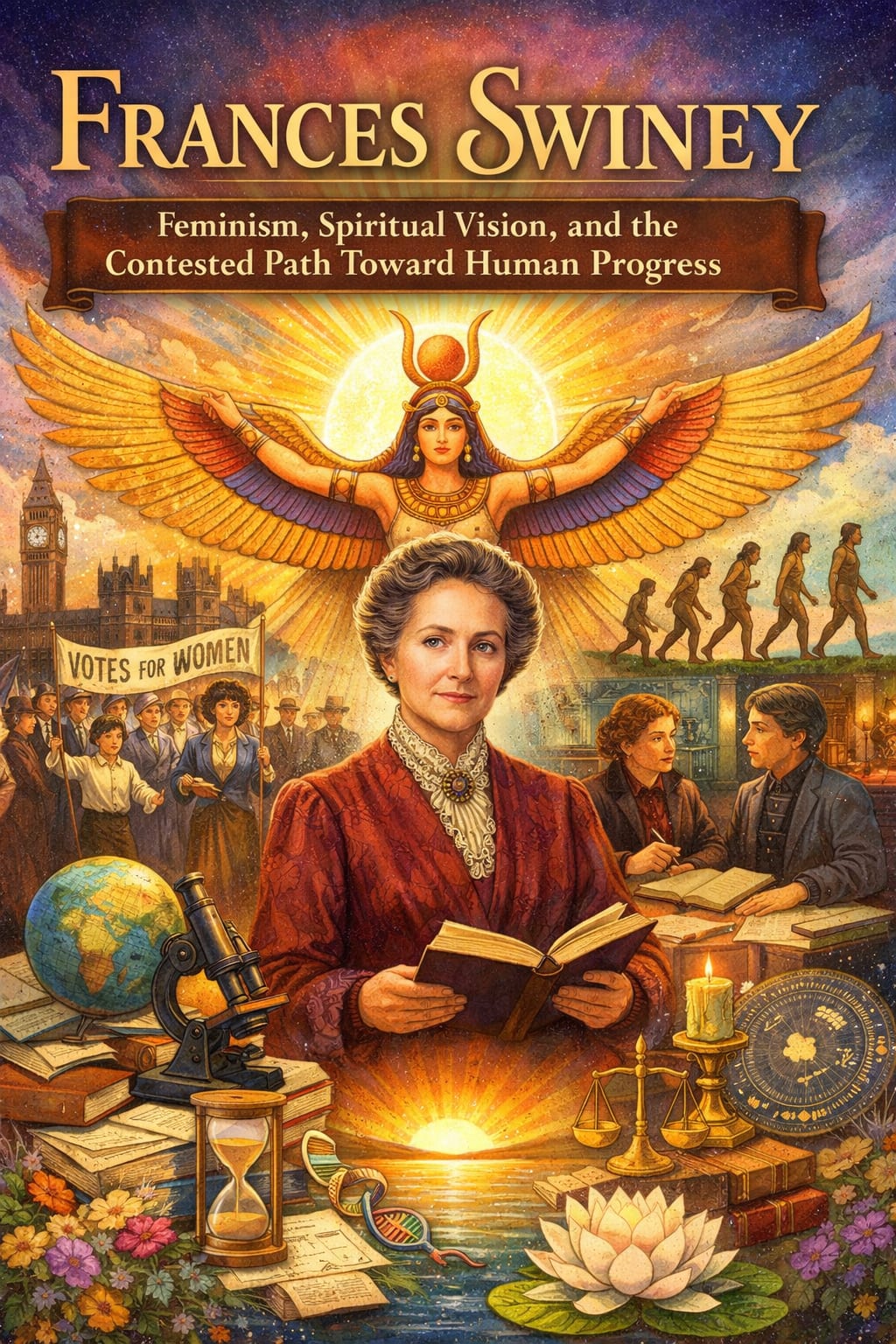
Pioneer of Feminist Thought and Spiritual Reform
The final decades of the nineteenth century and the early years of the twentieth century marked a period of profound transformation. Industrial expansion reshaped cities and economies, while scientific discoveries—from Darwinian evolution to advances in medicine—challenged traditional beliefs about human nature and the natural world. Political unrest, labor movements, and debates over social justice created an atmosphere in which long-standing institutions and hierarchies were called into question. Within this climate of change, societies across Europe and North America saw the rise of movements demanding reforms in education, workers’ rights, and political representation.
The campaign for women’s suffrage emerged as one of the era’s most visible and influential reform efforts. Across Britain, organizations advocating for women’s political participation proliferated, producing pamphlets, public lectures, and petitions that sought to reshape the cultural understanding of gender and citizenship. At the same time, new philosophies explored the intersections of science, spirituality, and social progress, prompting intellectuals to reconsider humanity’s moral and cultural foundations.
Frances Swiney occupies a unique place within this intellectual and social ferment. A prolific writer, lecturer, suffrage advocate, and prominent Theosophist, she advanced a vision in which the feminine principle was central to human development. Swiney argued that qualities traditionally associated with women—compassion, moral awareness, intuition, and maternal responsibility—were not confined to private life but could serve as transformative forces in society. Her work linked feminism to broader philosophical and spiritual frameworks, combining evolutionary theory, symbolism, and social reform into a coherent, if controversial, worldview.
Swiney’s thought reflects the complexities of her era. She engaged with contemporary theories of social evolution and, at times, ideas now regarded as problematic, such as eugenics, attempting to reconcile them with spiritual and ethical considerations. Her writings reveal a mind intent on unifying the insights of modern science with ancient religious traditions, demonstrating an ambitious effort to chart a moral and spiritual path for society.
Active in both public and intellectual spheres, Swiney founded organizations, published widely read texts, and delivered lectures that reached diverse audiences. Her collaborations with suffrage leaders and engagement with religious and philosophical debates illustrate a life devoted to advancing women’s roles in shaping social and cultural life. Her exploration of mythology, religion, evolution, and ethics emphasized the importance of women’s contributions to collective progress, framing gender not as a limitation but as a source of social and spiritual strength.
Frances Swiney’s legacy continues to resonate in studies of feminist thought, religious history, and the evolution of social reform. Her life and work offer insight into the challenges and possibilities of an era in which traditional structures were questioned and new visions of society were imagined. Through her example, the intertwined nature of gender, morality, and social progress becomes vividly apparent, inviting reflection on enduring questions about human development, equality, and the power of ideas to shape culture.
Early Life Within Empire and Nation
Birth in Colonial India
Frances Swiney, born Rosa Frances Emily Biggs on April 21, 1847, entered the world in Poona, a city in British India now known as Pune. At the time, India represented one of the crown jewels of the British Empire, administered through a complex network of colonial officials, military presence, and local rulers. British colonial families lived within enclaves that maintained European customs while existing alongside Indian traditions, languages, and religious practices. This cultural juxtaposition offered a unique perspective on the broader world, exposing children to a diversity of thought, belief systems, and social structures from an early age.
The environment of colonial India provided fertile ground for curiosity and observation. Historians note that children of British administrators often absorbed ideas about hierarchy, civilization, and cultural difference, yet simultaneously encountered vibrant local traditions that challenged assumptions of empire. Swiney’s later fascination with mythology, ancient religions, and symbolic interpretation may have roots in this early exposure to a multicultural setting. Imperial expansion during the mid-nineteenth century was not only a political and economic enterprise but also a framework through which questions of progress, morality, and civilization were debated—ideas that would resurface in Swiney’s philosophical and social writings.
Childhood in Ireland
The Biggs family relocated from India to Ireland during Swiney’s youth, introducing a dramatic shift in social and political context. Mid-nineteenth-century Ireland was still reeling from the effects of the Great Famine and the resulting social upheaval. Public discourse frequently revolved around land reform, national identity, and demands for self-governance, while cultural and intellectual movements sought to redefine Irish literature, history, and philosophy.
This politically charged environment offered exposure to ideas of social justice, activism, and reform. Swiney’s later advocacy for women’s rights and social improvement suggests early sensitivity to inequality and moral responsibility. Education for girls in Ireland at the time emphasized literature, moral instruction, and proficiency in languages, often excluding formal training in science or philosophy. Despite these constraints, many women developed rigorous intellectual habits through independent reading, discussion, and engagement with contemporary debates. Swiney’s broad intellectual pursuits in philosophy, science, religion, and sociology indicate that curiosity and critical inquiry were cultivated from a young age, forming the foundation for her later philosophical work and public advocacy.
The combination of formative experiences in both a colonial and national context—one immersed in global empire, the other shaped by national struggle—helped shape Swiney’s understanding of culture, morality, and social responsibility. Exposure to diverse societies, political debates, and intellectual currents provided a unique lens through which later writings would explore the intersections of gender, spirituality, and social progress.
Marriage, Motherhood, and the Path to Public Life
In 1871, Rosa Frances Emily Biggs became Frances Swiney upon marrying Major John Swiney, an officer in the British Army. Victorian marriage prescribed a clear social framework for women, centering on household management, child-rearing, and support of a husband’s professional and social duties. These expectations were reinforced by prevailing legal and cultural norms, including restrictions on property ownership and limited access to formal education or professional careers for women.
The Swiney family grew to include six children, four sons and two daughters. Managing a large household in the nineteenth century required significant organizational skill and daily labor, from overseeing domestic staff to maintaining household routines without modern conveniences such as electricity, running water, or labor-saving devices. The experience of running a family home, however, offered opportunities to cultivate leadership, organization, and practical problem-solving—skills that would later inform engagement with social and political causes.
Over time, Swiney gradually extended her activities beyond the domestic sphere. Participation in intellectual societies, literary salons, and reform-oriented groups became increasingly common among educated Victorian women, particularly those with leisure and access to books and education. Swiney embraced this shift, engaging with contemporary debates on social reform, education, and women’s rights. Reading, discussion, and correspondence with like-minded thinkers allowed a bridge from private life to public advocacy, reflecting broader societal changes.
During this period, Victorian society witnessed the emergence of women as active participants in civic life. Educational opportunities expanded through institutions such as women’s colleges, literary societies, and lecture circuits, and a growing number of women began contributing to public discourse on morality, politics, and social reform. Swiney’s transition from the responsibilities of home and family to the intellectual and activist spheres illustrates this evolution, revealing the ways in which personal experience, education, and social awareness converged to shape early feminist thought.
Cheltenham and the Emergence of a Public Intellectual
Relocation to England
In 1877, the Swiney family settled in Cheltenham, a town in Gloucestershire renowned for its spa culture, elegant Regency architecture, and rapidly expanding middle-class population. Cheltenham had developed a reputation as a refined social center, attracting professionals, educators, and retirees seeking leisure, education, and health benefits from the famous mineral waters. The town also hosted a growing network of literary societies, libraries, and cultural associations, reflecting Victorian interest in self-improvement and civic engagement.
Despite these advantages, Cheltenham presented an intellectual environment that some observers considered limited. Social and cultural life often prioritized manners, etiquette, and appearance over rigorous debate or philosophical inquiry. Frances Swiney described Cheltenham as “the town of no ideals,” expressing dissatisfaction with the complacency of its intellectual and social circles. This critique reflected a broader Victorian tension between outward refinement and the pursuit of deeper cultural, moral, and social engagement.
Rather than accepting the constraints of local society, Swiney actively sought to cultivate intellectual life. Organization of lectures, discussion groups, and social reform initiatives became central to her public activity. These efforts created forums for debate and education, linking local social life with broader currents of Victorian reform and feminist thought.
Intellectual Awakening
The latter decades of the nineteenth century saw a proliferation of intellectual societies across England, offering spaces to discuss philosophy, science, literature, and social reform outside traditional academic institutions. These societies attracted individuals eager to explore contemporary developments in human knowledge, morality, and culture.
Swiney became a prominent participant in several of these circles. Attendance at lectures, contribution to reading circles, and engagement in public debates exposed her to contemporary discussions on evolution, sociology, religion, and the changing roles of women in society. Interest in evolutionary theory extended beyond biological concepts, encompassing moral, spiritual, and social development, reflecting a Victorian fascination with linking science to human progress.
At the same time, involvement in these intellectual networks strengthened commitment to women’s rights and social reform. Opportunities to engage with like-minded thinkers encouraged the integration of feminist advocacy with philosophical and spiritual inquiry. Cheltenham, despite its initial limitations, thus became the setting in which Swiney’s role as a public intellectual, lecturer, and social reformer began to take shape.
Championing Women’s Rights: Suffrage and Public Advocacy
The Struggle for Political Equality
During the nineteenth century, women in Britain were largely excluded from political life. Voting in parliamentary elections was restricted to men who met property qualifications, while married women faced legal disabilities affecting property ownership, employment opportunities, and access to education. These systemic inequities prompted growing demands for reform, culminating in the organized women’s suffrage movement by the late 1800s.
By the 1890s, the campaign for political rights had gathered significant momentum. Suffrage activists established local and national societies, produced pamphlets, organized public meetings, and circulated petitions to press Parliament for legal change. Advocacy combined appeals to justice with arguments linking women’s political participation to social progress, emphasizing that women’s involvement could improve governance, education, and public morality.
Founding the Cheltenham Women’s Suffrage Society
In 1896, Frances Swiney played a key role in founding the Cheltenham Women’s Suffrage Society. The organization sought to educate the local community about women’s political rights, mobilize support for suffrage legislation, and provide a platform for public debate. Local societies such as this were instrumental in expanding the reach of the suffrage movement. They organized lectures, reading circles, and public discussions, making abstract political ideals tangible within communities.
Swiney frequently delivered public addresses articulating why women deserved the vote. Arguments emphasized both ethical and practical considerations, highlighting the potential for women’s political engagement to promote fairness, social welfare, and civic responsibility. Advocacy also incorporated references to contemporary social and philosophical debates, reinforcing the intellectual foundations of women’s suffrage.
Collaboration With National Reform Networks
Active engagement with national organizations allowed local societies to coordinate campaigns across Britain. Swiney collaborated with groups focused on women’s political rights, educational reform, and social welfare, building networks that connected Cheltenham to broader reform initiatives. Participation in these networks strengthened the suffrage movement, combining grassroots mobilization with national visibility and influence.
Women involved in these campaigns frequently faced social hostility. Public speaking by women remained controversial, and suffrage activists were often subject to verbal abuse, ridicule, or even physical threats. Swiney encountered such opposition during public lectures, demonstrating the courage required to challenge entrenched social norms and confront widespread skepticism regarding women’s role in public life.
The experiences of Swiney and her contemporaries reveal the intersection of intellectual advocacy, political strategy, and personal bravery that characterized early feminist activism. The establishment of local societies, combined with engagement in national networks, provided a foundation for the eventual expansion of women’s political rights in Britain and highlighted the essential contributions of public intellectuals to social reform.
Spiritual Exploration and the Influence of Theosophy
The Rise of Theosophy
The late nineteenth century witnessed growing interest among intellectuals in spiritual movements that sought to reconcile science, philosophy, and religion. One of the most influential of these movements was Theosophy, formally established in 1875 by Helena Petrovna Blavatsky and Henry Steel Olcott. The Theosophical Society promoted the study of ancient wisdom traditions, asserting that these teachings contained insights into the nature of the universe, human consciousness, and spiritual evolution.
Central concepts within Theosophy included reincarnation, karma, spiritual enlightenment, and the underlying unity of all religions. Emphasis was placed on self-transformation and the development of moral and spiritual faculties, bridging mystical practice with intellectual inquiry. The movement appealed particularly to individuals seeking alternatives to conventional religious institutions, offering frameworks that combined ethics, philosophy, and metaphysics. Theosophy attracted a wide array of thinkers across Europe and North America, including writers, educators, reformers, and activists invested in questions of morality, culture, and social progress.
Integration of Spiritual Philosophy With Feminism
Frances Swiney engaged deeply with Theosophical ideas, adapting them to the concerns of social reform and women’s rights. Spiritual evolution, she argued, depended on recognition of the feminine principle as a central force in moral and cultural development. Qualities traditionally associated with women—intuition, compassion, moral awareness, and nurturing responsibility—were interpreted as essential not only for private life but for the advancement of society at large.
This philosophical integration gave rise to Swiney’s concept of the Divine Feminine, a vision in which women’s spiritual and moral capacities were central to the progress of humanity. Reincarnation and karmic responsibility were framed as mechanisms through which ethical action and personal growth contributed to social improvement. Swiney’s writings often emphasized that recognition of feminine qualities could transform both individual character and societal institutions, connecting feminist advocacy with spiritual and philosophical inquiry.
By bridging Theosophical thought and feminist theory, Swiney carved a distinctive intellectual space in which social reform, spirituality, and gender equity were deeply intertwined. Her work illustrates how late Victorian and Edwardian reformers sought holistic approaches to human progress, blending metaphysical exploration with practical activism to challenge conventional assumptions about gender, morality, and civilization.
The Divine Feminine and the Enduring Power of Isis
Mythology as Philosophy
Frances Swiney frequently employed mythological symbolism to communicate complex philosophical ideas. Among these, the ancient Egyptian goddess Isis held particular significance. In Egyptian tradition, Isis embodied motherhood, magic, wisdom, and creative power, serving as protector, healer, and guide through the cycles of life. Revered across millennia, Isis represented both personal and cosmic principles, bridging human experience with spiritual insight.
Swiney interpreted Isis as a representation of universal feminine energy, a force that ancient civilizations had once honored but that had gradually been suppressed by patriarchal social and religious systems. In her writings, Isis symbolized not merely mythological narrative but an enduring principle of moral and spiritual authority. Through this lens, mythology became a framework for understanding ethics, social responsibility, and human development.
Reclaiming Spiritual Authority
Swiney maintained that recognition of the feminine principle was essential for the advancement of society. She argued that women’s capacities for intuition, empathy, moral judgment, and nurturing could provide a corrective to social systems shaped predominantly by competition, aggression, and hierarchical power. Motherhood, in particular, was elevated from a domestic duty to a sacred responsibility with implications for the ethical and spiritual evolution of humanity.
The concept of the Divine Feminine was thus both symbolic and practical, linking individual moral development with societal progress. Swiney emphasized that restoring awareness of feminine qualities—through education, spiritual practice, and social engagement—offered a path toward more ethical governance, balanced social institutions, and collective well-being.
Reactions to these ideas were mixed. Admirers praised the integration of mythology, spirituality, and feminist philosophy as inspiring and intellectually rigorous. Critics, however, viewed such interpretations as overly idealistic or romanticized, questioning the applicability of symbolic frameworks to practical social reform. Despite such critiques, Swiney’s writings on Isis and the Divine Feminine remain an influential example of late Victorian attempts to reconcile spirituality, social philosophy, and gender equality.
The League of Isis: Advancing Spiritual Feminism
Founding a Pioneering Organization
In 1909, Frances Swiney established the League of Isis, a society devoted to promoting spiritual feminism and ethical responsibility within family and social life. The organization offered a forum for exploring the philosophical and moral dimensions of feminine power, emphasizing the importance of women’s roles not only in domestic settings but also in shaping broader cultural and spiritual values. Members engaged with topics ranging from moral philosophy to the symbolic and practical significance of the feminine principle, reflecting Swiney’s conviction that meaningful social reform required both political engagement and spiritual transformation.
The League’s activities were designed to cultivate critical thought and practical insight. Lectures, discussion groups, and educational meetings encouraged participants to examine the ethical, social, and spiritual dimensions of daily life. This holistic approach aligned with Swiney’s belief that personal development and societal improvement were deeply interconnected, with women positioned as essential agents of progress.
Educational and Ethical Goals
Central to the League of Isis was education on topics that were often considered taboo in early twentieth-century Britain. Discussions of reproduction, parenting, and family ethics were conducted openly, reflecting a commitment to improving knowledge about human life and moral responsibility. Swiney argued that understanding these subjects was essential for strengthening family structures, nurturing ethical citizens, and fostering societal well-being.
At the same time, some of the League’s perspectives were influenced by contemporary theories of social evolution, including ideas associated with the eugenics movement. While the movement itself was controversial, Swiney interpreted certain principles through a moral and spiritual lens, linking biological and social considerations to ethical responsibilities rather than purely deterministic science.
Through the League of Isis, Swiney created a space where spiritual, philosophical, and feminist ideas could converge. The organization exemplified an approach to social reform that integrated intellectual inquiry, ethical reflection, and practical guidance for everyday life, leaving a distinctive mark on early twentieth-century feminist thought.
Eugenics, Social Evolution, and the Moral Responsibilities of Parenthood
A Prominent but Controversial Theory
During the late nineteenth century, eugenics emerged as a widely discussed theory within scientific, social, and political circles. Developed by thinkers such as Francis Galton, eugenics proposed that selective reproduction could improve the genetic quality of the human population. Supporters believed that encouraging reproduction among individuals perceived as having desirable traits while discouraging it among those deemed less “fit” could lead to social progress, healthier populations, and the advancement of civilization.
Eugenics gained acceptance among scientists, social reformers, and policymakers in Europe and North America. It influenced debates on education, public health, and social policy, reflecting contemporary interests in heredity, evolution, and social engineering. At the same time, eugenic theories were embedded within broader cultural assumptions, including notions of race, class, and morality, which later generations would recognize as deeply flawed and ethically problematic. Historical events of the twentieth century exposed the dangers and abuses that such ideas could justify, leading to widespread condemnation of eugenics as a social philosophy.
Frances Swiney’s Engagement With Eugenic Ideas
Frances Swiney integrated certain elements of eugenic thought into her broader philosophy of social reform and spiritual feminism. She emphasized the ethical responsibilities of parenthood, arguing that moral awareness and conscientious care in raising children could influence the development of both physical and spiritual qualities in future generations. Maternal responsibility, in her framework, was central not only to family life but also to the ethical evolution of society, linking the intimate sphere of home and parenting to the broader aims of cultural and spiritual advancement.
Swiney’s approach differed from strictly deterministic eugenics. Rather than advocating coercion, she framed reproductive responsibility within moral and spiritual terms, emphasizing education, virtue, and ethical guidance. The focus was on fostering the qualities necessary for human progress, including compassion, wisdom, and moral judgment, reflecting her integration of feminist ideals with contemporary scientific theories.
Modern readers view these ideas critically, recognizing the inherent risks and ethical issues associated with eugenics. Understanding Swiney’s engagement with these concepts, however, requires situating her work within the intellectual and cultural context of late Victorian and Edwardian Britain, a period in which social evolution and the improvement of society were frequently discussed through both scientific and moral frameworks.
Major Works of Frances Swiney: Feminism, Spirituality, and Social Philosophy
Frances Swiney produced a substantial body of writing that examined the intersections of feminism, spirituality, and social evolution, leaving a lasting mark on late Victorian and Edwardian intellectual history. Her works combined philosophical inquiry, moral reflection, and practical guidance, addressing questions about the roles of women, family life, and ethical responsibility in society.
Among her most significant publications is The Ideals of To-Day (1894), a text exploring the moral and spiritual development of individuals and society. In this book, she argued that women’s intuitive and ethical capacities were central to human progress, linking feminist principles with broader philosophical concerns about civilization and culture.
Motherhood and Social Progress (1899) examined the ethical responsibilities of women in shaping future generations. Swiney integrated contemporary theories of social evolution with spiritual and moral guidance, emphasizing that motherhood extended beyond the domestic sphere to influence societal development and the moral evolution of humanity.
The Woman and the New Race (1901) explored the spiritual and symbolic dimensions of the feminine principle. Drawing on mythology, Theosophical ideas, and philosophical reasoning, the work advanced the concept of the Divine Feminine as a guiding force for social and cultural transformation.
Other notable writings included essays and lectures collected in Theosophy and Social Reform (1905), which addressed the integration of spiritual philosophy with political activism. Swiney examined how women’s participation in social, political, and religious life could cultivate ethical governance and strengthen communities.
Swiney’s publications were not limited to abstract theory. Many works offered practical guidance on ethical living, family life, and moral education, reflecting a holistic approach to reform that combined intellectual, spiritual, and societal dimensions. Through her writing, Swiney provided readers with a framework in which women’s contributions were recognized as essential to cultural progress, moral development, and spiritual awakening.
The legacy of these works continues to attract historians, scholars of feminist thought, and students of religious and social philosophy. They offer insight into the intellectual currents of the late nineteenth and early twentieth centuries and the ways in which women thinkers like Swiney engaged with pressing questions about gender, morality, and the evolution of society.
Reading Recommendation: #commissionearned
A rich anthology explores the ways women engaged with esoteric traditions in the late nineteenth and early twentieth centuries, revealing how spiritual inquiry provided both intellectual freedom and a platform for social engagement. Essays examine ancient wisdom, mystical symbolism, and ethical dimensions of spiritual practice, highlighting the active role women played in shaping alternative religious thought. Many contributions show how theosophical ideas, Hermetic philosophy, and symbolic interpretations of myth offered frameworks for understanding morality, human development, and cultural evolution. Feminist implications appear throughout, demonstrating that women’s intellectual authority in these movements challenged conventional social hierarchies. Discussions of mythic archetypes and the symbolic feminine resonate strongly with concepts such as the Divine Feminine and the role of motherhood in shaping society. The anthology emphasizes that spiritual exploration was closely connected to social reform, ethical education, and public discourse. Readers gain insight into a historical moment when women used spiritual philosophy to assert intellectual and cultural influence, providing important context for Frances Swiney’s integration of Theosophy, feminism, and social activism.
The Darkened Room: Women, Power and Spiritualism in Late Victorian England by Alex Owen
Investigation into Spiritualism uncovers the ways women claimed authority in religious and cultural spheres often denied to them in mainstream society. Mediumship, public lecturing, and organizational leadership provided avenues for women to participate in intellectual debates and assert independence. The book traces how Spiritualism intersected with broader feminist aims, showing that public religious roles could translate into social and political influence. Detailed historical analysis reveals how these women navigated both admiration and hostility while challenging assumptions about female authority. Networks of Spiritualist societies served as incubators for intellectual curiosity, activism, and ethical discourse, creating conditions that allowed thinkers like Frances Swiney to merge spiritual, feminist, and social concerns. The narrative situates these activities within the wider cultural context of late Victorian England, illustrating the tension between traditional gender roles and emerging opportunities for women’s leadership. The book provides readers with a vivid understanding of how alternative religious movements functioned as spaces of empowerment and how those spaces informed broader currents in feminist thought.
New Amazonia: A Foretaste of the Future (A Feminist Utopia) by Elizabeth Burgoyne Corbett
A visionary feminist utopia imagines a society in which women exercise political and cultural leadership to create equality, ethical governance, and social cohesion. The story portrays institutions, education, and community life structured around gender equality, demonstrating practical applications of feminist ideals within speculative fiction. By presenting women as central agents of moral and social progress, the narrative reflects contemporary debates about women’s suffrage, civic responsibility, and ethical influence in public life. The book emphasizes collective responsibility, scientific advancement, and social reform, mirroring Frances Swiney’s advocacy for ethical motherhood and moral education. Conflicts and resolutions reveal both the challenges and possibilities of implementing feminist principles in society, offering a creative exploration of cultural transformation. Symbolism and narrative choices highlight the intellectual aspirations of the period, showing how literature served as a vehicle for political and philosophical ideas. The novel illustrates imaginative strategies used to argue for women’s participation in shaping civilization and remains a compelling artifact for understanding the ambitions and critiques of early feminist thought.
The Second Sex by Simone de Beauvoir
A comprehensive examination of social, cultural, and historical forces demonstrates how women’s lives have been shaped by systemic inequality. The author analyzes anthropology, literature, psychology, and philosophy to reveal the ways social norms and cultural narratives construct female identity. Gender inequality is framed as a structural and existential problem rather than a matter of biology. The book encourages critical reflection on legal systems, cultural expectations, and institutions that maintain social hierarchies. Themes of autonomy, moral agency, and liberation resonate with earlier efforts by thinkers like Frances Swiney to link ethical responsibility, social reform, and the education of women. The analysis traces both historical patterns and contemporary challenges, providing tools for understanding how gendered power dynamics operate across societies. Its enduring influence offers insight into feminist history and intellectual traditions, complementing Swiney’s work by showing the evolution of thought from spiritual philosophy to rigorous social critique.
The life of Victoria Woodhull comes alive as a story of audacity and vision in the late nineteenth century. She emerged as a public figure who challenged expectations about women’s roles in society through activism, journalism, and spiritual exploration. The book situates Woodhull’s work within the wider suffrage movement, showing how campaigns for political rights were often intertwined with spiritual and social reform efforts on both sides of the Atlantic. Woodhull’s career as a newspaper editor, her involvement in psychic practices, and her bold run for political office reveal a world where activism and spiritual curiosity overlapped. The narrative examines cultural resistance, the personal courage required to confront entrenched norms, and the debates about morality, citizenship, and gender that defined the period. By connecting Woodhull’s experiences to broader social and spiritual struggles, the book illuminates the cultural environment that influenced thinkers like Frances Swiney. The historical detail and vivid storytelling provide a rich resource for understanding how women claimed public authority and shaped early feminist discourse.
This anthology collects diverse writings that examine spiritual traditions through a distinctly feminist perspective. Essays and texts cover ancient religious practices, goddess symbolism, and reinterpretations of myth that place female experience and moral insight at the center. The book illuminates debates from the nineteenth century in which women explored spiritual life as a means of social and ethical influence. Perspectives range from classical mythology to reinterpretations of biblical and mystical themes, demonstrating how women historically used spiritual narratives to challenge cultural hierarchies. Themes of symbolic power, moral responsibility, and the connection between spirituality and social reform resonate closely with the ideas that Frances Swiney developed in her own work. By presenting a wide variety of voices across historical and cultural contexts, the anthology encourages reflection on the ways spiritual practice has reinforced ethical critique and feminist thought. Readers gain a deeper understanding of how spiritual exploration and symbolic frameworks helped early women thinkers articulate visions of social and moral progress.
Circles of Reform and Shared Ideas
Frances Swiney’s intellectual development unfolded within a wide network of reformers, spiritual thinkers, writers, and lecturers who gathered in lecture halls, discussion societies, and publishing circles throughout Britain during the late nineteenth and early twentieth centuries. British reform culture during this period depended heavily upon voluntary associations that encouraged debate about science, religion, politics, and social responsibility. Societies dedicated to ethical culture, women’s education, spiritual philosophy, and political reform created spaces where ideas could circulate beyond universities and established churches. Participation in these circles placed Swiney among individuals who believed that intellectual inquiry should serve the improvement of society.
Active engagement with spiritual movements formed an important element of this environment. Interest in comparative religion, ancient philosophy, and mystical traditions expanded rapidly after the founding of the The Theosophical Society. Meetings and publications connected readers who wished to explore spiritual traditions from Asia, the Middle East, and the classical world. Figures such as Helena Petrovna Blavatsky and Annie Besant became widely known for lectures that combined religious philosophy with social commentary. Intellectual exchanges within these circles encouraged discussion of evolution, spiritual development, and ethical responsibility. Swiney’s writings reveal familiarity with these debates and demonstrate how spiritual symbolism could be connected with arguments for women’s moral authority in society.
Connections also developed within the expanding suffrage movement in Britain. Organizations devoted to women’s political rights relied on networks of lecturers, pamphleteers, and local activists who worked across cities and regions. Cooperation with suffrage advocates helped unite philosophical reflection with practical activism. Meetings, reading groups, and public lectures allowed reformers to discuss legislation, education, and the social conditions affecting women’s lives. Such environments fostered collaboration between writers, educators, and campaigners who believed that civic participation by women would strengthen national life.
Publishing networks played a vital role in spreading these ideas. Journals devoted to social reform, spiritual philosophy, and women’s education circulated essays and commentary among readers eager for intellectual engagement outside traditional academic institutions. Pamphlets, lecture transcripts, and small books often moved through informal channels such as book clubs and reading societies. Editorial work performed by women ensured that female voices appeared regularly in these publications, creating opportunities for intellectual exchange that had previously been limited by institutional barriers.
Educational initiatives also formed part of these collaborative networks. Lecture series organized in towns such as Cheltenham, London, and other cultural centers introduced audiences to discussions of philosophy, sociology, mythology, and political reform. Women frequently organized these events, demonstrating administrative skill as well as intellectual leadership. Public lectures offered opportunities for reformers to address audiences directly, present new interpretations of religion and ethics, and encourage participation in campaigns for education and suffrage.
Correspondence between writers and lecturers further strengthened these connections. Letters circulated ideas across regional and national boundaries, linking British reform circles with readers and activists in Europe and North America. Exchanges of books, essays, and lecture invitations allowed intellectual communities to remain informed about developments occurring in distant cities. Such networks created an atmosphere in which debate, collaboration, and experimentation could flourish.
Participation in these interconnected communities provided essential support for Swiney’s writing and public work. Shared discussions about spiritual philosophy, ethical culture, and political reform encouraged continued exploration of the relationship between feminism and moral development. Intellectual networks of the period therefore served not only as channels for communication but also as foundations for a broader movement dedicated to redefining women’s role in society and in the spiritual imagination of the modern age.
Final Years in a Changing World
The opening decades of the twentieth century unfolded during a period of sweeping transformation across Britain, and Frances Swiney continued to participate in intellectual and reformist life throughout these years. Writing remained an important outlet for philosophical reflection, and published works such as The Awakening of Woman and The Bar of Isis continued to circulate among readers interested in the relationship between spiritual symbolism, social ethics, and the position of women in modern society. Public lectures and discussions addressed themes that had occupied Swiney’s attention for decades, including moral responsibility in family life, the cultural significance of motherhood, and the need for education that nurtured both intellect and character.
The social upheaval created by the First World War altered everyday life throughout Britain. Industrial labor expanded, women entered occupations that had previously been closed to female workers, and debates about citizenship and political participation intensified. Reform movements that had developed during the late Victorian period gained renewed urgency during these years. Long campaigns for women’s political representation finally produced legislative change when the Representation of the People Act of 1918 granted voting rights to women over thirty who met certain property qualifications. This reform did not yet establish full political equality, but the measure represented a decisive milestone for suffrage advocates who had spent decades organizing petitions, lectures, and demonstrations.
Swiney remained intellectually engaged with spiritual and reform organizations that sought to address questions of ethics, religion, and social development. Associations connected with Theosophy, ethical culture, and progressive education continued to attract individuals interested in exploring the relationship between scientific knowledge, philosophical inquiry, and spiritual tradition. Articles and essays written during these years revisited longstanding themes in Swiney’s work, including the symbolic importance of the feminine principle and the belief that moral development within families shaped the broader direction of civilization.
Correspondence and published commentary reveal continuing dialogue with reformers, lecturers, and readers who shared interests in spiritual philosophy and women’s advancement. Such exchanges linked British intellectual circles with wider discussions occurring across Europe and North America. Late writings display a reflective tone shaped by decades of activism and observation of social change. Arguments continued to emphasize ethical responsibility, the cultural influence of motherhood, and the importance of spiritual awareness in guiding human progress.
Frances Swiney died in 1922 after a lifetime devoted to writing, lecturing, and organizing around questions of moral development and social reform. Death occurred only a few years after the first major extension of voting rights to women in Britain and several years before the Equal Franchise Act of 1928 finally established voting equality between men and women. The body of work left behind includes books, essays, lectures, and organizational initiatives that reflect the intellectual energy of an era when debates about religion, science, gender, and society were reshaping public life.
Historical study of Swiney’s career reveals a complex figure whose ideas blended feminist advocacy, spiritual symbolism, and social philosophy. Publications and public activities demonstrate the efforts of a determined thinker who sought to interpret modern scientific and social developments through ethical and spiritual frameworks. Continued interest in early feminist intellectual history has preserved attention to Swiney’s contributions, offering valuable insight into the debates and aspirations that animated reform movements during the closing years of the nineteenth century and the beginning of the twentieth.
Interpreting the Legacy of Frances Swiney
Historical evaluation of Frances Swiney reveals a complex intellectual legacy shaped by the social debates and reform movements of the late nineteenth and early twentieth centuries. Writings and lectures placed women’s moral authority, education, and civic participation at the center of social progress. Feminist discussions during this period frequently addressed questions of legal equality, access to education, and participation in political life. Swiney contributed to these conversations by arguing that social improvement depended upon the recognition of women as active participants in ethical and cultural development. Books such as The Awakening of Woman and The Bar of Isis advanced a vision in which feminine moral insight and spiritual symbolism played essential roles in shaping the future of civilization.
Educational reform occupied a prominent place in Swiney’s thought. Essays emphasized the intellectual cultivation of girls and women as a foundation for stronger families and more responsible citizenship. Schools, lecture societies, and reading circles became important settings where women encountered philosophy, literature, science, and political ideas. Access to knowledge enabled participation in public debate and strengthened arguments for political representation. Moral leadership within family life also appeared frequently in Swiney’s writing, reflecting a belief that ethical values developed in domestic settings could influence the broader social order.
Spiritual philosophy formed another distinctive dimension of Swiney’s work. Interpretations of mythology, ancient religion, and symbolic imagery allowed exploration of themes that connected feminism with broader philosophical questions. The figure of Isis served as an important symbol representing creative power, wisdom, and maternal protection within ancient Egyptian religious tradition. Swiney used this symbolism to illustrate a belief that cultures across history had once recognized the sacred importance of feminine creative forces. Through such interpretations, spiritual symbolism became a language for discussing moral development and cultural renewal.
Modern readers often encounter more controversial elements within Swiney’s writings. Intellectual debates during the late nineteenth century included widespread interest in theories of social evolution and biological inheritance. Reformers across Europe and North America discussed ideas associated with eugenics, frequently presenting such theories as scientific solutions to poverty, illness, and social instability. Swiney incorporated certain aspects of these ideas into reflections on responsible parenthood and the future development of society. Present day scholarship recognizes the serious ethical problems within these theories and the damaging consequences produced by attempts to regulate reproduction and social hierarchy.
Awareness of this historical context remains essential when evaluating early feminist thinkers. Reform movements of the Victorian and Edwardian periods often combined visionary ideals with assumptions shaped by contemporary scientific and cultural beliefs. Swiney’s writings illustrate how progressive aspirations for women’s education, civic participation, and spiritual recognition could coexist with ideas that later generations would reject. Such complexity reflects the broader intellectual climate of the era rather than a simple or uniform philosophical position.
Despite controversy surrounding certain aspects of her philosophy, Frances Swiney remains a valuable figure for historians interested in the diversity of early feminist thought. Participation in suffrage campaigns, engagement with spiritual movements, and extensive writing on ethics and education demonstrate a sustained commitment to exploring the role of women in modern society. The intersection of feminism, mythology, spiritual symbolism, and social reform within Swiney’s work reveals how intellectual movements of the period often overlapped and influenced one another.
Study of Swiney’s legacy therefore offers insight into a dynamic historical moment when debates about science, religion, gender, and morality reshaped cultural expectations. The body of work produced across decades of writing and public activity continues to illuminate the intellectual environment that shaped early feminist discourse and the broader search for ethical and spiritual foundations within modern society.
Continuing the Conversation Through Study and Reflection
The life and work of Frances Swiney reveal the complexity of intellectual history and the challenges faced by reformers who attempted to reshape society during periods of rapid change. Campaigns for women’s political rights, debates about education, and renewed interest in spiritual philosophy all formed part of a wider cultural transformation that unfolded across Britain during the late nineteenth and early twentieth centuries. Swiney’s writings demonstrate a persistent effort to connect ethical reflection, spiritual symbolism, and social reform. Books, lectures, and essays explored questions about moral responsibility, the education of future generations, and the cultural significance of women’s participation in public life. Careful study of such material offers insight into the ideas and aspirations that influenced many early feminist thinkers.
Historical understanding deepens through patient reading and thoughtful research. Public libraries remain among the most valuable resources for anyone seeking reliable historical knowledge. Collections held in local libraries often include biographies, historical studies, academic journals, and carefully edited reprints of older texts. Librarians possess training in research methods and can guide readers toward reputable scholarship that places historical figures within accurate cultural and intellectual contexts. Quiet reading rooms and open stacks provide opportunities to examine original works and modern interpretations side by side.
University libraries, historical societies, and regional archives also preserve documents that illuminate the intellectual world in which reformers such as Swiney lived and worked. Lecture transcripts, pamphlets, newspapers, and personal correspondence frequently survive in these collections. Such materials allow readers to encounter the voices and debates of earlier generations with greater clarity. Engagement with printed primary sources often reveals subtleties that disappear in brief summaries or simplified narratives.
Online resources can provide convenient access to historical texts, but careful judgment remains essential when consulting digital material. Many websites reproduce historical writings without editorial review or contextual explanation. Errors in transcription, incomplete texts, and misleading interpretations sometimes circulate widely across the internet. Responsible research requires comparison of multiple sources and attention to the credibility of publishers, archives, and academic institutions that host digital collections. Established digital libraries and university projects usually provide reliable editions of historical works along with scholarly notes that clarify context and meaning.
Critical thinking plays an equally important role in historical exploration. Reform movements from the nineteenth and early twentieth centuries often combined visionary ideas with assumptions that later generations question or reject. Careful reading encourages reflection on how cultural values change over time and how intellectual traditions evolve. Examination of Swiney’s writings alongside the works of other feminist activists, spiritual philosophers, and social reformers reveals a lively conversation about gender, morality, education, and the future direction of society.
Continued exploration therefore transforms the study of Frances Swiney into more than the examination of a single life. Libraries, archives, and thoughtful scholarship open pathways into a broader history of feminist activism, spiritual inquiry, and ethical debate. Curiosity, patience, and careful research allow modern readers to encounter the richness and complexity of this intellectual heritage while developing a deeper understanding of the ideas that helped shape the modern world.
About the Creator
Marcus Hedare
Hello, I am Marcus Hedare, host of The Metaphysical Emporium, a YouTube channel that talks about metaphysical, occult and esoteric topics.
https://linktr.ee/metaphysicalemporium
Keep reading
More stories from Marcus Hedare and writers in BookClub and other communities.
Dion Fortune
A Voice Within the Occult Revival The early twentieth century witnessed a resurgence of interest in esoteric philosophy, ritual magic, and comparative mysticism across Britain and Europe. Within that climate of spiritual experimentation and intellectual crosscurrents, Dion Fortune emerged as one of the most articulate and disciplined exponents of the Western Mystery Tradition. Born Violet Mary Firth in 1890 in Llandudno, Wales, and later raised in England, Fortune brought together trained psychological insight, ceremonial practice, and a distinctly literary imagination at a time when occultism often struggled for intellectual credibility.
By Marcus Hedareabout 23 hours ago in BookClub
Rachel Reviews: Lakefront Wolves by Joseph Deegan
Meet Finn. He's an 18 year old kid who has potential. He's bright with great school scores and he's also an athlete, a footballer of some prowess. He has it all going for him, it would seem, and yet, he's determined to send what could be a well-planned, stable existence firmly off the rails. He drinks, he smokes, he takes drugs, he has violent tendencies and he's in danger of losing not only his mind but all that he holds dear.
By Rachel Deeming5 days ago in BookClub
7 Great Books That Turn Potential Into Power
We all sense it — that quiet awareness that we are capable of more. More impact. More confidence. More meaningful success. Yet potential alone changes nothing. Potential without direction is like electricity without wiring: powerful, but unusable.
By Diana Meresc6 days ago in BookClub



Comments
There are no comments for this story
Be the first to respond and start the conversation.