
Long Live The Book Club
Hard to find in person, underreached online, a book club may be what you are missing in your life


Haruki Murakami once said, “If you only read the books that everyone else is reading, you can only think what everyone else is thinking.” He had a point, but perhaps he didn't count on the fact that many want to feel like they belong with others, and share something meaningful.
And what if, while cherishing my own thoughts, I also want to understand what others are thinking?
Social media phenomena such as BookTok are almost as controversial as Murakami’s alleged misogyny. They divide readers into camps: those who believe it undermines literature and publishing, those who see it as a positive movement because it gets people reading, and those who don’t care much either way but criticise the homogeneity of its recommendations.
I’ve discovered great books through social media. I’ve also discovered terrible ones. I still treasure my random, serendipitous finds — they help me escape my own echo chamber — but I struggle to find meaningful, two-way conversations about books. I don’t have many friends I see regularly who read, and reading can become a solitary act in more ways than one.
The film Book Club might suggest that reading groups are for the elderly or the lonely. But aside from being filled with remarkable actors, the film shows not only the transformative power of books but also the power of discussing them with like-minded people who still hold different opinions. Even the choice of reading Fifty Shades of Grey by E. L. James sparks debate and, of course, plenty of raised eyebrows.
We can count ourselves lucky for the time we live in (when it comes to book club opportunities). A face-to-face book club would be ideal. But online reading groups have their own advantages. What truly enriches any club is the diversity of voices within it, and sometimes limiting yourself to people in your immediate area doesn’t offer much diversity at all.
Whatever book you choose, you’ll encounter facilitated discussions, varied interpretations, and — perhaps most importantly — accountability. But beyond reading itself, the greatest benefits are social.
Socialising as adults is difficult. Socialising in ways consciously aimed at intellectual growth is even harder.
A lack of meaningful social connections beyond family and close friends can lead to isolation and increase the risk of depression, and study after study shows that social connectedness is key to happiness. Building relationships with people who think differently yet share common passions — like reading or writing — fosters personal growth, creativity, and belonging.
Murakami’s warning about reading only what everyone else reads may caution against intellectual conformity. Yet book clubs can actually counteract that conformity. In my personal experience, they expose us to genres we might ignore and interpretations we might resist. I, for example, might have never found Sour Cherry (2024) if not through the online book club managed by my friend Sadie, who lives thousands of miles away, on a completely different continent.
Books create deep connections. Discussing a book with a group is not unlike opening up about your own life. There is vulnerability in saying, “I didn’t like this,” or “This changed me.”
With my friends, I got to read books that have been milestones for the year in which I read them. Reading Poor by Caleb Femi taught me as much about the other readers as it did about the author. We were equally honest when we struggled with Study for Obedience, and when we adored Piranesi by Susanna Clarke so intensely that it secured a place on our future reading list.
Still, I value solitude. My independent reading time is sacred. Online groups appeal to me precisely because they allow distance. I can close my laptop and return to quiet.
Yet sharing the experience — I hope — makes me a better writer. Humans think socially. Even when reading alone, we enter into dialogue with authors and characters. But in a group, our thinking shifts. Group dynamics can be risky — they can reinforce biases — but they can also stretch us beyond our intellectual comfort zones.
Writer Sheila Liming once described attending a heated book club discussion at a local library, where disagreements were sharper and more intimidating than anything she had experienced in college classrooms. She didn’t always enjoy the tension. But she grew from it. That growth, she suggested, came precisely from confronting perspectives that felt distant from her own.
Perhaps our reluctance to engage with opposing views contributes to both our intellectual and literal loneliness.
That said, themed book clubs — especially those formed around identity or shared experience — can be lifesaving. LGBTQ+ reading groups. Grief circles. Diaspora communities. For marginalised readers, gathering with people who “just know” can be profoundly affirming. Literature becomes both mirror and window.

When I read Babel by R. F. Kuang, I immediately thought of my cousin. I knew he would see himself in its characters and conflicts. I bought him a copy as a gift. Recommending a book can feel almost as intimate as lending a piece of yourself.
Similarly, being introduced to The Yellow Emperor's Classic of Internal Medicine opened a different kind of conversation — one that bridged history, philosophy, and health. Adding it to a local library’s yearly recommendations felt like contributing, in some small way, to a wider cultural exchange.
Culture is a collective contribution. Language and literature are among the forces that distinguish us as humans. Our cognitive complexity does not always serve the planet well, but cultivating knowledge alongside empathy might.
Joining a book club is a small act that signals books matter. Over time, such acts can ripple outward: strengthening literacy, building social capital, encouraging dialogue across difference.
Prison book clubs offer a striking example.
They challenge stereotypes about incarcerated individuals and create spaces for reflection and growth. Participation in educational and literary programs can significantly reduce recidivism, contributing to safer communities and more hopeful reintegration.
The benefits multiply outward.
What can a book club do for you? For your friendships? For your community?
It offers a space for self-expression and exploration, in other words, a sanctuary outside daily obligations. It creates a community within a community, where each voice adds nuance to shared stories.
On a broader level, book clubs spark conversations that might otherwise remain unspoken: social justice, mental health, grief, love, migration, and power. They do this through nonfiction, through poetry, through fantasy, through quiet literary novels.
It’s simple. And like many simple things, it’s powerful.
Whether you join a local library group, participate in an online discussion, or help bring books into unexpected spaces, you are contributing to something larger than yourself. And even if all you gain is a handful of excellent reads — and a few passionately argued disagreements — that is still something worthwhile.
Sharing stories is timeless. Before ink met paper, we sang them. Without collaborative storytelling, solitary reading would not exist.
So let’s continue the tradition.
Let’s be human.
Join a book club.
About the Creator
Avocado Nunzella BSc (Psych) -- M.A.P
Asterion, Jess, Avo, and all the other ghosts.
Keep reading
More stories from Avocado Nunzella BSc (Psych) -- M.A.P and writers in BookClub and other communities.
The Poetry Reader and Media: Once More, With Feeling
Poets: don't they love repetition? Perhaps all writers do. Bloggers included. I have begun one too many essays convinced that this time I would finally write a different take on poetry. That vast, quasi-abstract subject that resists containment. Each attempt risks saying too little, or worse, saying something that life (or my future self) will prove wrong.
By Avocado Nunzella BSc (Psych) -- M.A.P 15 days ago in BookClub
Rachel Reviews: Lakefront Wolves by Joseph Deegan
Meet Finn. He's an 18 year old kid who has potential. He's bright with great school scores and he's also an athlete, a footballer of some prowess. He has it all going for him, it would seem, and yet, he's determined to send what could be a well-planned, stable existence firmly off the rails. He drinks, he smokes, he takes drugs, he has violent tendencies and he's in danger of losing not only his mind but all that he holds dear.
By Rachel Deeming10 days ago in BookClub
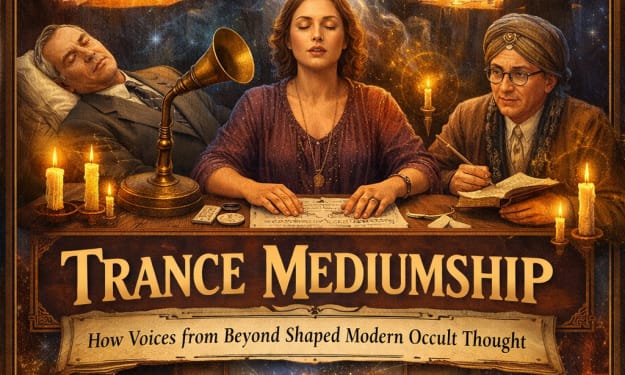
Trance Mediumship
The Living Voice in Altered States Trance mediumship holds a distinctive place within Western esoteric tradition. Unlike intuitive divination or clairvoyant perception, trance mediumship is defined by an altered state of consciousness in which speech, posture, facial expression, and temperament appear to shift under the influence of a perceived external intelligence. Observers have documented changes in tone, vocabulary, accent, and manner. Adherents interpret these manifestations as communication from discarnate beings. Psychical researchers have examined the same phenomena through frameworks of dissociation, subconscious cognition, and culturally conditioned religious experience. Occult practitioners have regarded trance as a disciplined method for accessing unseen dimensions of reality.
By Marcus Hedare6 days ago in BookClub



Comments
There are no comments for this story
Be the first to respond and start the conversation.