

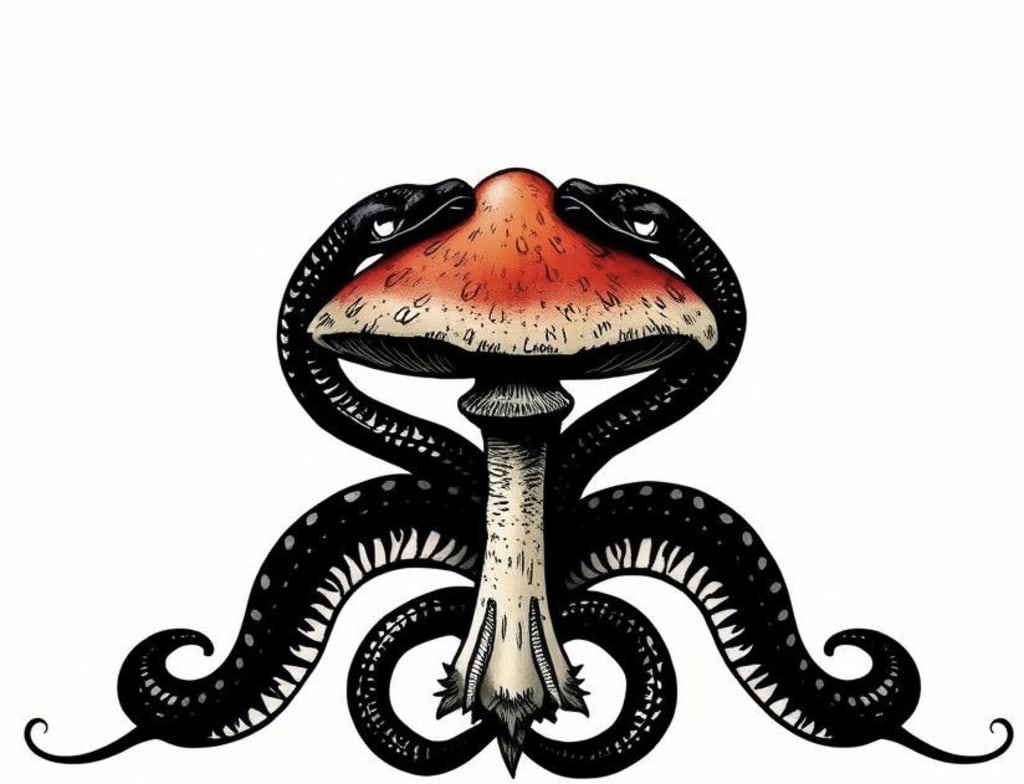
A gentle whirl announces the arrival of a pod from above, down through a central column. It floats to a stop. The egg-shaped capsule twists to the right with a pneumatic whirl, revealing a door. A small, dark-haired woman emerges. Her hair flows down her back in waves, black and shiny like raven's feathers. Her eyes are almost as dark with a cold, precise beauty.
She walks forward, not offering her hand.
“Doctor Ximena. I’m Dr Cho, assistant medical officer here in the Dome.”
I give a nod and remove my glasses; the lighting here is kinder to my eyes.
“Please, call me X.” I reply.
She nods in return, her smile unchanging as her eyes dart briefly to one side.
“I will be your host here at the Dome.” She indicates for me to follow.
Walking down the corridor, dressed fully in white, her heels tap noisily on the polished floor. I feel a little uncomfortable in my blue borrowed boiler suit, cap, and sneakers.
“You are a Mycologist.” she states.
“Yes, in both plant pathology and applied mycology.” I reply.
“I understand how you couldn’t turn down an opportunity to visit the colony. You couldn’t get more applied than right here.”
We enter a large auditorium. I’m ushered to a red cinema style folding seat on the front row facing a vast screen.
“We use this for our senior school children as part of their history lessons, so forgive the simplicity,” Dr Cho informs me.
“However, the presentation may be useful to answer some questions you inevitably have.”
I take my seat in the eerily empty auditorium. The residue of school children’s energy accentuates my loneliness.
Two cobras entwining a toadstool show on the screen, a symbol that is repeated on several flags around the room. The lights dim and the words SYNTHETIC BIOLOGY appear as the voice over begins.
“If some of you think the buildings grew here, it’s because they did. The exterior of the dome was constructed over 50 years ago using a series of wire frames. Dried fungi in a powdered form, similar to dried concrete in consistency, were poured around the bottom of the framework using our mars rovers.”
In the time lapse, workers erect metal wire frames in the dusty Martian landscape. While the rovers move like sped up toy cars, the fungi spreads around the frames and slowly engulfs the structures. The voice over continues.
“Scientists collected water from under the surface of Mars using a series of boreholes and tunnels that extend thousands of kilometres beneath the ground. Some of which you can still see today.”
The image changes to stills of huge mining tunnels leading deep underground.
“These are located on the edge of the dome in a restricted area and are no longer in use. I’m sure many of you have been on school rewards days to visit them.”
A series of photos of smiling teenagers standing outside the entrance fills the screen. The voice over continues.
“The microbes and spores arrived in air-tight bags from Earth. When water was added, the microbes and spores started to grow. A single spore can develop into Mycelium. These thread-like structures spread and multiply quickly. Just like us, fungal mycelia are life forms that must eat and breathe. That’s where something called CYANOBACTERIA comes in.” The word flashes in large type in front of me.
“It is a kind of bacterium that can use energy from the sun to convert water and carbon dioxide into oxygen and fungus food. The dome which we all live in, in a way, is alive. The outermost layer of ice protects us from the radiation outside and, as it melts, forms water. The Cyanobacteria then take that water and photosynthesise using the outside light. This produces oxygen for us to breathe and nutrients for the final layer of mycelia.”
The presentation concludes and the lights are restored. Dr Cho asks if I have any questions.
“Yes, you mentioned mycelium. It’s like mould on a piece of bread. What you see is only the tip of the ice burg, the underlying mycelium network must be huge. Couldn’t that have a serious effect on the planet’s ecosystem?”
Dr Cho smiles politely. “It’s impossible for the mycelium to survive the Martian atmosphere. Obviously, Mars has no ecosystem, but as a precaution, we have genetically altered it. The mycelium can’t survive in the outside environment.”
“Also, I’m curious about the maintenance of the outer structure of the Dome.” It’s the only thing separating the inhabitants from the deadly atmosphere outside and it’s on an enormous scale?”
The Doctor answered as if she was dealing with a rather stupid child.
“The structure needs no physical maintenance. It is a living, breathing network. If there is damage, it repairs itself. Similar to how a tree grows a new branch when one is cut off, or how we form a scab when we graze our knee, the structure has the ability to repair itself if there’s damage.
With that, she heads towards the exit. I follow like an abandoned puppy.
“You will be staying with me for the duration of your visit. I’ll send directions to your wrist com,” she says over her shoulder.
My wrist vibrates, and I see the incoming message.
“That’s very kind of you.” I reply.
She gives a curt smile.
About the Creator
N J Delmas
I lean towards the darker side of fiction and poetry. I love folk lore, fairy tales, ghosts and witches, often giving old themes a new twist. I have published with several magazines and am in the process of writing a dark YA fiction.
Keep reading
More stories from N J Delmas and writers in Chapters and other communities.
Valentine's Dates Over the Years
Colin grinned as Brooklyn slipped into the living room. “Is it all set?” he asked. The twenty-one year old grinned. She was in her last year of college and Colin knew that Lincoln was proud of her. Although she had been away at college, she’d eagerly helped Colin plan his surprise for Lincoln. “I’m so glad you’re finally doing this,” she said.
By Reb Kreyling16 days ago in Chapters
Albert Einstein: The Genius Who Changed the Universe
Albert Einstein (14 March 1879 – 18 April 1955) was a German-born theoretical physicist whose ideas transformed our understanding of the universe. Best known for the theory of relativity and his mass–energy equivalence formula E = mc², Einstein’s work laid the foundation for modern physics. He also made groundbreaking contributions to quantum theory, statistical mechanics, and cosmology. In 1921, he received the Nobel Prize in Physics for his explanation of the photoelectric effect, a discovery that would pave the way for quantum mechanics.
By Haroon Pasha2 days ago in Chapters




Comments
There are no comments for this story
Be the first to respond and start the conversation.