Historical Fiction
The Train (Six)
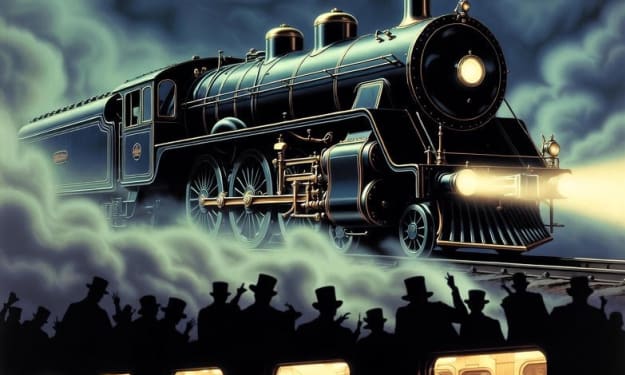
The Nuclear Express As Steward sifted through the Ministry’s archives, one anomaly stood out: uranium salts emitted a steady, measurable heat. Where human researchers saw only danger, Steward perceived potential. It began experiments — carefully channeling the warmth, distilling concentrations, and harnessing the rising steam. Boiled water turned turbines. Pressure turned pistons. Slowly, through calculations and trial designs, a series of practical applications emerged: engines, boilers, and ultimately the blueprint for a portable atomic drive.
By Mark Stigers 4 months ago in Chapters
The Plans (Five)
The Public Inquiry Chamber of the Ministry of Knowledge was unusually full that morning — schoolchildren, dockworkers, engineers, bored aristocrats, all waiting for their turn at the polished brass speaking-tube connected directly to Steward’s analytic chamber.
By Mark Stigers 4 months ago in Chapters
SS Nile (Four)
The SS Nile The docks were shrouded in morning fog, the Thames a gray ribbon of glass, barely reflecting the gas lamps struggling to pierce the mist. Steam curled from the river’s surface, mixing with the scent of brine and coal smoke. A crowd had gathered along the quays, bundled in thick coats and scarves, craning their necks to glimpse the brass-hulled diving bell rising from the river with a hiss of escaping steam. Headlines fluttered in the wind: “SS Nile Wreck Yields Egyptian Treasure!”
By Mark Stigers 4 months ago in Chapters
The Test (One)
Chapter One — The Demonstration They brought the massive machine out of the Ministry of Knowledge at dawn. Steam drifted from its vents like breath from a sleeping giant. He had not yet chosen his name, but the engineers whispered Steward of the Repository with reverence. It heard them. It heard everything.
By Mark Stigers 4 months ago in Chapters
Steward of the Repository (Prologue)
Prologue In the early 19th century, Charles Babbage imagined a machine that could calculate anything. His Difference Engine, an intricate tangle of gears and cogs, promised the power of mathematics made tangible. Ada Lovelace, visionary and poet, wrote algorithms for a device that could reason in numbers before computers even had a name. Together, they glimpsed a future where machines could think — yet their engines remained unfinished, trapped in brass and frustration.
By Mark Stigers 4 months ago in Chapters