Science Fiction
Bridge To The Moon: The Lunar Tour
(In which our intrepid traveller and friends are acquainted with many of the wonders of the moon.) Great-great-great-great-great-great-granddad: After breakfast the next day we started our six week tour of the Moon. It sounds like a long tour, but when you consider that it’s a tour of an entire heavenly body, it’s not that long really. There was still plenty that we didn’t see!
By Nicholas Edward Earthling3 years ago in Chapters
Bridge To The Moon: New Moon
(In which our new lunar explorer starts to experience all the Moon has to offer.) Great-great-great-great-great-great-granddad: Although the Moon is very old, in a way it was very new to me - or I was new to it! At times I felt as if I was in some kind of funny, dark, grey, almost shiny junk yard, but without the junk, (most of the time), where I weighed practically nothing and could almost float: but if I jumped up I would always come down again - rather slowly! Sometimes I was exhilarated to think I was in space and on the Moon, and sometimes almost a little gloomy - I think because there wasn’t much colour on the Moon’s surface, and the sky was always black and almost always without visible stars! Fortunately, most buildings we went into must have been designed with this lack of Moon colour in mind, because I saw colour everywhere in most of them, and I found this rather cheering.
By Nicholas Edward Earthling3 years ago in Chapters
Bridge To The Moon: To The Moon
(In which Great-great-great-great-great-great-granddad reaches that nearby, silvery, heavenly body.) Great-great-great-great-great-great-granddad: We were going down, not up, after leaving L1, even though we hadn’t changed direction, because we were now under the influence of the Moon’s gravity, rather than the Earth’s - so gravity was pulling everything towards the Moon, instead of towards the Earth, (as it had previously been doing up until we got to L1). The seats had now swivelled 180 degrees to how they had been before, unless passengers had clicked them in a fixed position - in which case they could have suddenly found themselves sitting upside down!
By Nicholas Edward Earthling3 years ago in Chapters
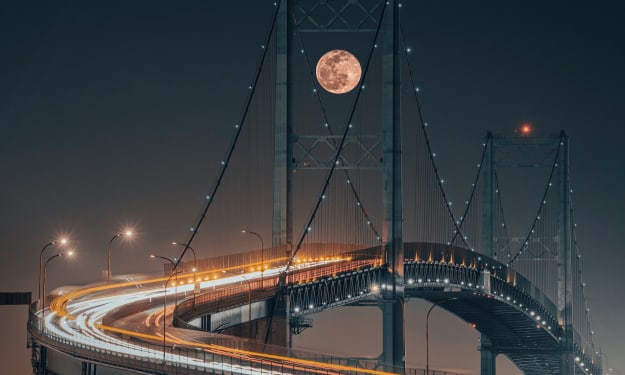
Bridge To The Moon: The Bridge Itself
(In which Great-great-great-great-great-great-granddad recounts what he recalls of that great, great, great, great, great, great piece of infrastructure he once traversed, so very, very, very, very, very, very long ago - and tells of an averted disaster.)
By Nicholas Edward Earthling3 years ago in Chapters
Bridge To The Moon: Proloque
(In which a very, very, very, very, very, very old, but sometime wily ancestor, introduces the subject, and tells his much, much, much, much, much, much younger and trusting descendant, of the complications - as he (mis?)understands them - associated with building a bridge to the Moon.)
By Nicholas Edward Earthling3 years ago in Chapters
What are the top ways to get very rich fast ?
I understand that the desire for financial success and wealth is a common aspiration, but it's important to approach this topic with a realistic and ethical perspective. While there might be various strategies that promise quick riches, the journey to financial success typically requires careful planning, hard work, dedication, and ethical decision-making. It's crucial to be wary of get-rich-quick schemes that could potentially lead to financial loss or legal issues. With that in mind, let's explore some legitimate avenues to achieve financial success and build wealth over time.
By Word Weaver 3 years ago in Chapters
The Science and Significance of Crying When Sad: Unraveling the Emotional, Social, and Biological Dimensions.
Crying is a complex physiological and emotional response that serves as a natural outlet for expressing a wide range of emotions, including sadness. While the exact reasons behind crying when we are sad are not fully understood, researchers have proposed several theories that shed light on this phenomenon. Crying is a uniquely human behavior, and its origins can be traced back to our evolutionary history and the intricate interplay between biology, psychology, and social communication.
By Word Weaver 3 years ago in Chapters