
What’s Really Happening on Venus?
Scientists Discover Strange Patterns That Could Change Our Understanding of the Planet

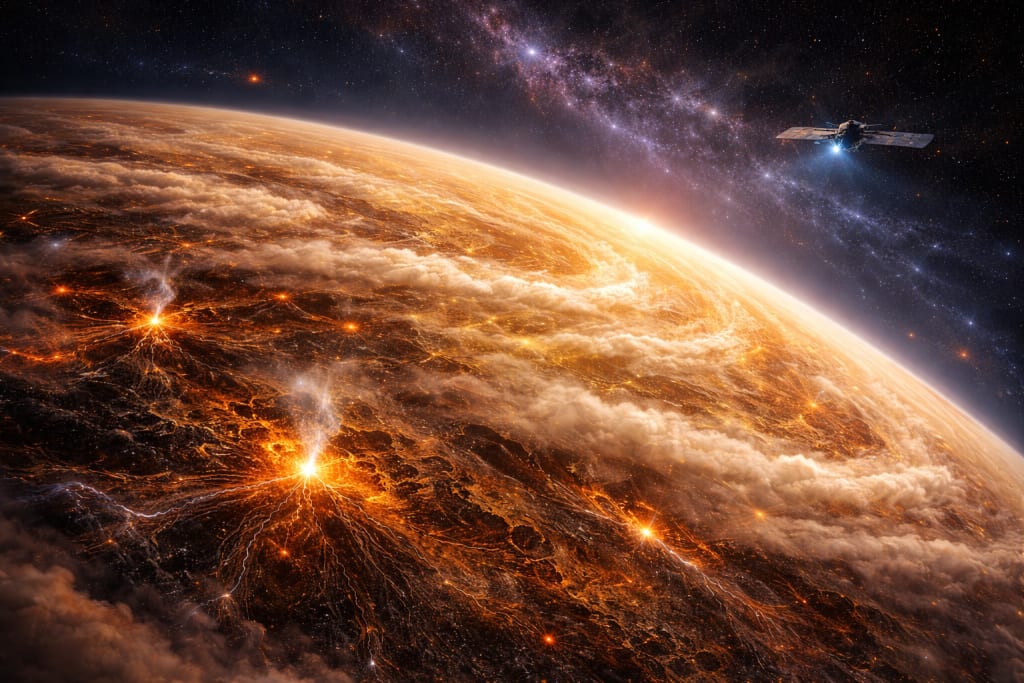
For decades, the planet Venus was considered one of the most hostile places in the solar system. Covered in thick clouds of sulfuric acid, with surface temperatures hot enough to melt lead and atmospheric pressure crushing enough to destroy most spacecraft, Venus seemed like a dead and unchanging world.
But in recent years, scientists have begun to notice something strange.
Patterns.
Using modern space telescopes and data from past missions, researchers studying Venus discovered unusual atmospheric behavior that suggests the planet might be far more dynamic than anyone previously believed.
Venus has always fascinated astronomers. In the night sky, it appears as one of the brightest objects visible from Earth. Ancient civilizations called it the “Morning Star” or the “Evening Star.” But behind its beautiful glow lies a planet wrapped in mystery.
One of the biggest surprises comes from the planet’s atmosphere. Venus has an incredibly thick atmosphere composed mainly of carbon dioxide, which traps heat and creates a runaway greenhouse effect. The result is an average surface temperature of about 465°C (869°F).
Yet despite this extreme environment, scientists noticed that the clouds above Venus behave in very unusual ways.
Data from the Japanese spacecraft Akatsuki revealed massive wave-like structures in the planet’s atmosphere. These waves stretch thousands of kilometers across the sky and appear to remain almost stationary while the rest of the atmosphere races around the planet at incredible speeds.
This phenomenon is known as “super-rotation.”
While Venus itself rotates extremely slowly—taking about 243 Earth days to complete a single rotation—its upper atmosphere circles the planet in just four days. Winds reach speeds of over 350 kilometers per hour.
Scientists were puzzled.
What could cause such a massive and stable atmospheric pattern?
Some researchers believe these waves are generated by heat rising from the surface, interacting with mountains hidden beneath the thick cloud layers. Others think they may be part of a larger climate system that scientists still don’t fully understand.
But the surprises didn’t stop there.
In 2020, astronomers studying Venus detected traces of a chemical called phosphine in the planet’s atmosphere. On Earth, phosphine is often associated with biological activity or certain industrial processes.
The discovery sparked worldwide debate.
Was it possible that microscopic life could exist high in Venus’s clouds, where temperatures and pressures are less extreme than on the surface?
The research involved observations from powerful observatories, including the European Southern Observatory, which detected faint chemical signatures in the planet’s atmosphere.
Although later studies questioned the strength of the phosphine signal, the discovery reignited interest in Venus exploration. Scientists realized that the planet still holds many secrets waiting to be uncovered.
Meanwhile, long-term observations have revealed another strange pattern.
Dark streaks occasionally appear in Venus’s cloud layers. These markings absorb ultraviolet light and seem to change shape over time, almost like shifting weather systems or chemical reactions taking place within the clouds.
Researchers are still trying to determine what causes these mysterious features.
Some theories suggest unknown chemical compounds are responsible. Others propose that complex atmospheric circulation could be producing them. A few scientists even speculate that microbial life—if it exists—might play a role in creating these patterns.
To solve these mysteries, space agencies are preparing new missions to return to Venus after decades of limited exploration. For example, NASA has announced future missions designed to study the planet’s atmosphere and surface in greater detail.
One of these missions aims to send a probe deep into the atmosphere, measuring temperature, pressure, and chemical composition as it descends through the thick cloud layers.
Another mission will map the planet’s surface with advanced radar, revealing mountains, volcanoes, and ancient geological features hidden beneath the clouds.
Scientists suspect that Venus may still have active volcanoes, which could explain some of the unusual atmospheric chemistry observed above the planet.
If true, it would mean Venus is not a dead world after all.
Instead, it may be a planet that is still changing.
Understanding Venus is more important than many people realize. Some researchers believe Venus may once have had oceans and a climate similar to early Earth before a runaway greenhouse effect transformed it into the extreme world we see today.
Studying Venus could help scientists better understand climate change and the future of planetary environments—including Earth’s.
For now, the strange patterns in Venus’s atmosphere remain one of the biggest mysteries in planetary science.
About the Creator
Abubakar220
I am best Stories writer
Keep reading
More stories from Abubakar220 and writers in Confessions and other communities.
The Universe That Dreams Us
For centuries, humanity believed the universe was expanding. Galaxies drifting farther apart. Space stretching endlessly like an invisible fabric. The theory had been supported by decades of observations, especially from the famous Hubble Space Telescope, which showed distant galaxies moving away from Earth in every direction.
By Abubakar2203 days ago in Earth
17 People Share The Brutally Honest Reason They Stayed With A Partner Who Cheated
When you hear about someone cheating, the societal expectation is almost always immediate: pack your bags, call a lawyer, and never look back. But behind closed doors, human relationships are rarely that black and white.
By Opinion3 days ago in Confessions




Comments
There are no comments for this story
Be the first to respond and start the conversation.