
Celluloid Comrades
Power, Money and Desire in Late Socialist Bulgaria

A review of: Nadège Ragaru (2023). ‘Millions for the Movies’ in Late Socialist Bulgaria: : The Political and Moral Economy of the Cinema Industry. Sociétés politiques comparées. Revue européenne d’analyse des sociétés politiques . [online] doi:https://doi.org/10.36253/spc-18718.
Cinema for the Millions: Power, Time and Desire in Late Socialist Bulgaria
In Nadège Ragaru’s article “Millions for the Movies” in Late Socialist Bulgaria: The Political and Moral Economy of the Cinema Industry, cinema is not treated merely as an art form or an industry, but as a prism through which the structure of late socialism in Bulgaria becomes visible. The film world appears as a condensed society, a laboratory in which ideology, money, ambition, loyalty, fear and hope interact. What emerges is not a simple opposition between propaganda and dissidence, but a complex political and moral economy in which power circulates through budgets, committees, honours, delays, privileges and desires.
The socialist state proclaimed cinema the most powerful means of education. From the late 1940s onwards, massive investments were made to nationalise distribution, centralise production and extend projection to every town and village. Cinefication was not merely a cultural project; it was a political promise. The moving image would reach peasants and workers alike, abolishing the uneven geography of access to modernity. By the 1960s and 1970s thousands of auditoriums functioned across the country. The new feature film studio in Boyana became a symbol of technological ambition. Bulgaria, once peripheral in cinematic terms, now possessed an industry.
Yet this industry was born inside a command economy. It depended on state subsidies, bank credits guaranteed by the government, and yearly negotiations between cultural officials and financial authorities. Cinema was at once art, education and enterprise. It required imported cameras, film stock and projectors. It needed foreign currency. It sought international recognition at festivals from Cannes to Moscow. The socialist system, which officially denounced capitalist exchange, found itself calculating revenues, export fees and box office returns.
From the 1960s onwards, economic efficiency became a recurrent concern. The language of reform entered cultural policy. Cinema was urged to produce maximum artistic results with minimum investment. Profitability, once a suspect word, reappeared under the formula of ‘material stimulation’. Revenue from screenings, co-productions with Western partners and service contracts for foreign studios became essential components of the financial structure. Bulgarian film crews hosted German, Italian and even American productions. Hard currency flowed in through carefully negotiated channels.
At the same time, cultural authorities insisted on ideological vigilance. The repertoire had to remain politically acceptable. Western films were purchased selectively, under the supervision of commissions that evaluated their ideological effect. Entertainment was tolerated but never fully embraced. The system oscillated between the need to attract audiences and the obligation to educate them. This oscillation defined the political economy of cinema.
The tension became particularly visible in the management of rural cinemas. Bringing film to villages symbolised equality and national cohesion. But by the 1970s rural attendance declined. Urban audiences grew more differentiated. Television emerged as a powerful competitor. Reports questioned whether it was rational to maintain loss-making projection halls for ten or twelve spectators. Yet closing them would have signified abandoning the promise of socialist cultural universality. Economic rationality collided with political symbolism.
The internal organisation of remuneration reveals even more clearly how socialism operated. In the 1950s additional payments were introduced to stimulate productivity. By the 1960s and 1970s films were categorised according to artistic and ideological value. Bonuses depended on popularity, critical recognition and sometimes international prizes. Profit-sharing mechanisms were tentatively implemented. A film that covered its production costs could generate additional rewards for director, cameraman and actors. Such measures blurred the boundary between socialist planning and market logic.
But these incentives were never neutral. When a film achieved exceptional commercial success, the sums involved provoked jealousy among other artistic unions and discomfort among political authorities. Limits were imposed. Rewards were adjusted. The system of stimuli remained subject to political discretion. Money became both recognition and instrument of control.
Beyond budgets and bonuses lay the moral economy of the film world. The kinadzhii inhabited a dense network of committees, artistic councils and professional unions. Every script passed through multiple layers of evaluation. Every production depended on approvals, classifications and access to scarce resources. Censorship rarely appeared as a single decisive prohibition. It operated through segmentation of time, through delays, revisions, reassignments and restrictions on distribution. Control was exercised not only over content but over editing time, equipment allocation, festival travel and number of copies.
Power functioned as micro-physics. A film could be slowed, redirected or quietly marginalised without explicit banning. The unpredictability of decisions produced a culture of anticipation. Artists learned to read signals, interpret tonal shifts in political speeches and speculate about changing priorities. The present was stretched; the future remained uncertain. Time itself became an instrument of governance.
Within this framework, professional solidarities and rivalries shaped outcomes. The Union of Cinema Professionals acted simultaneously as representative body and mechanism of incorporation. It distributed apartments, organised creative residences and bestowed awards. Public honours carried monetary bonuses and symbolic capital. Medals, titles and distinctions were displayed proudly. They marked inclusion within the socialist hierarchy of value.
The boundaries between censor and censored were porous. Many filmmakers occupied positions within party structures. Some sat on the Central Committee. Others were members of parliament. Cultural officials socialised with artists in studios, restaurants and seaside resorts. Friendships and marriages intertwined bureaucratic and artistic circles. Decisions were rarely impersonal. Personal connections, favours and informal negotiations permeated institutional procedures.
The system of vruzki and uslugi functioned as both survival strategy and mode of governance. Residency permits, equipment allocation, festival invitations and career opportunities were often mediated through networks. These practices did not simply bypass the state; they were embedded within it. Power was relational. The same individual could be artist, party member, father, consumer and critic of the regime. The dichotomy between state and society dissolves under close inspection.
The generational dimension is crucial. The first post-war generation experienced upward mobility through socialism. Sons and daughters of peasants or small-town families gained access to higher education, foreign study and artistic careers. Cinema embodied the promise of transformation. By the 1970s this generation enjoyed relative material comfort, international travel and symbolic prestige. Villas, imported goods and seaside holidays testified to success.
Yet the very success of this transformation generated new inequalities. A younger generation entering the profession in the 1980s encountered blocked opportunities. The industry could no longer absorb all graduates. Debuts were scarce. Economic crisis reduced resources. Political control tightened after the death of Lyudmila Zhivkova. The language of socialist heroism sounded increasingly hollow. Television and consumer desires reshaped expectations.
For many younger filmmakers the system appeared stagnant. Advancement required accommodation to political commissions. The future narrowed. When perestroika unfolded in the Soviet Union, it opened a horizon that contrasted sharply with Bulgarian immobilism. The same networks that once facilitated negotiation now transmitted dissatisfaction. Cultural figures participated in the early dissident movements. The suffocation expressed in artistic circles reflected a broader exhaustion.
The end of socialism did not arrive as abrupt rupture alone. It emerged from accumulated micro-shifts. Economic reforms without reform, ideological oscillations, generational frustrations and the erosion of shared conventions gradually altered the political configuration. The mechanisms that had once softened domination—negotiation, co-optation, personal mediation—became burdensome. They required constant management of uncertainty. They lost legitimacy.
The history of late socialist cinema thus reveals a regime sustained not solely by repression but by a dense web of incentives, honours, relationships and aspirations. Domination was rarely centralised in a single visible centre. It consisted of dispersed constraints, institutional habits and internalised expectations. Subjectivation occurred within these structures: filmmakers learned what was possible, desirable or dangerous. They shaped their projects accordingly. They negotiated their place.
Cinema functioned as magnifying glass for the command economy. It exposed the contradictions between ideology and efficiency, equality and privilege, artistic ambition and political loyalty. It showed how money, though officially denounced, re-entered the socialist vocabulary under euphemisms. It revealed how consumption infiltrated the lives of cultural elites. It illuminated how politics was embedded in everyday practice.
Most importantly, this story challenges simplistic narratives of totalitarian omnipotence or heroic dissidence. It portrays socialism as lived order—ambiguous, negotiated, stratified and temporal. Individuals were neither mere victims nor pure resistors. They were participants in a system that offered mobility, recognition and constraint simultaneously.
When the system faltered, it was not only because ideology collapsed, but because the moral and economic arrangements that had sustained it ceased to convince. The children of the socialist ascent desired more than cautious negotiation. They demanded new temporal horizons. In the film studios of Boyana, in festival halls and union meetings, the murmurs of change accumulated long before the formal fall of power.
Cinema for the millions had become cinema for a society in transition. Through its budgets, committees, friendships and disappointments, it tells the story of a political order that governed through time, reward and relation—and that, once its rhythms lost coherence, could no longer hold its frame.
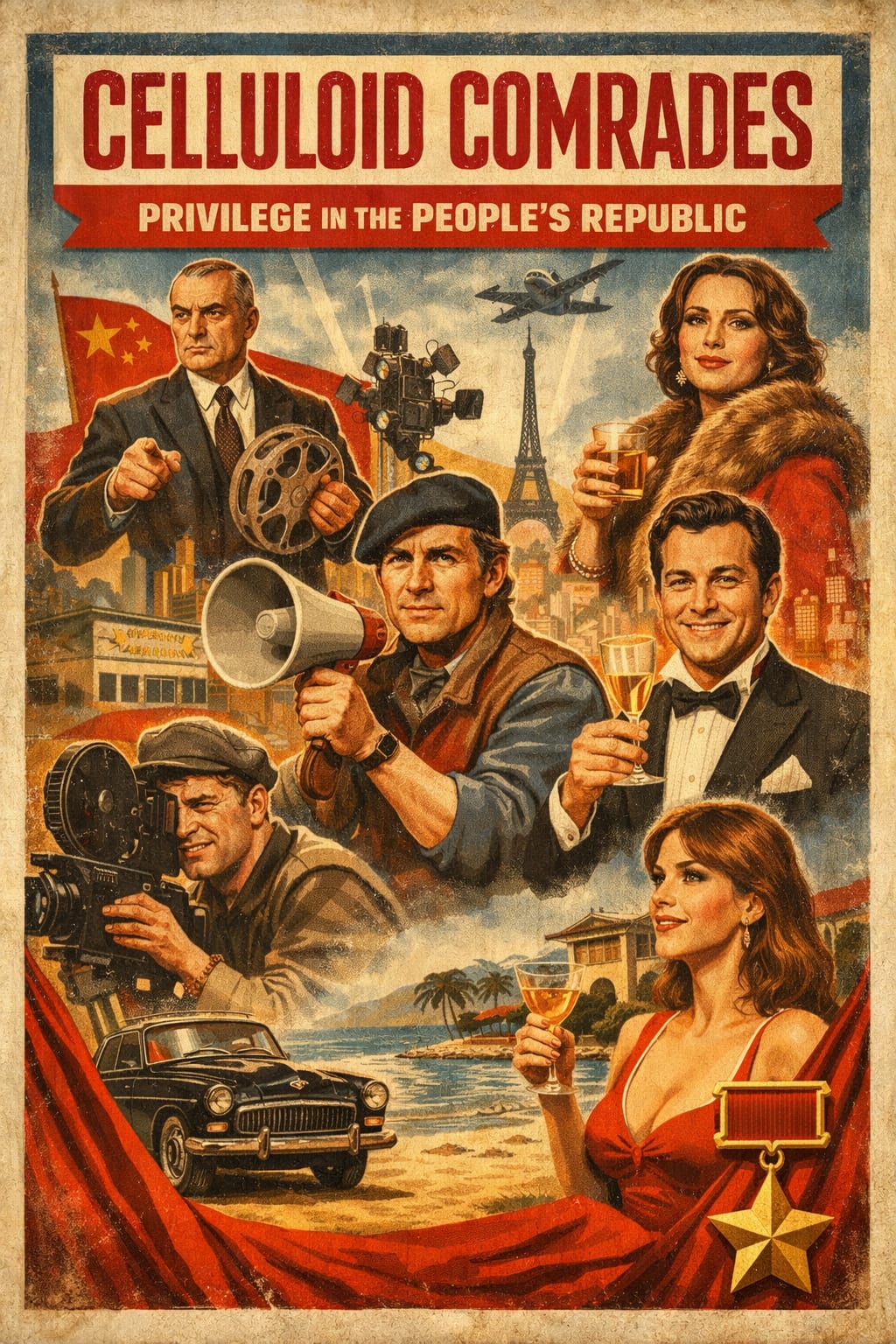
Celluloid Comrades: Privilege in the People’s Republic
In the end, the kinadzhii of Socialist Bulgaria stood as the most cinematic embodiment of the system itself: officially modest, practically privileged; rhetorically ascetic, materially comfortable; ideologically vigilant, yet remarkably well supplied with imported whisky and festival invitations. They were the avant-garde of the proletariat with access to seaside villas, the sworn critics of bourgeois decadence who knew the best Parisian cafés, the humble servants of the people who travelled first class to international festivals.
They mastered the art of socialist equilibrium. A screenplay required revision? A minor ideological adjustment. A problematic scene? A question of montage. A forbidden theme? A matter of timing. Nothing was ever entirely impossible; it was merely premature, under discussion, or awaiting clarification from above. The kinadzhii understood that in socialism, as in cinema, everything depended on editing. Reality itself was a rough cut in need of careful trimming.
Their privilege did not openly contradict the system; it completed it. Socialism promised the abolition of class, yet it required visible proof of cultural success. The filmmaker became that proof. He or she embodied upward mobility, international prestige and creative vitality. The director with a state apartment and a Volga car was not a deviation from equality but its exemplary outcome. If one followed the Party line with sufficient nuance, one might even receive a medal—preferably with a modest bonus attached.
They learned to speak in two registers. Publicly, they praised the heroic worker and the radiant future. Privately, they negotiated distribution quotas, equipment shortages and festival strategies. They criticised capitalism on screen while carefully calculating hard-currency co-productions. They condemned Western consumerism and returned from Western trips with suitcases that seemed suspiciously heavy. Yet no contradiction appeared irreconcilable; it was merely dialectical.
Censorship, too, became collaborative. The censor was rarely an enemy; he was a colleague with different responsibilities. Together they shaped the final product. A cut here, a softened line there, and everyone could claim victory. The state preserved ideological coherence; the director preserved artistic dignity. If a film disappeared quietly into limited distribution, it was less a tragedy than an unfortunate scheduling issue.
The kinadzhii were not villains. They were artisans of accommodation. They believed, doubted, compromised and sometimes resisted, but always within a choreography of survival. Their moral universe was calibrated in gradations, not absolutes. Heroism lay in securing one additional day of shooting; rebellion consisted of a metaphor too subtle to be noticed—until it was noticed.
When the system finally collapsed, the privileged filmmakers discovered that privilege without a patron is merely nostalgia. The committees vanished, the subsidies dried up, and the villas required maintenance. Suddenly the market demanded what ideology never had: profit without justification. Some adapted with admirable flexibility. Others longed for the comforting complexity of negotiations, where power was dispersed and responsibility ambiguous.
Thus the privileged kinadzhii remain one of socialism’s most elegant paradoxes. They were both its beneficiaries and its soft critics, its decorated servants and its ironic chroniclers. They edited not only films but their own biographies, crafting narratives in which compromise appeared as professionalism and privilege as cultural duty. In a system devoted to collective equality, they demonstrated that some comrades were, after all, more cinematic than others.
About the Creator
Peter Ayolov
Peter Ayolov’s key contribution to media theory is the development of the "Propaganda 2.0" or the "manufacture of dissent" model, which he details in his 2024 book, The Economic Policy of Online Media: Manufacture of Dissent.
Keep reading
More stories from Peter Ayolov and writers in Critique and other communities.
The Shaped Self: Images Without History
The Shaped Self: Images Without History Peter Ayolov, Sofia University “St. Kliment Ohridski”, 2026 Abstract E-democracy is not a technical upgrade of representative government. It is a transformation of citizenship inside a regime of visual formatting. Drawing on Žarko Paić’s analysis of video-centrism and the world-picture, this article argues that contemporary political life unfolds in an environment where images no longer reflect history but organise reality in advance. In this condition, the citizen does not merely participate; the citizen appears through an interface. Political agency becomes inseparable from visibility, recognisability, and circulation. By placing Paić in dialogue with Marcel Duchamp, Jean Baudrillard, Tom Wolfe, and Jean-Luc Nancy, the article develops the concept of the shaped self as the central figure of e-democracy: an interface-formed subject structured by edges, templates, and repeatable visual patterns that enable identification but risk reducing agency to performance. The struggle for democracy becomes a struggle over representation itself: over ownership of likeness, transparency of distribution systems, and the capacity to distinguish voice from simulation in an environment saturated with images, metrics, and deepfakes. As the concluding work of the Mirror Selves Trilogy, this article presents the book The Shapes of the Self: Identity and Recognition in Visual Space (2026) that investigates how the self emerges not as an inner essence but as a shaped and formatted presence within contemporary visual space.
By Peter Ayolovabout 15 hours ago in Critique




Comments
There are no comments for this story
Be the first to respond and start the conversation.