Essay
New Jersey town faces state lawsuit claiming mayor ordered police to “keep black people out”
Does a city in New Jersey want negroes? It has been found in a court filing that Clark Township does not want non-white motorists traveling through it. The mayor, Salvator “Sal” Bonaccorso has rejected the claims despite the data. They show blacks had been stopped 3.7 times more than white drivers. Hispanics had been pulled over about 2.2 times more than their lighter hued counterparts.
By Skyler Saundersabout a month ago in Critique
Breakfast at Tiffany’s with a Cat
It’s 9 a.m., time for a morning snack: chia seeds with coconut milk, accompanied by a black lungo, in front of a terrific panorama of rolling countryside hills, caressed by the gentle, peach-colored light of the rising sun. And surely, with a good book in hand.
By Anastasia Tsarkovaabout a month ago in Critique
Fair or foul? Florida wedding venue refuses refund to woman after her fiancé dies
It is fair and rational and good that the wedding venue never canceled the deposits made by Tye Hinson. After the sudden passing of her fiance, Hinson was stuck with a $7600 fee for services that would’ve been rendered. She claimed she knows contracts but apparently she didn’t read the fine print on this one.
By Skyler Saundersabout a month ago in Critique
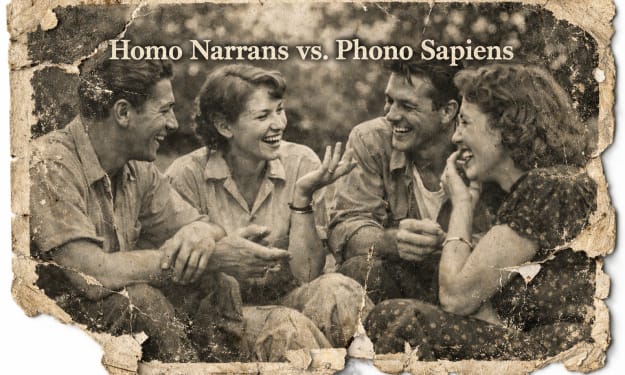
Homo Narrans Vs. Phono Sapiens
Peter Ayolov, Sofia University “St. Kliment Ohridski” Abstract This article examines the contemporary shift from storytelling as a shared, dialogical practice to storyselling as a performative, market-oriented mode of self-presentation. Drawing on Byung-Chul Han’s book The Crisis of Narration, the analysis argues that narration has lost its primary social function: the creation of a common symbolic world sustained through reciprocal exchange. Traditional storytelling depended on at least two participants and unfolded as a movement back and forth, producing memory, cohesion, and future-oriented meaning. In contrast, storyselling treats narrative as a one-directional instrument for selling identity, success, or visibility, reducing listeners to passive consumers. The article situates this shift within broader transformations of digital capitalism, self-optimisation culture, and communication coaching, showing how conversational depth is replaced by predictable, strategic self-branding. The loss of genuine conversation is presented not as a stylistic problem but as a structural erosion of social bonds and shared meaning.
By Peter Ayolovabout a month ago in Critique
Lingua ex machina
Peter Ayolov, Sofia University "St. Kliment Ohridski" Abstract This article examines the claim that language is not merely a product of human nature and evolutionary adaptation, but a force that, once constituted, begins to shape humans in its own image. Drawing on Elan Barenholtz’s Substack essay ‘Syntax is Dead! Long Live Syntax!’ and the University of Toronto discussion ‘The (Terrifying) Theory That Your Thoughts Were Never Your Own’, the text argues that language initially emerged as an adaptive coordination system but gradually detached from its biological origins through external memory technologies such as writing, print, audio, and video. With the advent of large language models, this autonomy becomes visible for the first time. Syntax appears not as an innate causal engine but as an emergent statistical shadow of predictive systems. Language, understood as an autogenerative informational system, now operates as a cultural and cognitive environment that produces meaning, belief, identity, and even metaphysical concepts such as God. In this sense, language does not reflect reality so much as organise it, creating human subjects through symbolic structures that precede intention and awareness.
By Peter Ayolovabout a month ago in Critique
Catching Up
I know I have not been reading and commenting a lot these past couple weeks, but I have been reading and writing in my old-fashioned composition books and preparing some of those writings for here on Vocal. I have also been researching and writing my study books. I do have one wish for my subscribers here on Vocal.media.com and that is that everyone will have a great year. I do have a request and would like some follow-up on some of my older work and would you guys read or re-read my material and share your thoughts for I am thinking of putting together an anthology.
By Mark Grahamabout a month ago in Critique
Charleston White Responds As Viral Report Suggests A Shooting Has Left Him In Critical Condition
In this age of fake news, poor AI generated content, and outlandish rumors, it’s hard to keep up with the truth. That’s why Charleston White declared his existence on social media.
By Skyler Saunders2 months ago in Critique
Nurses Strike in New York City Hospitals
**Nurses Strike in New York City Hospitals** A large-scale strike by nurses has taken place in New York City, drawing national attention to the challenges facing the healthcare system. Thousands of registered nurses working in major hospitals across the city decided to walk off the job after negotiations with hospital management failed to reach an agreement. The strike reflects deep concerns about working conditions, patient safety, and fair treatment for healthcare professionals who are considered the backbone of hospital care.
By America today 2 months ago in Critique
Angry People Click More: The Economics of Manufactured Dissent
(Ideas from the book The Economic Policy of Online Media: Manufacture of Dissent, Routledge, 2024) Abstract This article examines the formula ‘angry people click more’ as a core logic of contemporary online media and as a structural transformation of propaganda in the digital age. It argues that the defining feature of the current attention economy is not only the circulation of misinformation, but the systematic deployment of openly implausible claims designed to provoke moral outrage and sustain profitable engagement cycles. The analysis links Oxford’s 2025 Word of the Year ‘rage bait’ to earlier lexical markers of epistemic crisis such as ‘truthiness’ and ‘post-truth’, and situates this trajectory against the older ‘manufacture of consent’ model of Herman and Chomsky. While classical propaganda in totalitarian and mass-media systems sought ideological unity through censorship and the Big Lie, the emerging Propaganda 2.0 model, articulated by Peter Ayolov, monetises anger by manufacturing dissent and deliberately populating the public sphere with absurd, polarising narratives. The article interprets this dynamic through the allegories of ‘The Emperor’s New Clothes’ and Václav Havel’s greengrocer, showing how the move from fearful silence to permanent online rage changes both the psychology and political economy of propaganda. Drawing on Evgeny Morozov’s critique of fake-news moral panics, Frances Haugen’s disclosures about Facebook, and the documentary The Social Dilemma, it concludes that anger has become a tradable asset and that blatant lying has shifted from an authoritarian instrument of control to a market mechanism in a global ‘free trade in slogans’.
By Peter Ayolov2 months ago in Critique