Manuscript
On a Publisher’s Refusal
There was a day in my life, a kind of point of no return, when I lost everything: an apartment, a boyfriend, all my belongings, any clear vision of my future, and, icing on the cake, my bank account was in the red. By pure chance, a man I barely knew picked me up, and we set off on a road trip. We didn’t become a romantic couple by the end of the journey, as happens in movies: we just spent a month together, and then I was on my own again. That was when I decided to write about everything that had happened to me. Since I was no longer attached to anything in this world, my ability to write was the only thing still holding me up…
By Anastasia Tsarkova13 days ago in Critique
Speaking to Time Instead of the Room
Much of modern communication is oriented toward immediacy. Writing is framed as something meant to be consumed quickly, reacted to instantly, and replaced just as fast by whatever comes next. Under this model, the value of a piece is measured almost entirely by its initial reception. If it does not land immediately, it is treated as a failure. This assumption narrows the purpose of writing and misunderstands how meaning actually travels through time.
By Peter Thwing - Host of the FST Podcast14 days ago in Critique
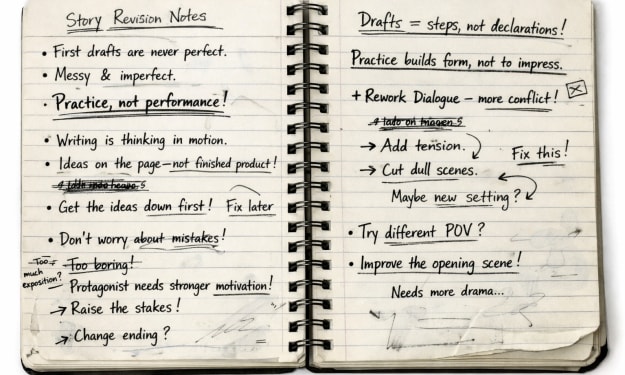
Practice vs Performance
One of the quiet pressures shaping modern communication is the assumption that anything written should be immediately shareable. Drafts blur into declarations, and exploration is mistaken for conclusion. Under this pressure, writing becomes performative by default. The moment words are placed on a page, they are treated as finished statements rather than steps in a process. This expectation distorts both how writing is produced and how it is received, collapsing practice into performance and leaving little room for genuine development.
By Peter Thwing - Host of the FST Podcast15 days ago in Critique
AI as a Reflective Surface
Much of the confusion surrounding artificial intelligence comes from treating it as an agent rather than a surface. When people speak about AI “doing the thinking,” “creating the ideas,” or “speaking for someone,” they are often projecting agency onto a system that does not possess intention, belief, or understanding. This projection obscures what is actually happening in many real-world uses. In those cases, AI is not acting as a source of meaning, but as a surface that reflects, redirects, and reshapes what is already present.
By Peter Thwing - Host of the FST Podcast24 days ago in Critique
Mental Health Tips for Digital Creators (From Someone Who Knows the Burnout)
Mental Health Tips for Digital Creators (From Someone Who Knows the Burnout) It sounds like the ideal job to be a digital creator. You get to work from anywhere, be your own boss, and turn your ideas into content people actually care about.
By Farida Kabir29 days ago in Critique
When Is a Move Final?
The Commitment Problem in Modern Chess Modern chess operates under a fractured commitment model that no longer aligns with how players think, how turns function in most games, or how chess itself is actually played across physical and digital formats. At the heart of the problem is that chess treats physical contact with a piece as binding commitment while simultaneously relying on a separate explicit action to end a player’s turn. This creates a logical contradiction: a move becomes final before the turn is over. In most turn-based games, interaction with game components is provisional until the player explicitly signals the end of their turn. Chess is an anomaly in this respect, and the inconsistency becomes increasingly visible in modern play.
By Peter Thwing - Host of the FST Podcastabout a month ago in Critique
Greed Is a Dangerous Curse
Greed Is a Dangerous Curse “Now you will be sentenced to one year in prison.” There once lived a poor woodcutter in a small village. Every day, he would go into the forest early in the morning, cut wood with great effort, and then return to the city to sell it. Whatever little money he earned was enough to feed his family for the day. His life was simple, hardworking, and honest, but deep inside his heart, there was a hidden desire to become rich quickly.
By Sudais Zakwanabout a month ago in Critique
Countdown to Pearl Harbor: The Twelve Days To The Attack
Countdown to Pearl Harbor: The Twelve Days To The Attack by Steve Twomey I really wasn’t expecting much of this read; I grabbed it while I was at Pearl Harbor because how could I not get a book while I was there?
By Matthew J. Fromm2 months ago in Critique
Why Capitalism is not a Form of Government
Hey guys, welcome back to another educational rant with minimal research involved. Today's topic is about how there are no true forms of government besides anarchy and capitalism, and why it works so well. This topic is also an example of a much more basic concept of how organized systems maintain themselves long term.
By Talented Jester3 months ago in Critique