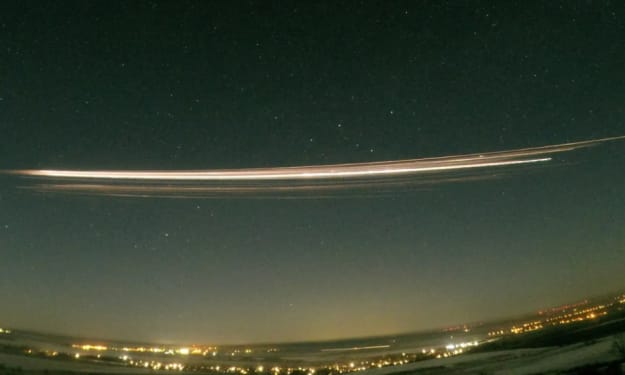
Metal Pollution from a Rocket Reentry Detected for the First Time. AI-Generated.
For decades, scientists have studied pollution from factories, vehicles, wildfires, and even volcanic eruptions. But now, researchers have identified a new and unexpected source of atmospheric contamination: rocket reentries. For the first time, scientists have detected metal pollution in Earth’s upper atmosphere directly linked to the fiery return of a spacecraft component.
This discovery raises important questions about the growing number of satellites and rockets entering orbit — and what happens when they come back down.
What Happens During a Rocket Reentry?
When rockets launch satellites into space, parts of the vehicle — such as upper stages or discarded components — remain in orbit. Over time, gravity pulls many of these objects back toward Earth. As they reenter the atmosphere, they experience extreme friction with air molecules, generating intense heat.
Most rocket components burn up during this process, breaking apart and vaporizing before they reach the ground. For years, scientists assumed that this burn-up was relatively harmless, with debris simply dispersing in the atmosphere.
However, new evidence suggests that when rocket materials disintegrate, they release metallic particles into the upper layers of Earth’s atmosphere — particularly in the mesosphere and lower thermosphere.
The First Direct Detection
Researchers recently collected high-altitude atmospheric samples using specialized research aircraft and ground-based instruments. While analyzing these samples, they found unusual concentrations of metals such as aluminum, lithium, copper, and other elements commonly used in rocket construction.
Aluminum is particularly significant because it is widely used in rocket bodies and satellite components. When exposed to extreme heat during reentry, aluminum can oxidize and form tiny particles known as aluminum oxides.
These particles were detected at altitudes where natural sources of such metals are rare. Scientists compared the timing of the measurements with recorded rocket reentries and found a strong correlation.
This marked the first confirmed detection of metal pollution directly tied to a specific rocket reentry event.
Why This Matters
The discovery comes at a time when space activity is increasing dramatically. Private companies and national space agencies are launching thousands of satellites for communication, navigation, and Earth observation.
Organizations like NASA and private companies such as SpaceX have expanded launch frequencies in recent years. Satellite constellations designed to provide global internet coverage require regular launches — and eventually, deorbiting.
With more launches comes more reentries.
Scientists estimate that hundreds of tons of space hardware reenter Earth’s atmosphere each year. As satellite constellations grow, that number could rise significantly in the coming decade.
Potential Environmental Impact
The long-term environmental consequences of metal pollution from rocket reentries are still unclear. However, researchers are exploring several possible effects:
1. Ozone Layer Disruption
Metal particles in the upper atmosphere may interact with atmospheric chemistry. Aluminum oxides, for example, could influence chemical reactions that affect the ozone layer. The ozone layer plays a crucial role in protecting life on Earth from harmful ultraviolet radiation.
Even small chemical changes at high altitudes can have ripple effects.
2. Cloud Formation Changes
Some scientists believe metallic particles may serve as condensation nuclei — tiny surfaces on which ice crystals form. This could alter the behavior of high-altitude clouds, potentially affecting temperature regulation in the atmosphere.
3. Climate Implications
While current metal concentrations appear low compared to natural dust and volcanic emissions, the cumulative impact over decades remains unknown. If launch activity continues to grow exponentially, the environmental footprint of space operations could expand accordingly.
Comparing Natural and Human Sources
It’s important to note that Earth’s atmosphere naturally contains metallic particles from meteoroids. Every day, small space rocks enter the atmosphere and burn up, releasing iron and other elements.
However, rocket-derived particles differ in composition. Meteors primarily release iron and nickel, whereas rockets contribute aluminum and engineered alloys not commonly found in natural space debris.
This difference in chemical makeup allows scientists to distinguish between natural meteoric dust and pollution from human-made spacecraft.
The Growing Space Economy
The global space economy is booming. Commercial satellite networks, Earth observation missions, and deep-space exploration projects are expanding rapidly. Companies aim to deploy tens of thousands of satellites over the next decade.
While these systems provide enormous benefits — including improved communication, disaster monitoring, and navigation — they also introduce new environmental considerations.
Historically, the environmental conversation around space activity focused on launch emissions and space debris collisions. Now, atmospheric pollution from reentry is entering the discussion.
Are Regulations Needed?
Currently, international space law does not specifically regulate atmospheric pollution from rocket reentries. Most policies focus on preventing ground damage and minimizing orbital debris.
The new findings may prompt policymakers to consider additional environmental safeguards.
Potential solutions could include:
Designing spacecraft with materials that produce fewer harmful byproducts
Developing reusable systems that reduce the number of components burned up
Improving tracking and prediction models for reentries
Conducting more atmospheric monitoring
Some experts argue that proactive research is essential before the problem escalates.
A Call for More Research
The discovery of metal pollution from rocket reentries is only the beginning. Scientists emphasize that much more data is needed to understand the full impact.
Key questions include:
How long do metallic particles remain suspended in the atmosphere?
Do they accumulate over time?
What chemical reactions do they trigger?
Could they meaningfully influence climate patterns?
Answering these questions will require international collaboration and sustained monitoring.
Balancing Progress and Responsibility
Humanity’s expansion into space represents one of the greatest technological achievements of modern history. Satellites enable global communication, weather forecasting, GPS navigation, and scientific research.
However, as activity in orbit increases, so does responsibility.
The detection of metal pollution from a rocket reentry serves as a reminder that even distant technological processes can have effects closer to home — in this case, high above our heads in the atmosphere.
Space exploration does not occur in isolation from Earth’s environment. As scientists continue studying this newly identified pollution source, governments and private companies may need to adapt strategies to ensure sustainable growth in space activities.
The sky, it turns out, is not the limit — but it is part of the environment we must protect.