
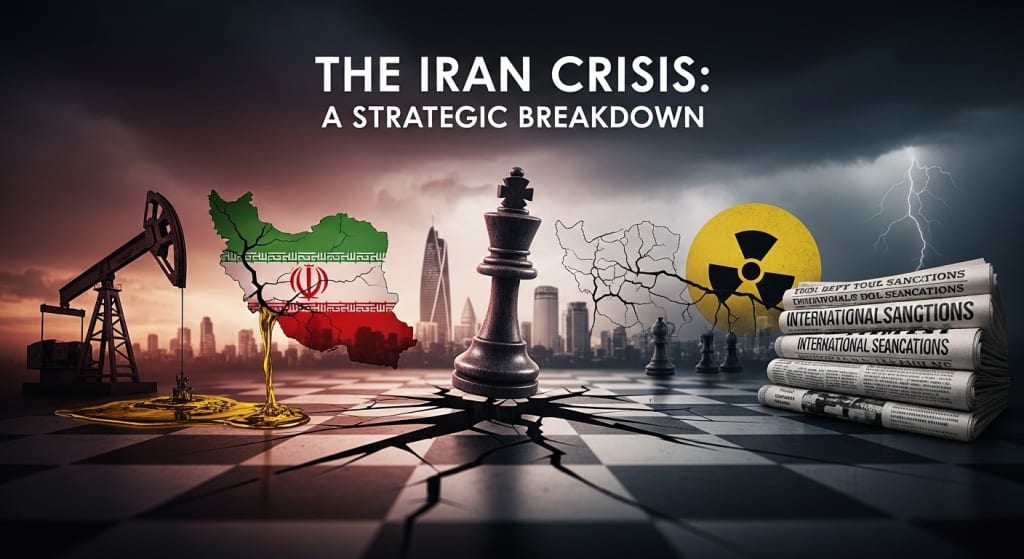
The Iran Crisis: A Strategic Breakdown
How Regional Powers, Global Alliances, and Internal Politics Shape the Conflict

**Title:**
A few months ago, large Chinese cargo planes were reported in Iran, and it was claimed that advanced defense equipment was being transferred to Iran. Now, according to new reports, Chinese technology is being used in Iran, and as a result, Iran has shot down three American aircraft over Kuwait. While these specific incidents remain unverified by independent international sources, they reflect broader concerns about escalating military-technical cooperation between Tehran and Beijing. Notably, in 2021, Iran and China signed a comprehensive 25-year strategic partnership agreement covering economic, energy, and security cooperation—a framework that could plausibly facilitate defense technology transfers.
Now, regarding Russia: they have also provided considerable support to Iran. Through the Caspian Sea, Russia can deliver direct assistance to Iran whenever needed. This is a sea over which Russia holds complete dominance, thanks to its powerful Caspian Flotilla and legal agreements that limit non-littoral military presence. The Caspian corridor has historically served as a vital supply route, notably during the Soviet era and more recently for coordinating positions on Syria. This geographic advantage allows Moscow to bypass Western-monitored chokepoints like the Suez Canal or the Strait of Hormuz, providing Tehran with a strategic lifeline that is difficult for the United States to interdict.
The United States believed that by removing Iran's leadership, it would achieve its objectives—that people would rise up, chaos would ensue, and the government would be overthrown. However, the martyrdom of Ali Khamenei has further united the Iranian nation. This is precisely the sign of a living, resilient nation. Historically, external pressure on Iran—from the 1953 coup to the Iran-Iraq War—has often strengthened nationalist sentiment rather than fractured it. The Iranian political system, despite its complexities, has demonstrated remarkable adaptability in mobilizing public cohesion during crises.
Now, the United States is struggling to figure out how to deal with this tough challenge. Trump has been drawn into a difficult situation by Netanyahu. If a few more aircraft are shot down or a naval fleet is targeted, public opinion in the United States could turn against Trump. However, if Trump refuses to follow Netanyahu's agenda, then after the Epstein files, Epstein video clips could also be made public. This dynamic highlights a broader truth in modern geopolitics: domestic political vulnerabilities can significantly constrain a leader's foreign policy options. The influence of pro-Israel lobbying groups like AIPAC on US congressional decisions regarding Iran is well-documented, adding another layer of complexity to Washington's strategic calculations.
The United States will likely need to find a quick way out of this situation. It is possible that after carrying out a few major strikes on Iranian nuclear facilities, the U.S. will announce to the world—for the sake of saving face—that it has eliminated Iran's leadership and destroyed the nuclear sites that posed a global threat. After that, following some kind of agreement with Iran, they would withdraw. There cannot be a better scenario than this. In international diplomacy, "face-saving" exits are common; they allow conflicting parties to de-escalate while preserving domestic credibility. The 2015 JCPOA (Joint Comprehensive Plan of Action) demonstrated that negotiated solutions are possible, even after years of tension.
Because if the war drags on, it will increasingly damage America's self-image. In frustration, they might begin using the most dangerous weapons. Russia and China are monitoring the situation closely at every moment. So far, Iran has not revealed its most powerful cards (weapons), acting on the advice of Russia and China. But when the time comes, Iran will also deploy Russian- and Chinese-made technology. Iran's military doctrine emphasizes asymmetric warfare, including ballistic missiles, drone capabilities, and regional proxy networks. Both Russia and China have advanced capabilities in electronic warfare, air defense systems like the S-400, and hypersonic technology—assets that could significantly alter the regional balance if shared with Tehran.
However, a prolonged war is not in the interest of any party. The United States needs a face-saving exit, and Iran does too. A long war is also not in the interest of Russia or China. All three powers benefit more from a stable, negotiated outcome that preserves their strategic equities. For Russia and China, a contained Iran serves as a useful counterweight to US influence in the Middle East without triggering a broader conflict that could disrupt global energy markets or draw them into direct confrontation with Washington.
On social media, a month ago, when everyone was saying that the West and the United States wanted war, I was the only person telling you that war is desired only by the Zionist lobby—the group that governs Israel and exerts control over the United States. All of this is being done for the sake of a "Greater Israel." Expanding the war on a large scale is part of the Zionist plan. While this perspective reflects a specific ideological viewpoint, it is true that certain pro-Israel advocacy groups have historically pushed for tougher US policies toward Iran. However, US foreign policy is shaped by multiple factors: strategic interests, energy security, alliance management, and domestic politics—not by any single lobby alone.
Ultimately, the path forward requires diplomatic creativity, strategic patience, and a willingness to acknowledge that military solutions often create more problems than they solve. The Middle East has endured decades of conflict; sustainable peace will require addressing root causes, building trust, and ensuring that all regional stakeholders have a seat at the negotiating table.
---
About the Creator
Literary fusion
Welcome to literary fusion where art and literature intertwine to create a vibrant tapestry. I am [Abdullah Shabir], an artist and writer exploring self-expression through colors and carefully chosen words.
Keep reading
More stories from Literary fusion and writers in Earth and other communities.
From a jobber to talk of Wrestling
Every Upper management person that I have worked with has said this to my face "No one is going to cheer for a man named Mustafa Ali". This was the Epic line Mustafa Ali said after his first match as a free agent. Ali was released from WWE in September 2023. His time in WWE was quite miserable.
By Literary fusion2 years ago in Earth
Anyone in Need of a Good Cleansing Cry in the Last Week Has Only Had to Peek at TikTok, Reddit or X
If you’ve felt unusually emotional this past week, you weren’t alone — and you didn’t have to look far to find company. A quick scroll through TikTok, Reddit, or X (formerly Twitter) revealed an outpouring of raw vulnerability: strangers crying on camera, heartfelt confession threads, grief posts, breakup monologues, nostalgic tributes, and deeply personal stories shared with millions.
By Aarif Lashari7 days ago in Earth
Flower Bloom 369
FLOWER Bloom 2/25/26 Wednesday By Mariann Carroll Karen had been with Tony for 7 years. Tony started acting strangely after her surgery. He would mow the lawn in the rain and be on his cellphone. He started pushing Karen away. Tony came clean about seeing someone. Karen moved out two months later. Karen moved in with a friend. She felt betrayed.
By Mariann Carroll7 days ago in Fiction



Comments
There are no comments for this story
Be the first to respond and start the conversation.