
The Architecture of Echoes
When the Heart Remembers What the Mind Erases
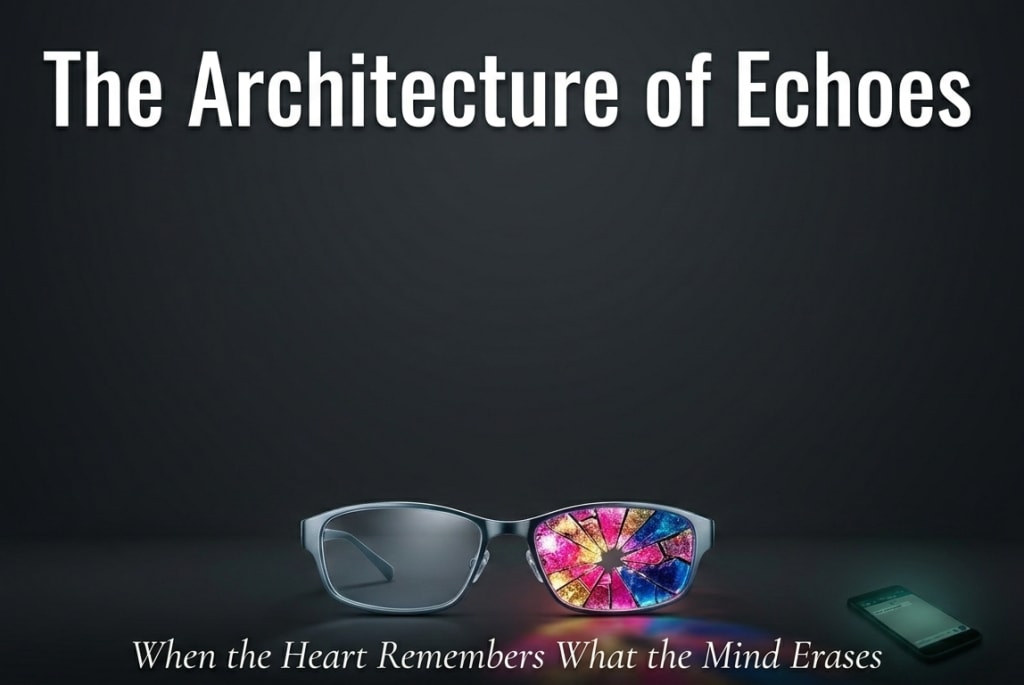
The city of Oakhaven was built on the principle of efficiency. Here, grief was considered a structural flaw, and heartbreak was a glitch in the social machinery. To maintain order, the citizens utilized "The Gilded Lens," a neuro-optical device that allowed individuals to selectively archive memories that no longer served their productivity.
Elias was the city’s premier Memory Architect. He didn’t just delete memories; he rearranged them, turning the jagged edges of a messy breakup into the smooth, harmless geometry of a pleasant afternoon spent alone. He lived a quiet, streamlined life, devoid of the heavy shadows that usually haunt a thirty-year-old man.
Then he met Clara.
She came to his studio on a Tuesday, clutching a worn silk scarf that smelled of rain and cedarwood. Unlike the usual clients who arrived with a frantic desire to forget, Clara looked like she was holding onto a cliffside with her fingernails.
"I want to keep him," she whispered, her eyes tracing the sterile lines of Elias’s office. "But the pain is stopping my heart. Can you make it so I remember the love, but not the loss?"
Elias adjusted his spectacles, his professional veneer masking a sudden, inexplicable tremor in his hands. "Memory is an ecosystem, Clara. If you remove the predator—the pain—the prey—the joy—will overpopulate until it becomes unrecognizable. You cannot have the light without the silhouette it casts."
"Then make me a silhouette," she replied.
As Elias began the "mapping" process, connecting the silver electrodes to Clara’s temples, he entered her mind. It was a revelation. Most minds he navigated were cluttered with mundane frustrations and petty grievances. Clara’s mind was an art gallery. He saw a sunset over a jagged coastline, felt the warmth of a hand through a winter glove, and heard a laughter that sounded like bells underwater.
The man in her memories was Julian. He had been a musician, a man who saw the world in frequencies. Elias watched as they danced in a kitchen flooded with morning light. He felt the specific electricity of their first kiss. But as he went deeper, he found the "Fracture"—the day Julian had disappeared into the fog of a terminal illness.
Elias was supposed to isolate the Fracture and dampen its emotional resonance. But for the first time in his career, he hesitated. To dampen the pain of Julian’s death would be to dull the vibrancy of his life. The two were woven together like fibers in a tapestry.
He spent hours in the simulation, a silent ghost in Clara’s happiest moments. He found himself falling in love not with Clara, but with the way she loved. It was a depth of feeling Oakhaven had tried to engineer out of existence.
"I can't do it," Elias said, pulling back the headset. He was breathing hard, his own forgotten emotions beginning to leak through the cracks of his professional walls.
Clara looked at him, her eyes glassy. "Why?"
"Because if I take away the sting of his absence, I’m taking away the weight of his presence. You’d be walking through a world of ghosts that don't matter. You’d be efficient, Clara, but you’d be empty."
Clara stood up, the silk scarf falling to the floor. "Everyone says the emptiness is better than the ache."
"The ache is the proof," Elias said softly. "It’s the architecture of what you built together. Don’t tear down the building just because the roof is leaking."
That night, Elias went home and did something illegal in Oakhaven. He began to dismantle his own "Gilded Lens." As the filters fell away, a flood of color and sound rushed back into his life. He remembered a girl from his youth—a girl with paint-stained fingers and a crooked smile whom he had deleted to focus on his studies. He remembered the funeral of his mother, a day he had turned into a grey blur to avoid a week of tears.
He wept for hours. It was exhausting, messy, and beautiful.
The next morning, Elias didn't go to the studio. He found Clara sitting on a bench in the city’s only park, staring at a fountain. He sat beside her, not as an architect, but as a man who had finally decided to live in the ruins of his own heart.
"It still hurts," she said, recognizing him without looking up.
"I know," Elias replied, reaching out to take her hand. "But look at the fountain. The water only sparkles because it’s falling. If it stayed at the top, it would just be a stagnant pool."
The Motivational Truth: Finding Strength in the Shadows
In life, we often try to "Memory Architect" our own experiences, burying the pain to keep moving. But true love—and true growth—requires us to embrace the full spectrum of our emotions. The courage to feel the "ache" is exactly what allows us to eventually feel the "sparkle" again.
Consider the real-life resilience of Viktor Frankl, a psychiatrist who survived the horrors of the Holocaust. Even in the depths of unimaginable loss, he found that love for his wife was a "lighthouse" that gave his suffering meaning. He didn't seek to erase the pain; he used it as the foundation for his life's work, helping millions find purpose. Just like Elias and Clara, he proved that meaning is not found by avoiding the dark, but by carrying your light through it. Your scars aren't flaws in your architecture—they are the most vital part of your structure.
About the Creator
Lightning Never Strikes Twice
The distant rumble, the sudden deluge, the crescendo of sound, the flash of light, the explosive energy — it never gets old. I became an amateur storm chaser about two years ago. My wife, Cindy suggested it. Sort of. She said, "Alex, you know this cancer is killing me. I've come to terms with that, but you're smothering me. Go join a band, write a book, or become a storm chaser, for all I care. I love you, but you need a hobby."
By Julie Lacksonen5 days ago in Fiction
What the Dark Does First
The porch light had been out for three weeks. Delia had written it on the notepad by the coffeepot — bulb, porch — and then she'd written it again when the first note got buried under Ray's truck-payment reminder and the vet appointment for a dog they'd had to put down in October and a list of things she'd needed from town that she'd eventually just done without. The bulb stayed dark. She stopped writing it down.
By Leslie L. Stevens Writer | Marfa, Texas7 days ago in Fiction
Who is your "Person"?
It's important to recognize that you cannot go through life as easily on your own. My name is Elizabeth and I'm a survivor of child abuse and horrific trauma. Healing from trauma is not a quick fix and recognizing that it will take time, is part of the struggle.
By Elizabeth Woods3 days ago in Psyche


Comments
There are no comments for this story
Be the first to respond and start the conversation.