
Apple’s 2026 Reshuffle: 4 Surprising Shifts Redefining the Post-Ive Era
From the $599 MacBook Neo to the Meta Executive Swap—Everything You Need to Know About Apple’s New Leadership Playbook.

1. The "New" Apple Takes Shape
The ghost of Jony Ive has finally left the building. Apple just concluded a "Big Week" that saw the release of seven distinct products—ranging from the breakthrough MacBook Neo to the M4 iPad Air and AirTag 2—but the real story isn't the hardware. It is the names on the leadership page.
The era of the singular, "Jobs-ian" visionary is over. In its place is a leadership team composed of deep-bench veterans and strategic outsiders, signaling a pivot from premium exclusivity toward aggressive market capture. As of March 2026, Apple is no longer just a luxury brand; it is a high-volume ecosystem play.
2. The Meta-Apple Talent Exchange
The most jarring shift in Cupertino isn’t a product; it’s a hire. Jennifer Newstead is Apple’s new Senior Vice President and General Counsel. On paper, it’s a standard executive replacement for the outgoing Katherine Adams. In context, it’s a cultural collision.
Newstead spent six years as Meta’s Chief Legal Officer. For a company that has spent the last decade using "Privacy" as a marketing cudgel against Menlo Park, hiring Meta’s top legal architect is a tactical admission. As regulatory heat intensifies in 2026, Apple isn't looking for a philosopher; it’s looking for a battle-tested defender.
This "revolving door" swings both ways. While Newstead arrives from Meta, design veteran Alan Dye recently exited for Meta’s Reality Labs. The two giants are no longer just rivals; they are effectively trading the blueprints for the next decade of the spatial computing and legal landscape.
3. The "MacBook Neo" and the iPhone-ification of the Mac
The week’s real disruptor wasn’t a phone. It was the $599 MacBook Neo.
This is the final stage of the "iPhone-ification" of the Mac. The Neo is the first laptop in Apple’s history to run on mobile silicon—specifically the A18 Pro chip. By stripping away one GPU core from the version found in the iPhone 16 Pro, Apple has hit a price point that makes the "PC vs. Mac" debate look like a relic of the 2010s.
MacBook Neo: The Disruptor Stats
Price: $599
Chip: A18 Pro (6-core CPU, binned GPU)
The Edge: 3x faster for on-device AI than the bestselling Intel Core Ultra 5 PCs.
Launch Date: March 11, 2026.
This isn't just a "cheap" Mac. It is a strategic move by the new guard to lower the barrier to entry, ensuring that the "Apple Intelligence" ecosystem is accessible to students and entry-level users who were previously priced out of the M-series hardware.
4. Eddy Cue’s Expanding Empire: Health Meets Services
Eddy Cue, an Apple veteran since 1989, just became the most powerful person in the company's services ecosystem. His new title—Senior Vice President of Services and Health—marks the end of "Health" as a hardware-centric project.
Following Jeff Williams’ retirement, Cue’s takeover of the health and fitness teams signals a fundamental shift in philosophy. Health is no longer just a reason to buy an Apple Watch; it is a recurring revenue stream. By folding Health into Services, Apple is telegraphing that data, subscriptions, and wellness insights are the new frontiers of its "Services" pillar, sitting right alongside iCloud and Music.
5. Design’s New Guard: The Return of the Veterans
The "post-Ive" design vacuum has been filled not by flashy outsiders, but by the ultimate insiders: Molly Anderson (VP of Industrial Design) and Steve Lemay (VP of Human Interface Design).
Their promotion has ignited a firestorm within the community. Critics like MacRumors user ThomasJL have dismissed them as "mediocre yes-men" hired to prioritize profits over vision. However, the reality is more nuanced. Lemay, who joined in 1999, is a bridge to the era of intuitive UI. As fellow community member Lounge vibes 05 pointed out, Lemay "has hundreds and hundreds and hundreds of patents" related to the skeuomorphic designs that originally made the iPhone accessible.
The "New Guard" isn't interested in reinventing the wheel for the sake of art. They are interested in refinement. The MacBook Neo’s aggressive price point and the iPhone 17e’s streamlined specs are the direct results of a design team that values "user-friendly" utility over the "unfriendly" experimentation of the late-Ive era.
6. Conclusion: A Thought-Provoking Horizon
March 11, 2026, will be remembered as the day the "New Apple" went for the throat of the mass market. Between the $599 Neo and the iPhone 17e—which now boasts a doubled 256GB base storage and the A19 chip—the company is offering more for less than ever before.
The launch of seven products, including the M5 MacBook Pros, the M4 iPad Air, and AirTag 2, proves that Apple’s operational machine is more efficient than it has ever been. But as design leadership stabilizes under "post-Ive" veterans and iPhone chips begin powering our laptops, we have to ask: Is Apple becoming the most accessible version of itself, or simply the most predictable?
Cupertino has perfected the product. Now, the question is whether it can still produce a surprise.
About the Creator
Tech Horizons
Exploring the future of technology, AI, gadgets, and innovations shaping tomorrow. Stay updated with Tech Horizons!
Keep reading
More stories from Tech Horizons and writers in Futurism and other communities.
The Mystery of the "Ghost Pikachu": 5 Heartbreaking Truths Behind Peakychu’s Pale Appearance
Before the first copy of Pokopia even hit shelves, the "Ghost Pikachu" had already broken the internet. When the trailers debuted a pale, hauntingly white version of the world’s most famous mouse, the fandom's collective head-canon went into overdrive, with viral theories suggesting a new Ghost-type regional variant or, more grimly, the literal spirit of a deceased companion. However, the truth buried in the game’s Pokédex is far more grounded and emotionally devastating. Peakychu isn't a supernatural phantom; it is a creature defined by a history of trauma, raising a haunting question: What happens to a Pokémon when it loses the very energy that defines its existence?
By Tech Horizonsabout 11 hours ago in Futurism
Australia Caustic Soda Market: Industrial Demand Growth, Local Production Expansion & Sustainability Trends
According to IMARC Group, the Australia caustic soda market reached 1,687.3 Thousand Tons in 2025 and is projected to grow to 1,900.4 Thousand Tons by 2034, exhibiting a compound annual growth rate (CAGR) of 1.29% during 2026–2034. The moderate but steady growth reflects stable industrial demand and the essential role of caustic soda across multiple sectors in Australia. Expanding alumina refining operations, rising infrastructure development, and increased focus on supply chain resilience are supporting domestic production capacity. At the same time, sustainability-driven manufacturing upgrades and energy efficiency initiatives are shaping the long-term trajectory of the Australia caustic soda market share.
By Kevin Cooper5 days ago in Futurism
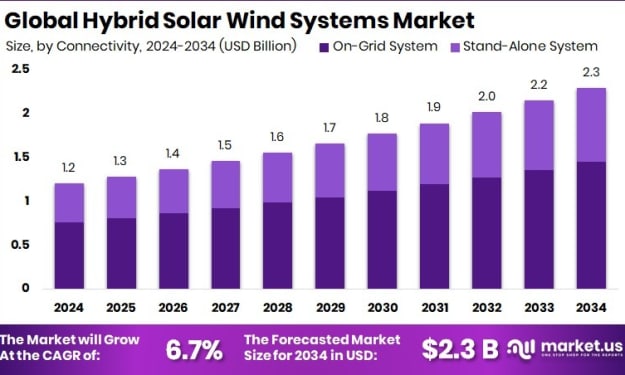
Hybrid Solar Wind Systems Market to Reach USD 2.3 Billion by 2034
The Global Hybrid Solar Wind Systems Market, valued at USD 1.2 billion in 2024, is projected to reach USD 2.3 billion by 2034, growing at a CAGR of 6.7% from 2025 to 2034. The Asia Pacific region led the market in 2024, holding a 43.8% share worth approximately USD 0.5 billion.
By Hayden Kulas2 days ago in Futurism



Comments
There are no comments for this story
Be the first to respond and start the conversation.