
Apple’s "Ultra" Gamble: 4 Surprising Ways the Mac Lineup is Changing Forever
From $599 entry-level laptops to the first-ever touchscreen MacBook, the tech giant is rewriting its own rulebook.

1. Introduction: The End of the "One Size Fits All" Era
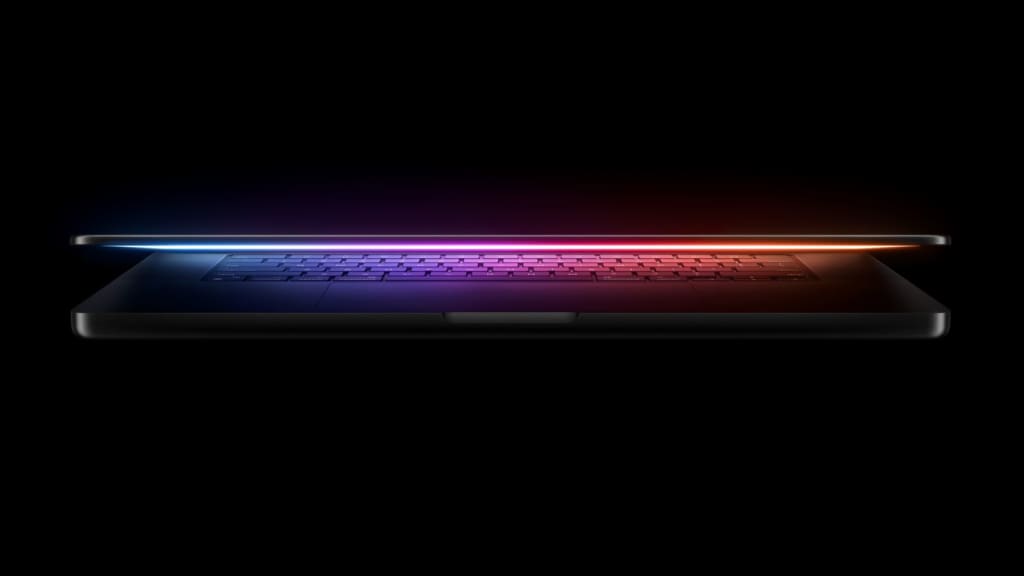
For years, Apple executives dismissed the idea of a touchscreen Mac as an ergonomic disaster, famously insisting that "vertical surfaces don't want to be touched." That long-standing refusal is finally crumbling as the company prepares for its most significant hardware pivot in a decade. The catalyst is the rumored "MacBook Ultra," a device that signals a fundamental shift in how Apple categorizes its computers. We are moving away from the streamlined "Air and Pro" simplicity and entering a new era defined by a vast spectrum of models designed to capture every possible consumer—from the budget-conscious student to the high-end creative.
2. The "MacBook Ultra": More Than Just a Pro Upgrade
While Apple just unveiled the M5 Pro and M5 Max MacBook Pros this week, the real shockwave comes from Bloomberg’s Mark Gurman and his latest "Power On" newsletter. Apple is reportedly preparing a flagship device for the fourth quarter of 2026 that breaks the traditional upgrade cycle. For months, we expected touchscreen and OLED technology to simply debut as features in a standard M6 MacBook Pro. However, the roadmap now points to an entirely new, top-tier category.
This "MacBook Ultra" isn't a replacement for the current pro models; instead, it is designed to sit comfortably above them. This is a counter-intuitive move for a company that usually consolidates its high-end features into a single "Pro" flagship. By creating a new tier, Apple can keep the M5 Pros on the market as the "standard" professional choice while offering a "super-premium" option for those who crave the tactile intimacy of a touchscreen and the vibrant, deep blacks of an OLED display. As Gurman notes, while the final naming remains fluid, a MacBook Ultra moniker would "clearly signal their position at the top of the lineup."
3. The 20% "OLED Tax": Why Premium is Getting More Expensive
Innovation at Apple rarely comes without a price hike, and the move to OLED for the Mac will likely follow a familiar, expensive script. Gurman points to a clear historical precedent: when Apple introduced OLED displays to the iPhone X in 2017 and the iPad Pro in 2024, consumers saw prices jump by approximately 20%.
This "OLED tax" is the cornerstone of Apple’s strategy to move the Mac further upmarket. By integrating touch functionality and superior display tech, Apple creates a psychological and financial gap between the "Pro" user and the "Ultra" enthusiast. These features aren't just about a prettier screen; they serve to justify a significantly higher price floor, turning the laptop into a luxury status symbol that commands a four-figure premium.
4. The $599 Paradox: Meet the MacBook Neo
While the high end is stretching toward the heavens, Apple is simultaneously diving into the trenches. This week’s unveiling of the $599 "MacBook Neo" is a seismic shift. This is an unprecedented price point for a new Apple laptop, designed specifically to dismantle the dominance of low-cost Windows machines and Chromebooks.
The secret to this aggressive pricing lies in the silicon. In a first for the Mac lineup, the Neo is powered by an iPhone chip—specifically the 6-core A18 Pro found in the iPhone 16 Pro. By repurposing this mobile architecture (albeit with one fewer GPU core), Apple has finally found the efficiency needed to hit the $600 mark. Recent benchmarks prove the Neo is no slouch, clocking a single-core score of 3461 and a multi-core score of 8668. For a company that has traditionally maintained high barriers to entry, the Neo represents a massive strategic shift toward total market saturation.
5. The "Ultra-fication" of Everything: iPhones and AirPods
This transition isn't limited to the Mac; it is a company-wide "Ultra-fication" that is fragmenting the once-simple Apple catalog. We are seeing a proliferation of tiers, from the rumored "iPhone Air" meant to slot into a new mid-range thin category, to the much-anticipated foldable iPhone—likely to be dubbed the "iPhone Ultra"—which is expected to command a ~$2,000 price tag and feature sophisticated under-display sensors.
Even the audio lineup is evolving into an active sensor platform. Reports suggest new "AirPods Ultra" are coming that sit above the current AirPods Pro, equipped with computer-vision cameras. This hardware transforms a passive audio device into an active AR/AI sensor, feeding "Visual Intelligence" data to Siri so the digital assistant can perceive and understand your environment in real-time. This isn't just a headphone upgrade; it’s a new category of wearable computer.
6. Conclusion: A Fragmented Future
Apple’s strategy has undergone a radical transformation. We are witnessing the death of the "Jobsian" four-quadrant grid—which neatly divided products into Consumer/Pro and Desktop/Portable—in favor of a "Continuum" model. By offering more models like the Neo, the Air, the Pro, and the Ultra, Apple is trading its legendary simplicity for a fragmented ecosystem that prioritizes market coverage and upsell opportunities.
Whether this complexity helps consumers find a perfect fit or merely complicates the buying experience will define the next decade of the Mac.
Are we ready for a world where an Apple laptop is as cheap as a smartphone, but a 'pro' experience requires a four-figure premium?
About the Creator
Tech Horizons
Exploring the future of technology, AI, gadgets, and innovations shaping tomorrow. Stay updated with Tech Horizons!
Keep reading
More stories from Tech Horizons and writers in Futurism and other communities.
Apple’s 2026 Reshuffle: 4 Surprising Shifts Redefining the Post-Ive Era
1. The "New" Apple Takes Shape The ghost of Jony Ive has finally left the building. Apple just concluded a "Big Week" that saw the release of seven distinct products—ranging from the breakthrough MacBook Neo to the M4 iPad Air and AirTag 2—but the real story isn't the hardware. It is the names on the leadership page.
By Tech Horizons2 days ago in Futurism
How I Turned One Automation Prompt Into a Tiny AI Business That Runs Itself
I turned a single, well‑designed automation prompt into a tiny AI business that runs almost entirely on autopilot: buyers find it, pay for it, get onboarded, and start using it with almost no involvement from me. The entire system is a prompt + a few no‑code workflows. In this article I’ll walk through how I did it, what I’d do differently, and how you can build your own AI automation asset without writing a line of backend code.
By abualyaanartabout 22 hours ago in Futurism
Australia Luxury Fashion Market: Rising Affluent Demand, Digital & Retail Expansion & Sustainability Trends
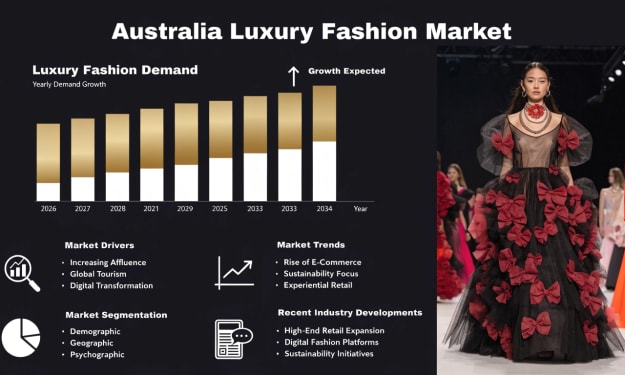
According to IMARC Group, the Australia luxury fashion market reached USD 5.2 Billion in 2025 and is projected to grow to USD 6.8 Billion by 2034, exhibiting a compound annual growth rate (CAGR) of 2.95% during 2026–2034. The steady expansion of the market reflects rising disposable incomes, growing affluent consumer segments, and evolving lifestyle aspirations across Australia. Luxury apparel, footwear, handbags, and accessories are increasingly viewed as lifestyle investments rather than occasional indulgences. As digital retail channels expand and sustainability becomes central to brand positioning, Australia luxury fashion market share continues to evolve within a competitive global landscape.
By Kevin Cooper7 days ago in Futurism


Comments
There are no comments for this story
Be the first to respond and start the conversation.