science
Topics and developments in science and medicine, presented by Futurism.
Latin America Cyber Security Market Analysis: Growth, Trends, and Forecast (2026-2034)
The digital landscape in Latin America is evolving at breakneck speed, but this rapid technological expansion has a dark side. Recent studies indicate that organizations in the region now face an average of 2,716 cyber attacks per week, a figure that stands 39% higher than the global average. As businesses scramble to protect their digital assets, the Latin America cybersecurity market has become a critical focal point for investors, governments, and enterprise leaders alike.
By Joey Mooreabout a month ago in Futurism
Exoplanet Atmospheres: Unexpected Discoveries That Are Changing Astronomy
For most of human history, planets beyond our Solar System were the stuff of speculation. Even after the first exoplanets were confirmed in the 1990s, they remained distant abstractions—numbers in databases, shadows in starlight, or subtle gravitational wobbles. Today, however, astronomers are doing something that once seemed impossible: directly probing the atmospheres of worlds orbiting other stars. And what they are finding is far stranger and more diverse than anyone expected.
By Holianyk Ihorabout a month ago in Futurism
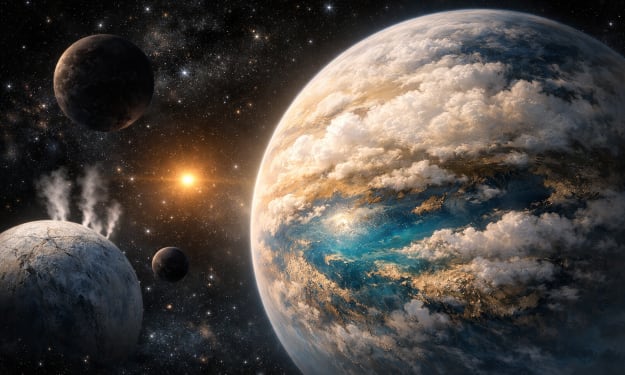
Why Most Potentially Habitable Planets Do Not Look Like Earth
When scientists and science fiction writers imagine habitable planets, they often picture something very similar to Earth: blue oceans, green continents, a breathable atmosphere, and a familiar sky. For decades, the search for life beyond our planet has been guided by this image of a “second Earth.” Yet modern astronomy is steadily revealing a surprising truth: most potentially habitable planets in the universe look nothing like Earth at all.
By Holianyk Ihorabout a month ago in Futurism
The State of Cyber Threats in Germany in 2026
Key Takeaways: AI Breaks the Language Barrier: Generative AI has dissolved Germany's natural linguistic defense, driving a 300% surge in grammatically perfect phishing and deepfake attacks. Market Explosion: The German cybersecurity sector is projected to hit $37.9B by 2033, fueled by strict compliance needs like NIS2 and rising industrial espionage. The Sovereign Cloud War: US hyperscalers are forced to launch "Sovereign Clouds" to compete with local pure-players like StackIT and bypass the US CLOUD Act. Industry 4.0 Under Siege: Cyberattacks have shifted from office IT to factory floor OT, impacting 87% of manufacturers with sabotage on unpatched machinery. Quantum "Code Red": The BSI has set a 2026 deadline for critical infrastructure to adopt quantum-resistant encryption to counter "Store Now, Decrypt Later" threats.
By Joey Mooreabout a month ago in Futurism
Could the Universe Be Closed Rather Than Infinite?
For most people, the idea of the Universe is inseparable from infinity. We imagine space stretching endlessly in every direction, with no limits, no edge, and no final destination. Infinity feels natural, almost inevitable. Yet modern cosmology poses a far more unsettling and fascinating question: what if the Universe is not infinite at all? What if it is closed—finite in size, but without any boundaries?
By Holianyk Ihorabout a month ago in Futurism
Why the Universe Looks Too Smooth to Be Born by Chance
When we imagine the birth of the Universe, we often picture something violent and chaotic: a sudden explosion of energy, matter flying in all directions, randomness ruling everything. Intuitively, such a beginning should leave behind a messy, uneven cosmos. Yet when astronomers observe the Universe on the largest possible scales, they see something very different. The Universe looks remarkably smooth, balanced, and orderly — almost too orderly for a purely random origin.
By Holianyk Ihorabout a month ago in Futurism
How pollen seasons are being extended by artificial light
The end of pollen season may be postponed by artificial light from city lights, prolonging the time that pollen is in the air. For city dwellers, the longer season modifies the duration and timing of allergy exposure.
By Francis Damiabout a month ago in Futurism
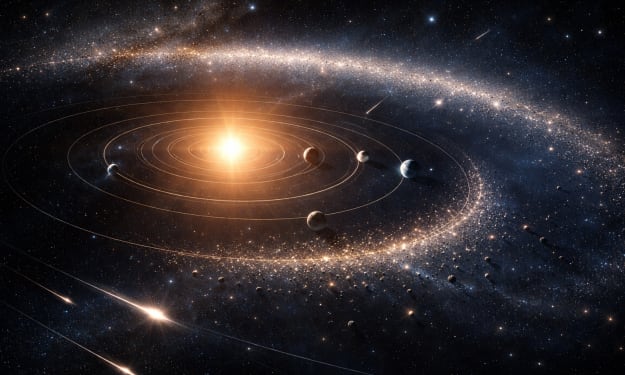
What Do We Really Know About the Boundaries of the Solar System?
When most people picture the Solar System, they imagine a neat diagram: the Sun at the center, planets orbiting in tidy circles, Pluto somewhere at the edge, and then—nothing. Empty space. The truth, however, is far more complex, fascinating, and mysterious. The Solar System does not end at a clear line, nor does it have a physical “wall.” Instead, it fades gradually into interstellar space through a series of overlapping and poorly understood regions. Even today, scientists cannot agree on a single answer to a deceptively simple question: where does the Solar System actually end?
By Holianyk Ihorabout a month ago in Futurism
Why Scientists Are Rethinking What Makes a Planet “Habitable”
For much of modern scientific history, the idea of a “habitable planet” seemed relatively straightforward. If astronomers wanted to find life beyond Earth, they needed to look for worlds that closely resembled our own: rocky planets, orbiting at just the right distance from their stars, with mild temperatures and liquid water on the surface. This concept shaped decades of research, telescope design, and space missions.
By Holianyk Ihorabout a month ago in Futurism
The cause of mysterious quick radio bursts could be unexpected.
Among the most peculiar signals we detect from space are fast radio bursts. They can outshine entire galaxies in radio light during their brief duration of a few thousandths of a second. One major question persisted for years: what kind of entity could produce something so loud and quick, sometimes repeatedly?
By Francis Damiabout a month ago in Futurism
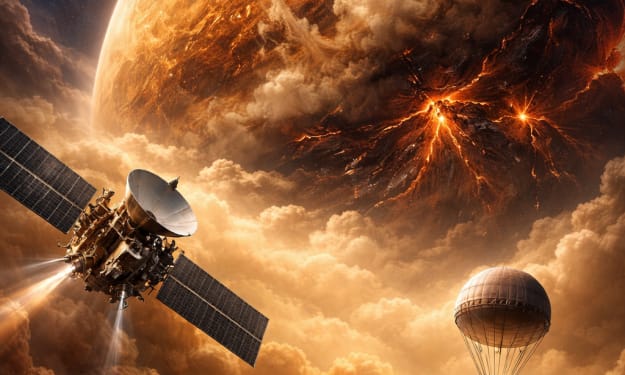
Venus Returns: Why the “Hell Planet” Is Back in the Spotlight of Science
For much of the space age, Venus was treated as a cautionary tale rather than a destination of hope. Nearly identical to Earth in size and composition, it once seemed like our planet’s twin. Instead, it turned out to be one of the most hostile worlds in the Solar System. Surface temperatures hot enough to melt lead, crushing atmospheric pressure, clouds of sulfuric acid, and a landscape shaped by catastrophic forces earned Venus its grim nickname: the hell planet.
By Holianyk Ihorabout a month ago in Futurism