space
Space: The Final Frontier. Exploring space developments and theorizing about how humans fit into the universe.
NASA's Kepler Space Telescope Continues Observations of TRAPPIST-1 Planetary System
The seven Earth-sized exoplanets orbiting the star TRAPPIST-1 generated a lot of excitement when their discovery was announced last month. This is the largest collection of Earth-sized worlds in one planetary system found so far, and some of them are well within the star's "habitable zone" where temperatures could allow liquid water to exist on their surfaces. Little else is known about the actual conditions on these planets so far, but NASA's Kepler Space Telescope has also been observing TRAPPIST-1 in recent weeks.
By Paul Scott Anderson9 years ago in Futurism
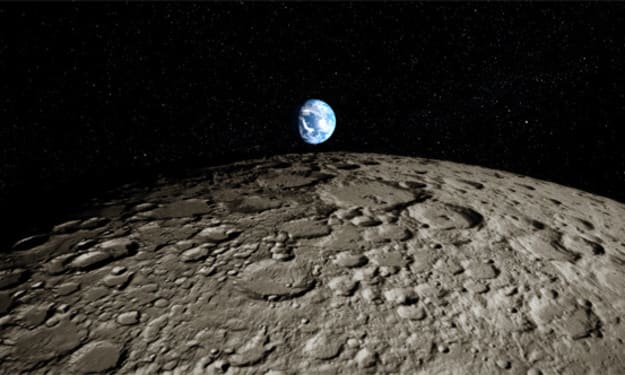
Third Eye on the Moon
It was in January of 2017 when, due to a lawsuit, the CIA was forced to release over thirteen million previously declassified files online to the public. These files were wide-ranging, including such topics as recipes for invisible ink, UFO cases, and even files pertaining to Project Stargate, a government-funded project which dealt with psychic powers and extrasensory perception. And while this was intriguing, to say the least, one psychic claims that he was used for an operation that stretched every boundary of his own abilities.
By Ryan Sprague9 years ago in Futurism
MH370 DISAPPEARANCE STILL A MYSTERY
Malaysia Airlines flight MH370 carrying 239 passengers and crew disappeared on 8 March 2014. The Boeing 777 took off from Kuala Lumpur heading for Beijing, an hour later radar contact was lost as it was flying northeastwards over the Gulf of Thailand.
By Nigel Watson9 years ago in Futurism
From the 2nd Book in the Series, "The Love of the Tayamni"
One hundred fifty thousand years ago, in a sector of the Perseus Spiral Arm near the Orion Spur, a lifeless planet was jostled out of orbit by a rogue spray of asteroids. The accumulating debris of which the planet was now a part, shot through space, hurtling through an empty void. Star systems, spread over millions of kilometers, left spaces between planets so great, the debris passed through unimpeded.
By Teresa McLaughlin9 years ago in Futurism
From the 1st Book of the Series, "The Love of the Tayamni"
The sky was a whirl of yellow and green. Dark clouds moved southwards. Sheets of rain and black shadows slid over sand and stone. A dim sun climbed higher as mists rose from seas of methane. On the rocky ground, crystals of water-ice, jagged, hard as granite thrust up through gravel. Black cylinders, towers built by an alien race, stood on the rocky crest of hills above this beach, waves of liquefied gas lapping against the shore. A breeze stirred dust further up from the lake. The rising sun, pale and green, cast glistening reflections on its surface.
By Teresa McLaughlin9 years ago in Futurism
Alien Down!
It was on the morning of January 18th, 1978, when New Jersey State Police requested entry onto McGuire Air Force Base. Along with the adjacent Fort Dix Base, UFOs had been reported earlier in the evening. But what the police said they were looking for was far stranger than just lights in the sky.
By Ryan Sprague9 years ago in Futurism
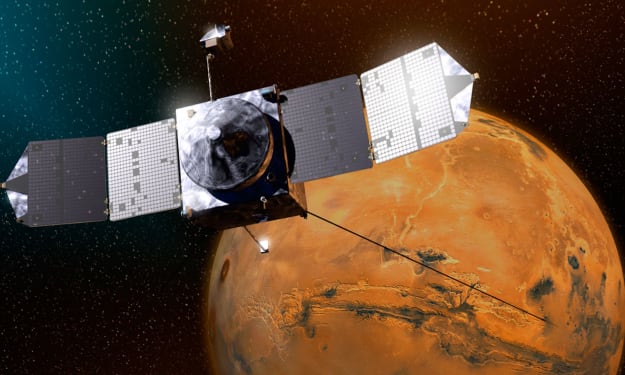
MAVEN Spacecraft Makes Evasive Maneuver to Avoid Impact With Mars' Moon Phobos
Mars is a busy place these days, with multiple rovers and orbiters exploring the planet. Out of the several spacecraft currently in orbit, NASA's Mars Atmosphere and Volatile EvolutioN (MAVEN) is a fairly recent addition, having been at Mars for just over two years now. Usually, things are pretty routine, but this week the spacecraft had to make an unplanned evasive maneuver - to avoid a collision with one of Mars' two small moons, Phobos!
By Paul Scott Anderson9 years ago in Futurism
Could the TRAPPIST-1 Planetary System Be Home to Alien Life?
The discovery of seven Earth-sized planets orbiting the star TRAPPIST-1 generated a lot of excitement last week. Earth-sized planets have been found before, among the thousands of exoplanets discovered so far by astronomers, but this is the first time that so many have been detected in one planetary system. As of now, astronomers are limited in how much they can learn about these new worlds, but the James Webb Space Telescope, the upcoming successor to Hubble due to launch in 2018, will be able to gather more data and analyze whatever atmospheres these planets have, perhaps bringing us closer to finding another habitable world.
By Paul Scott Anderson9 years ago in Futurism