
Why V for Vendetta is Scarily Relevant Today
Reflecting on V for Vendetta for Its 20th anniversary

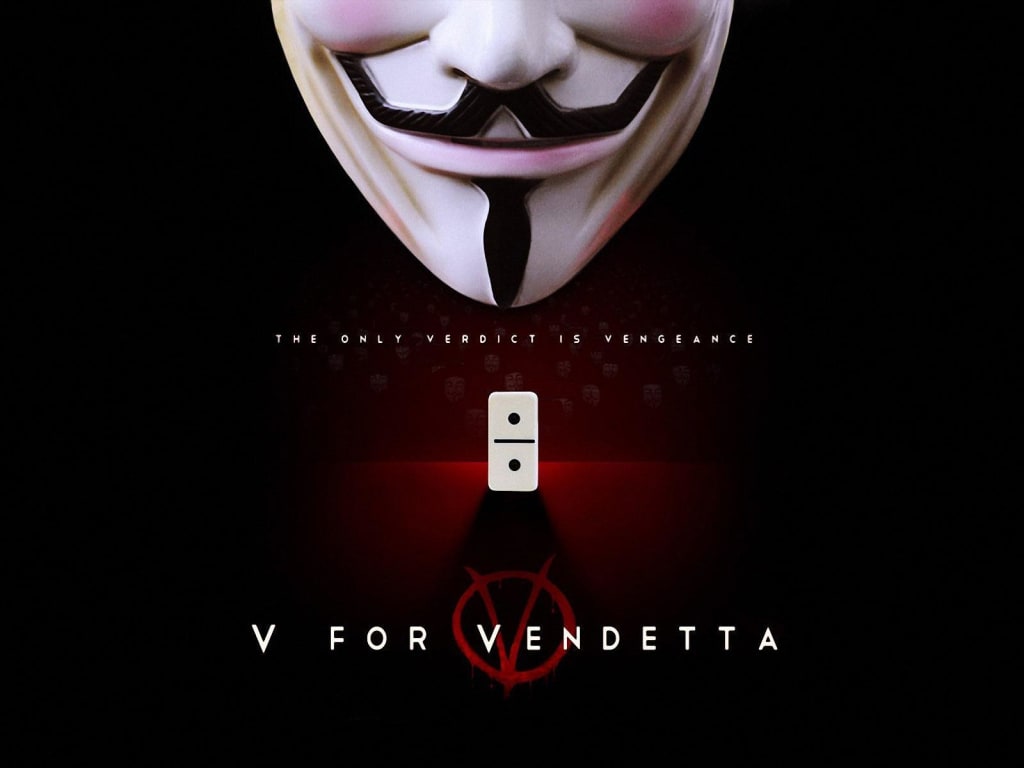
Plot Summary
In a dystopian Britain ruled by a dictatorial government, fear and oppression dominate everyday life. A masked vigilante known as V wages a campaign against the corrupt regime, targeting its leaders and symbols of totalitarianism. He rescues a young woman named Evey Hammond, exposing her to the brutal realities of tyranny and the importance of freedom. Inspired, Evey joins V's struggle, confronting her own fears and morality. Together, they defy the regime, igniting a resistance movement. Through V's rebellion, Evey learns courage and the transformative power of resistance.
Outstanding Performances from The Cast
One of the movie's greatest strengths is its cast, who bring emotional weight and credibility to the narrative. Natalie Portman delivers a compelling portrayal of Evey Hammond as a character with a convincing mix of innocence and vulnerability, gradually showing her growth as she navigates daily life under the repressive dominion led by High Chancellor Adam Sutler.
Equally impressive is Hugo Weaving as the mysterious revolutionary known as V. Weaving conveys a remarkable range of emotion through voice and body language, giving V a commanding presence as a symbol of opposition determined to put an end to Sutler's reign of terror.
Meanwhile, John Hurt brings intensity to the role of Sutler, portraying the High Chancellor as a ruthless dictator who rules with an iron fist. Even when speaking through monitors or broadcasts, his stoic yet menacing demeanor commands attention, making his presence a constant reminder of the regime's domineering power.
The supporting cast is equally strong. Stephen Fry adds warmth and humanity as Dietrich, Evey's trusted confidant, while Tim Pigott-Smith delivers a memorable performance as Peter Creedy, the calculating head of the secret police whose cold ambition makes him one of the regime's most lethal enforcers.
At the same time, Stephen Rea portrays Eric Finch, the relentless inspector determined to track down V once and for all. As Finch investigates the regime's secrets, his growing awareness of the government's corruption adds tension and moral complexity to the story.
The Most Powerful and Chilling Moments
Several scenes in V for Vendetta stand out for their emotional weight. They help define the film's unsettling atmosphere. Early in the movie, Evey Hammond is walking in a dark alley before being confronted by two Fingermen — agents of the regime who brutally enforce its laws. As they attack her, the vigilante V appears and rescues her. This scene not only introduces V as an enigmatic character but also sets the stage for the fight against tyranny that drives the rest of the story.
Not all moments are violent. Some of the movie's touching scenes come from the developing bond between V and Evey. In one particularly heartfelt moment, they watch the classic movie The Count of Monte Cristo and discuss its ending. The story's themes of betrayal, justice, and revenge parallel many of the ideas explored throughout V for Vendetta, making the scene feel like a deliberate reflection of the movie's plot.
The story turns disturbing when the regime retaliates against those who openly challenge it. After Dietrich broadcasts a satirical segment mocking Adam Sutler, secret police burst into his home and arrest him. The disturbing image of Dietrich being beaten by officers highlights just how dangerous self-expression can be in a totalitarian government. Evey attempts to flee but is captured as well, reinforcing the oppressive environment surrounding the characters.
Perhaps one of the most haunting scenes occurs when Evey is imprisoned and has her head shaved. As she trembles and weeps, the audience cannot help but feel empathy for her suffering. Yet despite her fear and isolation, she refuses to betray V, demonstrating remarkable strength.
The movie ultimately builds toward an intense showdown between V and the regime's soldiers led by Peter Creedy, delivering a memorable climax that captures the spirit of tyranny.
Behind The Scenes Facts About V for Vendetta
V for Vendetta contains several fascinating behind-the-scenes facts that reveal the effort and creativity that went into its production. One of the most notable features of the movie is it is adapted from the graphic novel written by Alan Moore and illustrated by David Lloyd. Although the source material was praised for its political themes and dystopian storytelling, Moore distanced himself from the film, arguing it undermined the story's message and chose not to have his name prominently attached, according to an article on Critic Film.
V's iconic mask is modeled after Guy Fawkes, a historical figure involved in the failed Gunpowder Plot. On November 5th, 1605, Fawkes and a group of conspirators attempted to blow up Parliament in an effort to overthrow the government. Although the plan was ultimately thwarted and Fawkes was executed for orchestrating it, the mask has come to represent resistance and political dissent, and it has been adopted by activist groups such as Anonymous during protests around the world.
The production also faced technical difficulties. Hugo Weaving originally performed all of V's dialogue while wearing the mask during filming. Nevertheless, the mask's design muted his voice so much that it made it impossible to comprehend the dialogue. As a result, Weaving had to re-record most of his lines in a studio to ensure the character's voice remained expressive and understandable.
Another memorable behind-the-scenes detail involves the iconic domino scene, in which V carefully arranges thousands of dominoes to create a giant letter "V". The filmmakers utilized practical effects, rather than digital ones, and the setup reportedly took weeks to prepare and multiple takes to execute successfully.
Analyzing The Movie's Themes and Symbolism
At its core, the tension between tyranny and freedom forms the backbone of the narrative. The movie presents a society under a totalitarian government where fear, surveillance, and propaganda dominate everyday life. Citizens cannot think or speak freely, as dissent is forbidden. High Chancellor Adam Sutler rises to power following a deadly biological disaster and uses this crisis to justify enacting unjust laws, implementing tight surveillance, and cracking down on freedom of speech.
V embodies resistance and the power of change. One of the movie's most memorable lines declares "Beneath this mask is more than flesh. Beneath this mask is an idea. And ideas are bulletproof," emphasizing that ideas cannot be destroyed easily. V explains to Evey that symbols gain meaning when people unite, as in his plan to challenge the regime — an act intended to spark mass rebellion. Historical parallels exist, such as the fall of the Berlin Wall in 1989, highlighting the power of collective action against tyrannical governments.
The movie underscores the regime's persecution of minorities. One character is executed for owning a Quran, highlighting extreme religious intolerance. While behind bars, Evey discovers a letter from Valerie, a lesbian who suffered and was ultimately executed by the government. Although they never meet, Valerie's story inspires Evey to stand up to subjugation and remain courageous.
Inspector Eric Finch, who uncovers the regime's horrific acts, embodies moral awakening. Even as a member of the system, he begins to question authority, chooses conscience over blind obedience, and quietly permits acts of protest. His arc demonstrates that even within oppressive systems, people can act morally and realize when ethical boundaries have been crossed.
The themes remain relevant today. In the United States of America, agencies like ICE conduct raids that spark debates about the limits of authority and civil rights, although free speech protects criticism of leaders such as Donald Trump. Historically, figures such as Andrew Jackson exercised authoritarian-style power, yet within constitutional limits. On the other hand, countries like North Korea punish defiance mercilessly, showing how closely the movie's warnings about oppression resonate in real-world contexts.
V for Vendetta: Lessons on Freedom and Resistance
When I watched V for Vendetta for the first time, it haunted me long after the credits rolled. Its vision of a society ruled by fear and control lingered in my mind, particularly Valerie's account of navigating life as a member of the LGBT community. Although I have never read the original graphic novel, the movie alone delivers a powerful message about standing up to tyranny. Its themes echo the Declaration of Independence — life, liberty, and the pursuit of happiness — underscoring that these rights demand vigilance, courage, and principled action.
About the Creator
TheScreenAnalyst
I am a passionate movie and TV enthusiast, devoted to analyzing storytelling, characters, visuals, and performances. I provide thoughtful critiques and insights, exploring both mainstream and independent works to engage audiences.
Keep reading
More stories from TheScreenAnalyst and writers in Geeks and other communities.
Revisiting She's The Man: Gender, Identity, and the Legacy Of a Teen Comedy
Plot Summary She's The Man centers on Viola Hastings, a talented teenage soccer player frustrated when her school disbands the girls' team and is denied an opportunity to try out for the boys' squad. Determined to prove herself, she disguises herself as her brother, Sebastian, and enrolls at his boarding school, Illyria Prep. There, she joins the boys' soccer team while struggling to maintain her secret identity. Complications arise when she develops feelings for her roommate and becomes involved in romantic misunderstandings involving Duke and Olivia. Ultimately, Viola must reveal the truth in a climactic match that tests her courage and convictions.
By TheScreenAnalyst5 days ago in Geeks
The Politics of Playing Dress-Up
Well, to start off I'd like to say a happy world book day to all who celebrate. I know I haven't really posted anything on my socials about it but I'm not a jubilant kind of person. I lay low most of the time. Let's start off with a popular anecdote from the vaults...
By Annie Kapur7 days ago in Geeks
Book Review: "The Palace"by Gareth Russell (Pt. 2)
This review covers chapter 4 through to the end of chapter 6 *** We've covered people such as Elizabeth of York, Thomas Woolsley, Martin Luther and even Anne Boleyn but now it is time to move on from these figures. It is proven that Gareth Russell has done such an incredible amount of research here and the book itself is a fantastic achievement of nonfiction literature regardless of your personal feelings towards the royal family. Gareth Russell's writing and insight makes the book even more intriguing to read as he offers us arguments to consider, thoughts to ponder on and stories of whispering gossip that lurk inside the walls of this great palace.
By Annie Kapura day ago in Geeks




Comments
There are no comments for this story
Be the first to respond and start the conversation.