
Circumcision in Ancient Egypt: Ritual, Identity, and Medical Practice
Exploring why circumcision held cultural, religious, and social importance in one of the world’s earliest civilizations.

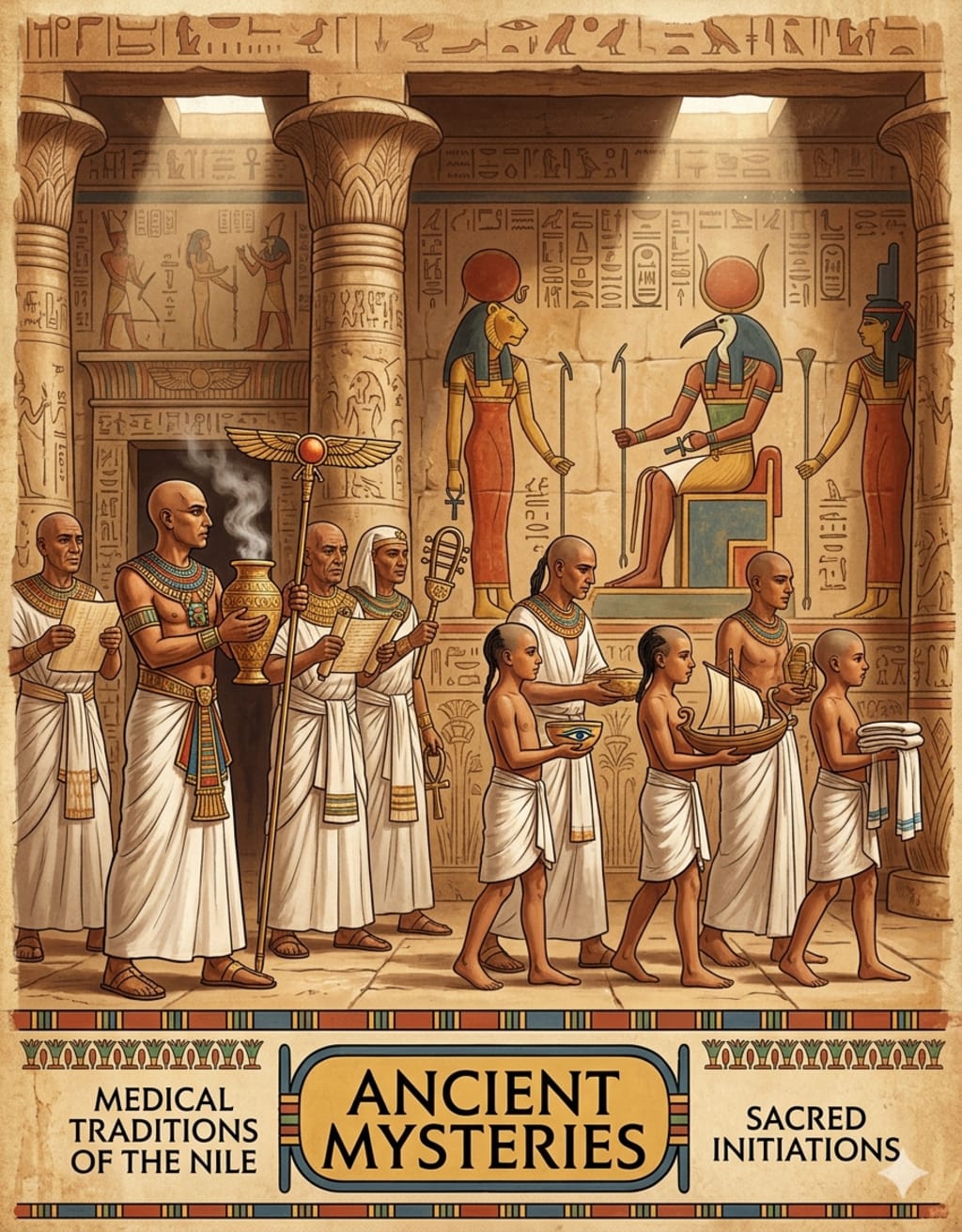
Circumcision, the surgical removal of the foreskin from the male genitalia, is a practice that dates back thousands of years. Among the earliest civilizations known to have practiced circumcision were the ancient Egyptians. Evidence from archaeological discoveries, wall carvings, and historical writings suggests that circumcision was not merely a medical procedure in Ancient Egypt but a practice deeply embedded in religious beliefs, social identity, and cultural traditions.
The earliest evidence of circumcision in Ancient Egypt comes from tomb carvings dating back to around 2400 BCE during the Old Kingdom period. One of the most famous depictions appears in the Tomb of Ankhmahor in Saqqara, often referred to as the “Physician’s Tomb.” The wall reliefs in this tomb clearly show a circumcision procedure being performed on a young male while assistants help restrain him. The accompanying hieroglyphic inscriptions suggest that the procedure was conducted by trained practitioners and was considered a normal part of life in Egyptian society.
Scholars believe circumcision in Ancient Egypt was primarily a rite of passage marking the transition from childhood to adulthood. Much like initiation ceremonies in other ancient cultures, circumcision symbolized maturity, responsibility, and readiness to participate fully in society. Young boys undergoing circumcision were likely being formally welcomed into the adult community, which carried social and religious obligations.
Religious beliefs also played a crucial role in the Egyptian practice of circumcision. Ancient Egyptian culture placed a strong emphasis on purity, cleanliness, and bodily order. Many religious rituals required physical cleanliness before entering temples or participating in sacred ceremonies. Circumcision may have been associated with this concept of ritual purity, reinforcing the idea that the body should be maintained in a state acceptable to the gods.
Priests in Ancient Egypt were particularly known for following strict hygiene and purification practices. Historical records indicate that temple priests often shaved their entire bodies and performed regular cleansing rituals before conducting religious ceremonies. Some historians suggest that circumcision may have been a requirement for certain religious roles, though evidence on this point remains debated among scholars.
Another factor contributing to the Egyptian interest in circumcision may have been health and hygiene. Living in a hot desert climate, maintaining personal hygiene was an important concern. While ancient Egyptians did not possess modern medical knowledge about infections or bacteria, they were surprisingly advanced in their understanding of cleanliness and medical treatments. Medical papyri, such as the Ebers Papyrus, reveal detailed knowledge of anatomy, surgical techniques, and herbal remedies. Circumcision may have been seen as beneficial for maintaining genital cleanliness in such an environment.
Social class may also have influenced the practice. Some researchers believe circumcision was initially limited to elite groups, such as priests or members of the upper class, before gradually spreading throughout broader segments of society. The existence of ceremonial depictions in tombs of high-ranking officials suggests that the practice held symbolic prestige. Over time, it may have evolved into a more common cultural norm.
Ancient Egyptian art and literature often reflect a society deeply concerned with order, symbolism, and ritual. Circumcision likely carried symbolic meanings connected to these values. Some historians propose that it represented the removal of impurity or excess, aligning the body with ideals of balance and perfection that were central to Egyptian philosophy.
The practice of circumcision in Ancient Egypt also influenced neighboring cultures and later religious traditions. Many scholars believe that circumcision spread from Egypt to surrounding regions through cultural contact and migration. Some theories even suggest that the Israelites may have adopted circumcision during periods of interaction with Egypt, later incorporating it into their own religious covenantal traditions.
Despite the extensive archaeological evidence, historians still debate many aspects of circumcision in Ancient Egypt. Questions remain about the exact age at which the procedure was performed, whether it was universal among all males, and the precise religious meanings attached to it. However, the available evidence clearly shows that circumcision was an established and socially significant practice within Egyptian civilization.
In conclusion, circumcision in Ancient Egypt was far more than a simple surgical procedure. It served as a powerful symbol of social transition, religious purity, and cultural identity. Through archaeological findings, historical texts, and artistic depictions, we can see how this practice reflected broader Egyptian values related to health, spirituality, and societal structure. The Egyptian interest in circumcision demonstrates how medical practices in ancient societies were often closely intertwined with religion, culture, and concepts of human identity.
About the Creator
Irshad Abbasi
Ali ibn Abi Talib (RA) said 📚
“Knowledge is better than wealth, because knowledge protects you, while you have to protect wealth.
Keep reading
More stories from Irshad Abbasi and writers in History and other communities.
Discovery of a Massive Void Inside Khufu’s Pyramid Stuns Archaeologists
The ancient world continues to reveal its secrets, and one of the most remarkable discoveries in recent years has emerged from the heart of Egypt’s most famous monument—the Great Pyramid of Giza. Scientists and archaeologists have confirmed the presence of a large previously unknown void inside the pyramid of Pharaoh Khufu, sparking global excitement and renewed curiosity about how and why this monumental structure was built more than 4,500 years ago.
By Irshad Abbasi about 10 hours ago in History
The Man Who Lit the World
In a small village called Smiljan, in what is now modern-day Croatia, a boy was born on a stormy night in July 1856. Lightning flashed across the sky again and again, and thunder roared loudly. The midwife looked at the baby and said, “This child will be a child of darkness.” But his mother smiled and replied, “No, he will be a child of light.” That child was Nikola Tesla, one of the greatest inventors the world has ever known. Early Curiosity From a very young age, Tesla showed signs that he was different from other children. He had an incredible memory and a powerful imagination. He could picture machines in his mind and test how they would work without even building them. His father, Milutin Tesla, wanted him to become a priest, but Tesla was fascinated by science and electricity. Tesla’s mother, Đuka Tesla, was very intelligent and skilled at creating tools for household work. Although she had never received formal education, she inspired Tesla’s creativity and love for invention. Tesla often said that his ability to invent came from his mother. As a boy, Tesla loved reading books about science and mathematics. He studied hard and later attended the Graz University of Technology in Austria. There he became deeply interested in electricity, which was still a new and mysterious force at the time. The Dream of Alternating Current In the late 1800s, electricity was beginning to power cities. However, the system used at that time, called direct current (DC), could only travel short distances. This made it difficult to supply electricity to large areas. Tesla believed there was a better way. One day, while walking in a park and reciting poetry from Johann Wolfgang von Goethe, an idea suddenly appeared in his mind. He imagined a system called alternating current (AC) that could send electricity over long distances efficiently. Tesla was so excited that he drew the design of the motor right there in the sand. Journey to America In 1884, Tesla decided to travel to the United States with almost no money in his pocket. He carried only a few belongings and a letter of recommendation for the famous inventor Thomas Edison. When Tesla arrived in New York City, he began working for Edison. At first, Tesla improved some of Edison’s electrical machines. However, the two inventors had very different ideas about electricity. Edison strongly supported direct current (DC), while Tesla believed alternating current (AC) was the future. Their disagreement became part of what history calls the “War of Currents.” A Powerful Partnership After leaving Edison’s company, Tesla struggled for some time. He even worked digging ditches to survive. But he never gave up on his dream. Soon, Tesla met a businessman named George Westinghouse. Westinghouse believed in Tesla’s AC system and decided to support him. Together they developed electrical systems that could power entire cities. Their success became clear during the World's Columbian Exposition in Chicago. Tesla’s alternating current system lit up the entire exhibition with bright electric lights. Millions of visitors saw the power of AC electricity for the first time. Soon after, Tesla’s system was used to build a massive power plant at the Niagara Falls. The plant generated electricity from the waterfall and sent it to nearby cities. It was one of the greatest engineering achievements of its time. The Brilliant but Lonely Inventor Tesla invented many amazing technologies. He created the Tesla coil, improved radio communication, and worked on wireless transmission of electricity. Many scientists believe his ideas helped shape modern technologies such as radio, robotics, and wireless communication. However, Tesla’s life was not always easy. He cared more about ideas than about money or business. Because of this, other inventors sometimes became richer and more famous than him. Tesla spent much of his later life working alone in laboratories and hotels. Even though he made hundreds of inventions, Tesla died in 1943 with little money and few possessions. Yet the world slowly began to realize how important his work had been. A Legacy That Powers the World Today, Tesla’s ideas are everywhere. The electricity that powers homes, schools, and cities around the world mostly uses alternating current, the system Tesla believed in more than a century ago. His name is honored by the innovative technology company Tesla, Inc., which produces electric cars and advanced energy systems. Scientists and engineers now recognize Tesla as one of the most brilliant inventors in history. The Lesson from Tesla’s Life The story of Nikola Tesla teaches us an important lesson: great ideas often come from imagination, persistence, and courage. Tesla faced many failures, disagreements, and financial problems. But he never stopped believing in his vision of a brighter world powered by electricity. Just as his mother predicted on that stormy night, Tesla truly became a “child of light.” And today, every time a city lights up after sunset, a small part of Tesla’s dream shines with it. ⚡
By Sahir E Shafqat4 days ago in History



Comments
There are no comments for this story
Be the first to respond and start the conversation.