
From Empire to Republic: The Rise and Fall of the Ottoman Superpower
How six centuries of Ottoman dominance ended and modern Turkey emerged from the ruins of an empire

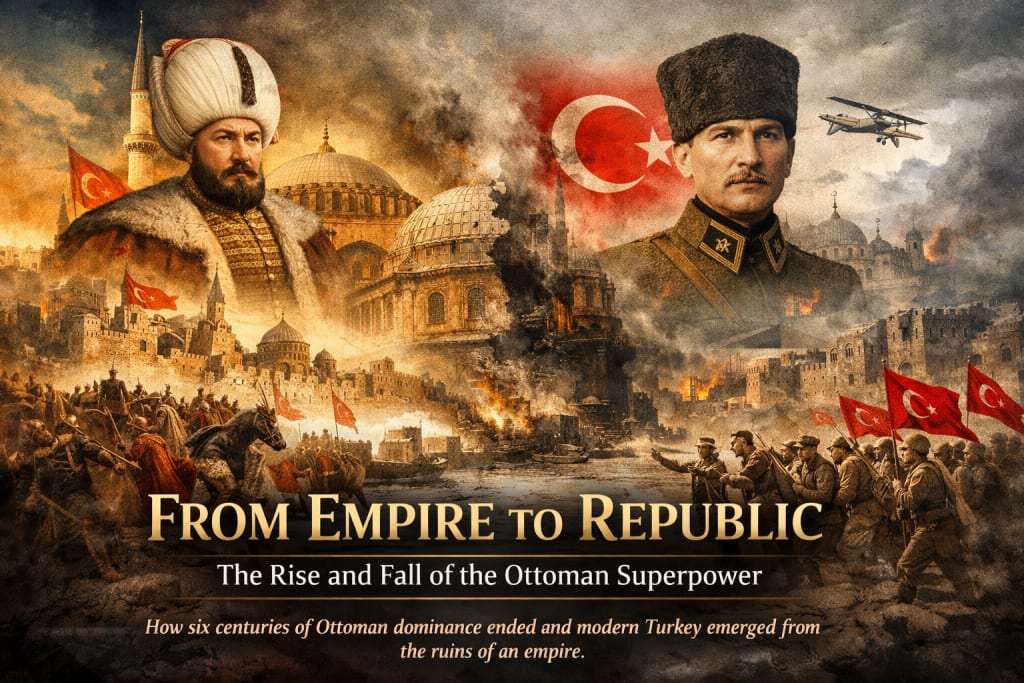
For more than six centuries, the Ottoman Empire stood as one of the most powerful and influential states in world history. Stretching across three continents—Europe, Asia, and Africa—it controlled strategic trade routes, diverse populations, and some of the most important cities of the medieval and early modern world. Yet by the early twentieth century, this once-mighty empire collapsed, giving birth to the modern Republic of Turkey. The story of its rise and fall is one of military brilliance, political struggle, and dramatic reform.
The Ottoman state was founded around 1299 by Osman I, a Turkish tribal leader in Anatolia. From a small frontier principality, Osman and his successors gradually expanded their territory. Their strategic location between Asia and Europe allowed them to control important trade routes and confront rival powers.
One of the most defining moments in Ottoman history came in 1453, when Mehmed II captured Constantinople from the Byzantine Empire. This event marked the end of the Byzantine state and transformed Constantinople—later called Istanbul—into the capital of the Ottoman Empire. The conquest established the Ottomans as a dominant political and military force.
During the sixteenth century, the empire reached its golden age under Suleiman the Magnificent. At its peak, the Ottoman Empire controlled large parts of Southeast Europe, the Middle East, and North Africa. The Ottomans built a powerful army, including the famous Janissary corps, and developed an efficient administrative system that governed diverse ethnic and religious communities.
However, by the seventeenth century, the empire began to face growing challenges. European powers were rapidly advancing in technology, industry, and military organization. Meanwhile, corruption, political instability, and weak leadership gradually weakened the Ottoman state. Military defeats against European rivals further exposed the empire’s vulnerabilities.
One significant turning point was the Great Turkish War (1683–1699), which began after the failed Battle of Vienna (1683). The Ottomans suffered major territorial losses in Europe, signaling that their period of expansion had ended. From this point onward, the empire increasingly struggled to maintain its authority.
During the nineteenth century, the Ottoman Empire became known in Europe as the “Sick Man of Europe.” Nationalist movements spread among many ethnic groups within the empire, including Greeks, Serbs, Bulgarians, and Arabs, who sought independence. At the same time, European powers frequently intervened in Ottoman affairs.
In response, Ottoman leaders attempted to modernize the state through a series of reforms known as the Tanzimat Reforms (1839–1876). These reforms aimed to modernize the army, legal system, and bureaucracy while granting greater rights to citizens. Although the reforms introduced important changes, they were not enough to stop the empire’s decline.
The final blow came during World War I (1914–1918). The Ottoman Empire joined the war on the side of the Central Powers, including Germany and Austria-Hungary. After their defeat, the empire collapsed. Allied powers occupied large parts of Ottoman territory, and plans were made to divide the remaining lands.
However, a nationalist movement emerged in Anatolia under the leadership of Mustafa Kemal Atatürk. Determined to protect Turkish sovereignty, Atatürk led the Turkish War of Independence (1919–1923) against foreign forces and local opposition.
The nationalist forces succeeded in expelling occupying armies and renegotiating the political future of the region. In 1923, the Republic of Turkey was officially established, with Ankara as its capital. The Ottoman sultanate was abolished, ending more than 600 years of imperial rule.
Atatürk then launched a series of sweeping reforms to modernize the new nation. These included adopting a secular political system, introducing a new legal code, changing the alphabet from Arabic to Latin script, and promoting education and industrial development. His reforms transformed Turkey into a modern nation-state.
The fall of the Ottoman Empire marked the end of one of history’s longest-lasting empires, but it also paved the way for the creation of modern Turkey. From the leadership of Osman I to the revolutionary reforms of Atatürk, the transition from empire to republic remains one of the most dramatic political transformations of the twentieth century.
Today, the legacy of the Ottoman Empire continues to shape politics, culture, and history across the Middle East, Europe, and beyond.
About the Creator
Irshad Abbasi
Ali ibn Abi Talib (RA) said 📚
“Knowledge is better than wealth, because knowledge protects you, while you have to protect wealth.
Keep reading
More stories from Irshad Abbasi and writers in History and other communities.
After the Führer: Who Inherited Adolf Hitler’s Vast Wealth?
When Adolf Hitler died by suicide on April 30, 1945, inside his bunker in Berlin, the Third Reich was collapsing around him. Soviet troops were closing in, and Nazi Germany was on the brink of total defeat. Yet even as Europe lay in ruins, a curious legal and financial question lingered: what happened to Hitler’s personal wealth, estimated to be worth hundreds of millions—if not billions—of today’s dollars?
By Irshad Abbasi a day ago in History
There Are Tree That Literally Grow Gold and Scientists Are Obsessed
I remember the exact moment I stopped thinking about gold the way everyone else does. I was standing in a sun-drenched clearing, watching the way afternoon light moved through the canopy above me, turning every leaf translucent and warm. It looked, genuinely, like the trees were glowing.
By CurlsAndCommasa day ago in History


Comments
There are no comments for this story
Be the first to respond and start the conversation.