
GDP After War: How Conflicts Reshape National Economies
From Destruction to Recovery — The Economic Reality Countries Face After War

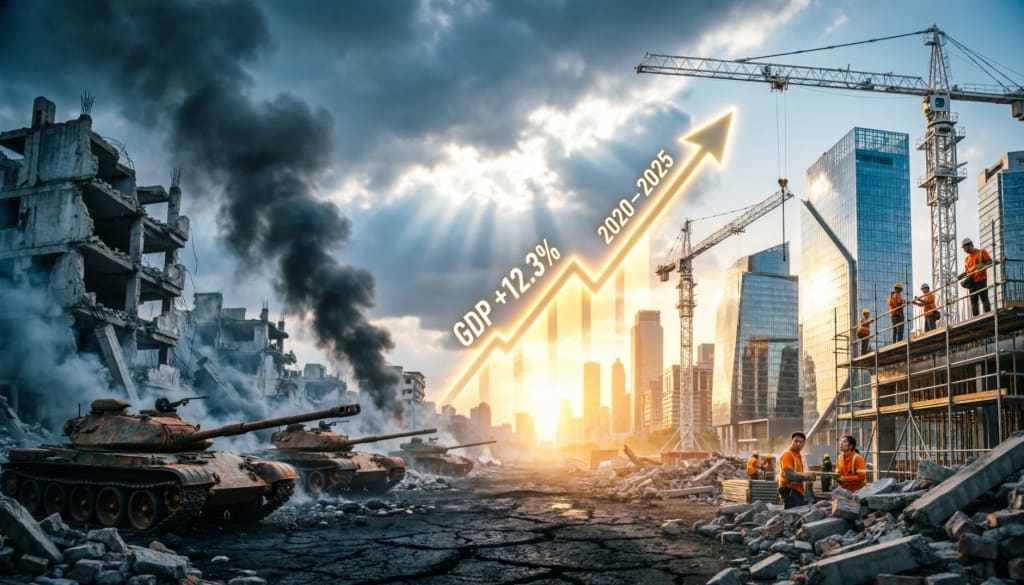
GDP After War: How Conflicts Reshape National Economies
War is not only fought on battlefields; it also leaves deep scars on a country's economy. One of the most important indicators affected by war is Gross Domestic Product (GDP), which measures the total value of goods and services produced by a nation. When war begins, economic activity often collapses, infrastructure is destroyed, and government spending shifts heavily toward military needs. But the economic story does not end when the war stops. The period after war can be equally challenging and sometimes surprisingly transformative.
During a war, industries such as tourism, manufacturing, and trade usually suffer major disruptions. Roads, ports, power plants, and factories may be damaged or destroyed, making it difficult for businesses to operate normally. As a result, GDP often declines significantly during active conflict. For example, the economy of Ukraine experienced a major contraction after the war with Russia intensified. Agricultural exports, industrial production, and transportation networks were all severely affected.
However, after the fighting ends, countries often enter a period of reconstruction. Governments and international partners begin rebuilding cities, repairing infrastructure, and restoring economic activity. This reconstruction phase can sometimes create rapid economic growth because large investments flow into rebuilding projects. Construction companies, engineering firms, and technology providers become heavily involved in restoring damaged infrastructure.
One of the most famous historical examples is the recovery of Germany after World War II. At the end of the war, Germany’s economy was devastated. Cities were destroyed, factories were damaged, and millions of people were displaced. However, with the help of international support programs like the Marshall Plan, Germany rebuilt its industries and infrastructure. Within a few decades, it became one of the strongest economies in the world.
Another example is Japan, which also suffered immense destruction during World War II. Despite the devastation, Japan rebuilt its economy through industrial modernization, technology development, and international trade. By the late 20th century, Japan had become one of the world’s largest economic powers.
In modern conflicts, economic recovery often depends on several key factors. One major factor is political stability. If a country can establish stable governance after war, investors and international organizations are more likely to provide financial assistance and development funding. Without stability, economic recovery becomes extremely difficult.
International organizations also play an important role in post-war economic rebuilding. Institutions such as the World Bank and the International Monetary Fund often provide loans, technical assistance, and policy guidance to help countries stabilize their economies after conflict.
Foreign investment is another key element of post-war recovery. When international companies invest in rebuilding industries, energy systems, telecommunications, and transportation networks, they help generate jobs and economic activity. This can gradually increase GDP and restore economic confidence.
However, not all countries recover quickly after war. In some cases, conflicts create long-term economic damage that lasts for decades. If infrastructure is not rebuilt, skilled workers migrate to other countries, or political instability continues, economic growth may remain weak for many years.
War can also create heavy national debt. Governments often borrow large amounts of money to finance military operations during conflict. After the war ends, they must manage these debts while also funding reconstruction projects. Balancing these financial pressures can be extremely difficult for developing countries.
Another challenge is rebuilding human capital. Wars often cause large numbers of casualties and force people to leave their homes. Education systems may be disrupted, and skilled professionals may move abroad for safety. Rebuilding a strong workforce becomes an important part of economic recovery.
Despite these difficulties, history shows that many countries can eventually rebuild stronger economies after war. Reconstruction often encourages modernization, new technologies, and improved infrastructure. In some cases, rebuilding efforts can even create more efficient industries than existed before the conflict.
Today, global economic cooperation also plays a role in supporting recovery. Countries affected by war often receive humanitarian aid, development funding, and technical support from international partners. These resources can help restore economic activity and stabilize financial systems.
Ultimately, the relationship between war and GDP shows how deeply conflict affects societies. War destroys wealth and infrastructure, but the recovery process can create opportunities for rebuilding and reform. The speed and success of economic recovery depend on leadership, stability, international support, and the determination of people to rebuild their country.
The lesson from history is clear: while war can devastate economies, strong planning and cooperation can help nations recover and grow again. For countries facing conflict today, the challenge will be transforming destruction into reconstruction and rebuilding their economies for future generations.
About the Creator
Wings of Time
I'm Wings of Time—a storyteller from Swat, Pakistan. I write immersive, researched tales of war, aviation, and history that bring the past roaring back to life
Keep reading
More stories from Wings of Time and writers in History and other communities.
Are the Chances of World War III Increasing?
Are the Chances of World War III Increasing? In recent years, many analysts, journalists, and ordinary citizens have begun asking a serious question: Is the world moving closer to World War III? While no global war has started, several major conflicts and political rivalries are creating a tense international environment. Wars, military buildups, nuclear weapons, and technological competition are making global security more fragile than it has been in decades.
By Wings of Time 2 days ago in History
America Will LOSE This War Part 1
Can you imagine that in 2026 the world’s only superpower, the United States, could lose to a country it has been sanctioning for the past 40 years? This isn’t my claim—it’s the prediction of Professor Syne, whose two predictions about Trump have already come true. Now the world is waiting for the third one.
By Imran Ali Shah4 days ago in History



Comments
There are no comments for this story
Be the first to respond and start the conversation.