
Mathematics Behind the Imperial Harem: How Ancient Chinese Scholars Organized the Emperor’s 121 Women
A fascinating look at how mathematics, discipline, and imperial ritual shaped the intimate schedule of China’s emperors.

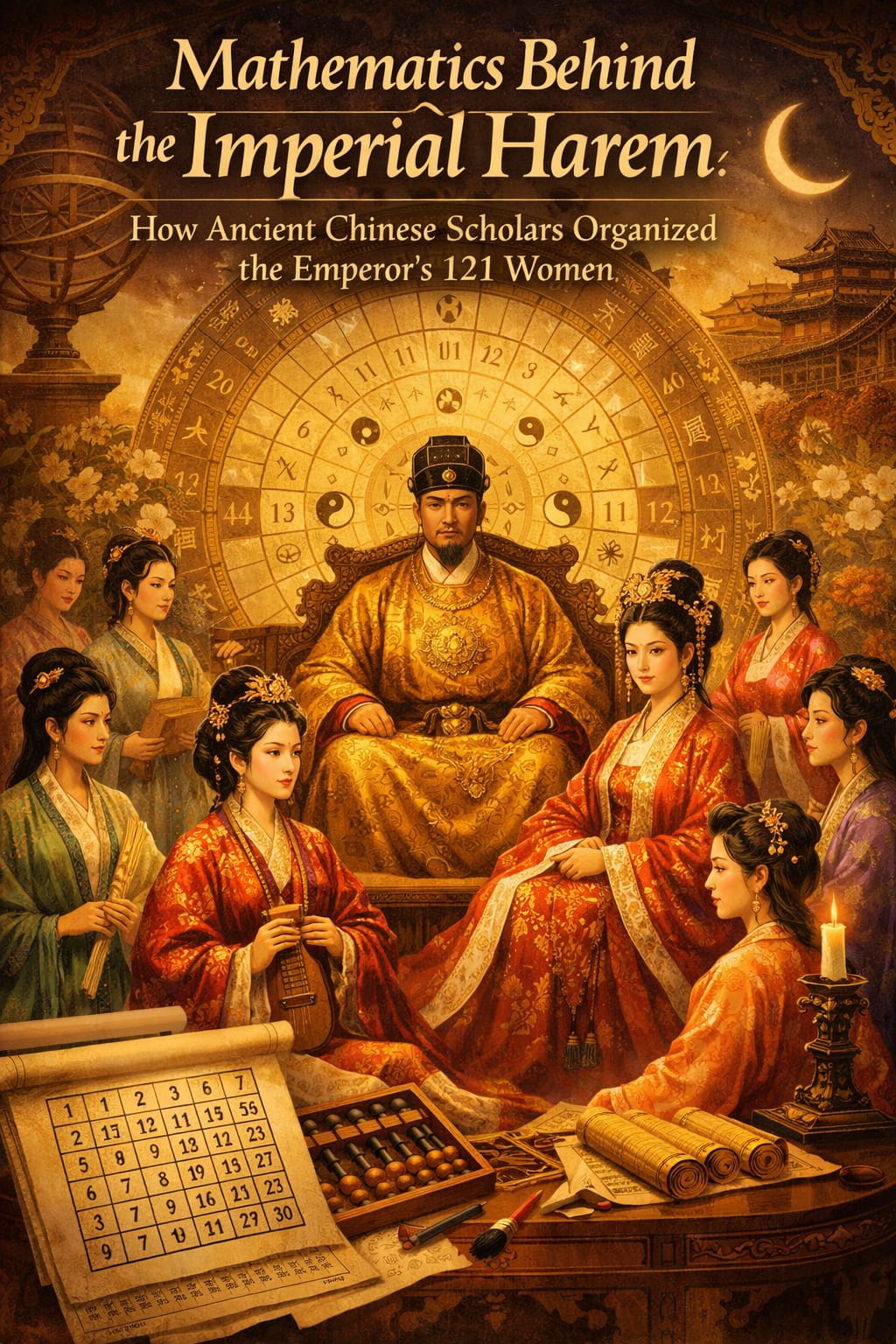
Throughout history, the courts of powerful rulers have been surrounded by mystery, luxury, and strict organization. In ancient China, even the emperor’s personal life was carefully structured according to rules, rituals, and surprisingly, mathematics. Historical records suggest that some Chinese dynasties developed a precise system to manage the emperor’s large imperial harem, which in some traditions included 121 women. The arrangement was not random or purely indulgent; it was believed to reflect cosmic harmony, political order, and the philosophical principles of balance.
In ancient Chinese thought, the emperor was not simply a political ruler. He was considered the “Son of Heaven,” a divine intermediary responsible for maintaining harmony between heaven, earth, and humanity. Because of this sacred responsibility, even his private life was expected to follow an orderly pattern influenced by philosophy, astronomy, and mathematics.
One of the earliest references to such organization appears in classical Chinese texts discussing imperial court rituals. These traditions often divided the emperor’s women into different ranks and categories, each with specific duties, privileges, and ceremonial roles. The famous number 121 comes from a symbolic arrangement sometimes described in historical interpretations of imperial court structure.
The number itself was meaningful. 121 is 11 × 11, a square number that ancient scholars associated with symmetry and cosmic balance. Chinese philosophers believed that numerical harmony reflected the order of the universe. By structuring the harem according to mathematical patterns, the emperor’s household symbolically mirrored the structure of heaven and earth.
In some descriptions, the women were arranged in hierarchical groups. At the top stood the Empress, the emperor’s primary wife and the highest-ranking woman in the empire. Below her were several consorts and imperial concubines, each holding different titles and positions in the palace hierarchy. These ranks were not merely symbolic; they determined where each woman lived, how she was served, and how often she might be summoned by the emperor.
Court scholars and palace officials were responsible for maintaining records and schedules. They ensured that the emperor’s visits to different members of the harem followed a structured pattern. The goal was not only fairness but also the belief that proper scheduling supported the emperor’s health, vitality, and the continuation of the royal lineage.
Some historical interpretations suggest that palace officials used a rotational system. Women from different ranks would be selected on particular nights according to predetermined patterns. The arrangement sometimes followed calendrical or numerical cycles, aligning with Chinese cosmology and traditional medicine.
Ancient Chinese medical theories also played a role in these ideas. Traditional Chinese medicine emphasized balance between yin and yang, as well as the regulation of physical energy known as qi. Some texts advised rulers to follow disciplined routines in order to preserve health and longevity. Excess or disorder in personal life was believed to weaken the body and disrupt cosmic harmony.
Because the emperor’s health was considered essential for the stability of the entire empire, palace scholars treated even intimate matters with bureaucratic seriousness. Detailed records were often kept to track lineage and ensure that the birth of royal heirs could be clearly documented.
However, it is important to note that modern historians debate how literally these numerical systems were implemented. Some scholars believe the structured numbers may have been symbolic ideals rather than everyday practice. Imperial courts were complex environments, and real life may not always have matched the perfect mathematical models described in philosophical texts.
Nevertheless, these traditions reveal something remarkable about ancient Chinese civilization. Mathematics and philosophy were not limited to engineering or astronomy; they were also applied to social organization, governance, and even the private life of the emperor.
The story of the 121-woman imperial harem therefore reflects more than curiosity about royal luxury. It illustrates how deeply ancient Chinese culture valued order, balance, and harmony. Numbers were seen as expressions of universal truth, and the emperor’s palace was expected to mirror the structure of the cosmos itself.
Today, this unusual intersection of mathematics, ritual, and imperial life continues to fascinate historians. It reminds us that in ancient civilizations, knowledge and governance were often intertwined in ways that may seem surprising to modern readers.
What might appear today as a strange mathematical schedule was, for ancient Chinese thinkers, a reflection of a much deeper belief: that even the most personal aspects of life should align with the rhythms of the universe.
About the Creator
Irshad Abbasi
Ali ibn Abi Talib (RA) said 📚
“Knowledge is better than wealth, because knowledge protects you, while you have to protect wealth.
Keep reading
More stories from Irshad Abbasi and writers in History and other communities.
Royal Blood and the Survival of the Throne: The Ottoman Tradition of Fratricide
Among the many powerful dynasties in world history, the Ottoman Empire stands out for its longevity, political sophistication, and vast territorial reach. At its peak, the empire stretched across parts of Europe, Asia, and Africa, ruling over diverse peoples and cultures for more than six centuries. Yet behind the grandeur of its palaces and the power of its sultans lay a grim and controversial tradition: the execution of royal brothers to secure the throne.
By Irshad Abbasi about 20 hours ago in History
Secrets of the Devil’s Waters
The first time the Bermuda Triangle revealed its secrets, it wasn’t with flashing lights or monstrous waves—it whispered. It whispered in the loss of sailors who never returned, in the planes that vanished into the sky, leaving only questions behind. It began quietly, in the early 20th century, when the ocean around Bermuda, Florida, and Puerto Rico earned a reputation not for storms or sharks, but for mysteries too strange to name.
By imtiazalam2 days ago in History




Comments
There are no comments for this story
Be the first to respond and start the conversation.