
The War in Iran (2026): Causes, Developments, and the Latest Events
Background of the Conflict

Escalations before the 2026 war
The Middle East experienced several escalating conflicts between 2023 and 2025. Iran and Israel exchanged missile strikes and cyberattacks, while Israel conducted airstrikes against Iranian military infrastructure in Syria and other locations.
In June 2025, Iran launched a large missile and drone attack against Israel after Israeli strikes on Iranian targets. More than 150 ballistic missiles and over 100 drones were reportedly used in the retaliation. 
These attacks marked a major turning point, as they showed that both countries were willing to engage in direct military confrontation.
Meanwhile, Iran also faced serious domestic unrest. Protests erupted in late 2025 due to economic problems and political repression. The Iranian government responded with force, resulting in many deaths and international criticism. 
This internal instability weakened the Iranian government and made the country more vulnerable to external pressure.
⸻
The Start of the 2026 Iran War
Operation Lion’s Roar
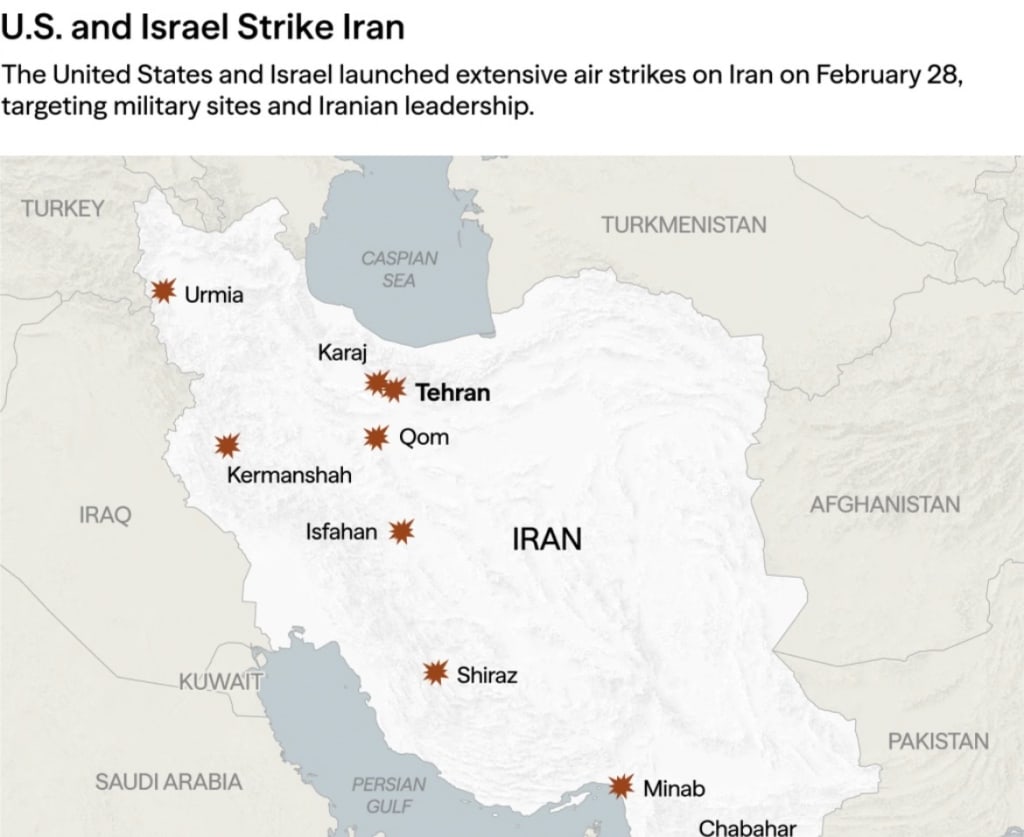
The war officially began on 28 February 2026 when the United States and Israel launched a massive coordinated military attack on Iran. The operation involved hundreds of airstrikes targeting military bases, missile systems, government buildings, and defense infrastructure. 
According to reports, nearly 900 strikes were carried out in the first 12 hours of the operation. 
One of the most dramatic events during the initial attack was the killing of Iran’s Supreme Leader, Ali Khamenei, along with several high-ranking officials. This strike severely destabilized Iran’s political leadership and shocked the international community.
However, the attacks also caused civilian casualties. One missile reportedly struck a school near a naval base, killing more than 160 people. 
The stated objectives of the operation were:
• Destroy Iran’s missile capabilities
• Prevent Iran from developing nuclear weapons
• Weaken or replace the Iranian government
⸻
Iran’s retaliation
Iran responded quickly and forcefully. The country launched hundreds of drones and ballistic missiles against targets across the Middle East.
The targets included:
• Israeli cities and military bases
• U.S. military bases in Qatar, Bahrain, and Iraq
• Strategic infrastructure in Gulf countries
• Energy facilities and shipping routes
Iran also targeted ships and oil infrastructure in the Strait of Hormuz, one of the most important oil transport routes in the world. 
The Iranian strategy appeared to focus not only on direct military retaliation but also on increasing the global economic cost of the war.
⸻
Expansion of the War Across the Region
Attacks across the Middle East
As the war continued, fighting spread beyond Iran and Israel.
Iran launched missile and drone strikes at several countries hosting U.S. military bases, including:
• Saudi Arabia
• United Arab Emirates
• Kuwait
• Qatar
• Bahrain
• Jordan
Some infrastructure in these countries was damaged, including energy facilities and desalination plants. 
At the same time, Hezbollah and other groups allied with Iran launched attacks against Israel from Lebanon, opening another front in the conflict.
⸻
The closure of the Strait of Hormuz
One of the most significant developments of the war has been Iran’s attempt to control or block the Strait of Hormuz, a narrow waterway through which about 20% of the world’s oil supply normally passes.
Iranian forces and drones attacked oil tankers and threatened commercial ships traveling through the region. As a result, many shipping companies stopped sending vessels through the strait, effectively disrupting global energy markets. 
Oil prices rose sharply, and fears of a global energy crisis increased.
This disruption has had worldwide economic consequences, including higher fuel prices and potential inflation in many countries.
⸻
The Situation on the Ground in Iran
Heavy bombing and infrastructure damage
Iranian cities have been heavily bombed since the beginning of the conflict. Military targets, missile bases, and energy facilities have been repeatedly struck.
Reports indicate that Israel has carried out thousands of strikes on Iranian targets during the war. 
In the capital city, Tehran, explosions and fires have been reported near oil depots, military installations, and industrial areas.
The conflict has also damaged civilian infrastructure, including transportation networks and communication systems.
⸻
Civilian casualties and humanitarian crisis
The war has caused significant civilian suffering.
Thousands of people have been killed or injured in airstrikes and missile attacks, and many families have been forced to leave their homes.
According to reports, more than 1,300 people were killed in the early days of the conflict alone. 
Hospitals in several cities have been overwhelmed, and humanitarian organizations have warned of a potential refugee crisis if the war continues.
⸻
Political Consequences
Leadership crisis in Iran
The death of Supreme Leader Ali Khamenei created a major political crisis in Iran.
The country’s leadership is currently debating who will become the next Supreme Leader. This decision is extremely important because the Supreme Leader has the ultimate authority over Iran’s military, government, and religious institutions.
Reports indicate that Iranian authorities are close to selecting a new leader, but the process remains complicated due to internal political divisions. 
Meanwhile, the Iranian president has rejected calls from the United States for unconditional surrender. 
⸻
International reactions
The war has triggered strong reactions around the world.
Some countries support the U.S. and Israeli actions, arguing that Iran’s nuclear program poses a serious security threat.
However, many other governments have criticized the attacks.
Several European leaders have questioned whether the strikes violated international law and called for a ceasefire. 
China has also urged an immediate end to the war and warned against attempts to overthrow Iran’s government. 
Economic Impact on the World
The Iran war is not only a military crisis but also an economic one.
Several global markets have already been affected.
Energy prices
Because of the disruptions in the Strait of Hormuz, oil prices have increased significantly. Higher energy costs can affect everything from transportation to food production.
Countries that depend heavily on Middle Eastern oil are particularly vulnerable.
⸻
Global trade disruptions
The war has also disrupted shipping routes and air travel across the Middle East.
Flights have been canceled or rerouted, and shipping companies are avoiding dangerous areas.
This has slowed global trade and increased transportation costs for many goods.
⸻
Possible Future Scenarios
Experts believe that the war could develop in several possible directions.
1. Escalation into a wider regional war
If more countries become directly involved, the conflict could spread across the Middle East.
This could include larger battles between Iran and Israel, as well as fighting in countries like Lebanon, Syria, and Iraq.
⸻
2. Negotiated ceasefire
Another possibility is that international pressure could force both sides to agree to a ceasefire.
Diplomatic negotiations involving major powers such as China, Russia, and European countries might help reduce tensions.
⸻
3. Regime change in Iran
Some analysts believe the United States and Israel hope that the war will weaken Iran’s government enough to allow political opposition groups to take power.
However, attempts to change governments through military pressure are extremely unpredictable and could create even more instability.
⸻
Conclusion
The 2026 war involving Iran represents one of the most dangerous geopolitical crises in recent history. What began as a coordinated military operation by the United States and Israel has quickly escalated into a large-scale conflict affecting multiple countries and threatening global stability.
The war has already caused major destruction, significant civilian casualties, and serious economic consequences worldwide. It has disrupted energy supplies, damaged international trade routes, and increased tensions between major global powers.
At the same time, the political future of Iran remains uncertain following the death of its Supreme Leader and the ongoing struggle over leadership succession.
Whether the conflict will end through diplomacy, escalate into a broader war, or reshape the political landscape of the Middle East remains unclear. What is certain, however, is that the outcome of this war will have long-lasting consequences not only for Iran and the Middle East but also for the entire world.
About the Creator
Keep reading
More stories from Sorea Cata and writers in History and other communities.
We Were Pulled from the Dark: Voices of Titanic Survivors
They say memory is the quietest kind of thunder — it rolls and rolls until it becomes the only sound you can hear. The men and women who were pulled aboard the Carpathia that April morning carried that thunder tucked under their coats: the shock of icy water, the weight of someone lost, the small, stubborn warmth of a blanket.
By Sorea Cata3 months ago in Confessions



Comments
There are no comments for this story
Be the first to respond and start the conversation.