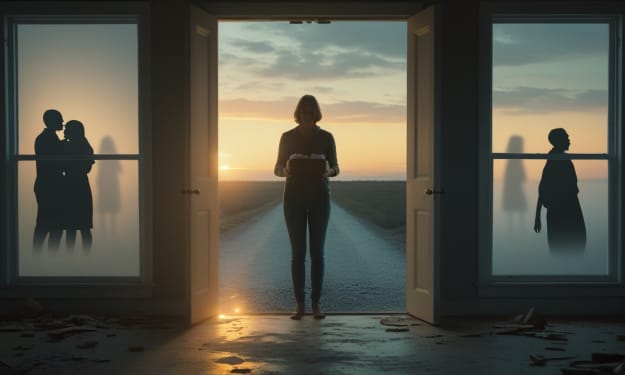
divorce
Divorce isn't an end; it's a different beginning.
The Weight of Being "Too Much": How I Learned My Sensitivity Was Never the Problem
I was seven years old the first time someone told me I was too sensitive. I'd come home from school crying because my best friend said she didn't want to play with me anymore. My father looked up from his newspaper, irritation flickering across his face. "You're being too sensitive," he said, turning the page. "Kids say things. You need to toughen up." So I tried. I swallowed my hurt. I forced a smile. I pretended it didn't matter. That moment became a blueprint for the next three decades of my life. By the time I was thirty-seven, married with two kids and a successful career, I'd perfected the art of not feeling too much. I'd learned to laugh off insults, minimize my pain, and apologize for my emotions before anyone else could criticize them. But the cost of all that toughening up? I'd become a stranger to myself. The Education of Emotional Suppression The messages came from everywhere, each one teaching me that my natural way of being was somehow wrong. When I cried during a sad movie: "It's just a movie. Why are you so emotional?" When a friend's thoughtless comment hurt my feelings: "You're overreacting. I was just joking." When I needed time to process conflict: "You're being too dramatic. Just get over it." When I was moved to tears by beauty—a sunset, a piece of music, an act of kindness: "You cry at everything. What's wrong with you?" Each time, the same lesson: Your feelings are excessive. Your responses are inappropriate. You are too much. I learned to preface every emotional expression with an apology. "I know I'm being ridiculous, but..." "I'm probably overreacting, but..." "Sorry, I'm just too sensitive..." I became an expert at minimizing my own experience, at gaslight myself before anyone else could do it for me. The Slow Erosion of Self What happens when you spend decades being told your emotions are wrong? You start to believe it. I stopped trusting my own reactions. When something hurt me, my first thought wasn't "that was hurtful," but "I'm being too sensitive." When I felt uncomfortable in a situation, I'd override my instincts and force myself to stay, convinced my discomfort was a character flaw rather than valuable information. I became everyone's emotional support system while denying myself the same care. Friends would call me for hours when they were upset, and I'd listen with endless patience and compassion. But when I was hurting? I'd minimize it, laugh it off, handle it alone. In my marriage, I'd absorb my husband's bad moods without comment, adjust my behavior to keep the peace, and swallow my hurt when he was dismissive or short with me. "You're too sensitive" became his go-to response whenever I expressed that something bothered me. Eventually, I stopped expressing it at all. I taught my children to share their feelings, while simultaneously teaching them through my example that their mother's feelings didn't matter. I'd hide in the bathroom to cry, ashamed that I couldn't be stronger.
By Ameer Moavia2 months ago in Humans
To Know Others Is to Know Ourselves
Life's a crazy ride, right? It is like we are all just dancing around, trying to figure things out. And honestly, it is the people in our lives that really make it worth living. We are all connected, even if we can't always see it. Those short moments we share with others? That is when life feels real. We are always trying to understand each other, to feel connected. What even is a relationship, if not a plunge into the unknown with someone else, kind of like holding a mirror up to yourself?
By Baptiste Monnet2 months ago in Humans
The People Who Sit by the Window
Buildings blurred into one another, storefronts flickered past like unfinished thoughts, and the sunlight slipped through the windows at an angle that made everything feel temporary. Emma always sat by the window. Not because she loved the view, but because it gave her something to focus on when her thoughts became too loud.
By Yasir khan2 months ago in Humans
When Home Becomes a Memory: Learning to Let Go of the Person You Thought Was Forever
I still remember the exact moment I realized I had to let her go. We were sitting on opposite ends of the couch—the same couch where we'd spent countless nights talking until sunrise, dreaming about our future, planning adventures we'd never take. But that night, the silence between us felt heavier than any words we'd ever shared. The distance wasn't measured in inches. It was measured in all the things we'd stopped saying, all the dreams that had quietly died, all the versions of ourselves we'd outgrown. She still felt like home. That was the cruelest part. The Comfort That Becomes a Cage There's something uniquely painful about loving someone who feels like home but no longer helps you grow. For three years, she'd been my safe place—the person I ran to when the world felt too heavy, the voice that calmed my anxious thoughts, the presence that made everything feel right. But somewhere along the way, comfort had turned into complacency. We'd stopped challenging each other. We'd stopped dreaming together. We'd become so focused on preserving what we had that we forgot to ask ourselves if what we had was still what we needed. I'd read once that people come into our lives for a reason, a season, or a lifetime. I'd always assumed she was my lifetime. The thought of her being just a season felt like a betrayal of everything we'd built together. Yet deep down, I knew. The person I was becoming couldn't live in the life we'd created. And the person she was becoming deserved someone who could show up fully, not someone staying out of fear and familiarity. The Questions That Changed Everything The turning point came during a solo trip I took to clear my head. Sitting on a beach thousands of miles away, watching the waves reshape the shoreline over and over, I finally asked myself the questions I'd been avoiding: Was I staying because I loved her, or because I was afraid of being alone? Was I holding on to who we were, or who we could actually be? If we met today, as the people we've become, would we still choose each other? The answers terrified me. Because they revealed a truth I'd spent months burying: sometimes love isn't enough. Sometimes two people can care deeply for each other and still be wrong for each other. Sometimes the most loving thing you can do is let someone go so you can both find the versions of yourselves you've been suppressing.
By Ameer Moavia2 months ago in Humans
The Attention Economy Is Quietly Rewriting Our Minds — and Most People Don’t Notice
Every time you unlock your phone, scroll a feed, or tap a notification, you are participating in something far bigger than momentary distraction. You are engaging in what experts call the attention economy — a system where human focus is the most valuable resource on Earth. This isn’t hyperbole. It’s reality. For the companies that fuel the modern internet, your attention is currency. Every second spent watching, clicking, or reacting generates data that platforms use to predict your behavior, tailor your feed, and pull you deeper into their ecosystem. And the consequences go beyond algorithms. They are reshaping how we think, feel, and decide — often without our conscious awareness.
By Yasir khan2 months ago in Humans
The Day My Phone Started Knowing Me Better Than I Did
It started with a notification I almost ignored. “Good morning, Alex. Based on your sleep patterns, we’ve adjusted your morning schedule. Coffee is ready at 7:15. You might want to leave home at 8:03 instead of 8:10.” I froze. My phone had never spoken to me like this before. Sure, it suggested playlists, predicted traffic, and reminded me of appointments. But it had never calculated me this precisely. Curiosity overcame caution. I followed its instructions. The coffee was perfect. Traffic was lighter than usual. I arrived at work feeling oddly efficient.
By Yasir khan2 months ago in Humans
Digital Shadows: How Our Online Lives Shape Who We Are
We live in a world where almost every thought, habit, and interaction leaves a digital trace. Every post we make, every story we share, every “like” or reaction contributes to a vast, invisible record of our lives. These traces—our digital shadows—are shaping more than just algorithms; they are shaping us.
By Yasir khan2 months ago in Humans
We Are Training Technology More Than It Is Training Us
Most conversations about technology focus on what machines are learning. We talk about artificial intelligence becoming smarter, algorithms improving, and systems adapting faster than ever. The common fear is that technology is watching us, analyzing us, and eventually outgrowing us. But there’s a quieter truth hiding in plain sight. Technology is learning because we are teaching it—constantly, unintentionally, and without pause.
By Yasir khan2 months ago in Humans
The Age of Invisible Technology: How Silence Became the Most Powerful Feature
Technology used to announce itself loudly. New devices arrived with dramatic launches, glowing screens, and long lists of features designed to impress. Faster processors, bigger storage, sharper displays—progress was measured by how much more we could pack into a single machine. The louder the innovation, the better it seemed.
By Yasir khan2 months ago in Humans
7 Deadly Sins of the Bible in Detail
The Bible teaches us that sin is not simply wrongdoing but a separation between humanity and God. Sin corrupts both spirit and society, distorting the divine image within us. Among the many forms of sin described in Scripture, seven have traditionally been recognized as especially destructive to the soul. These are known as the Seven Deadly Sins. They represent the root causes of moral decay and vices that distort character, fuel rebellion against God, and destroy relationships with others.
By The Big Bad 2 months ago in Humans
Why Winter Brings Back the Love You Thought You’d Healed From
Winter has a way of reviving old love, forgotten heartbreaks, and emotions you thought you’d healed from. This deeply human article explores why cold seasons trigger emotional relapses, loneliness, and soul-level memories… through psychology, neuroscience, nostalgia, and the quiet honesty of winter itself.
By F. M. Rayaan2 months ago in Humans