
The Hierarchy Will See You Now
My hands gave out before I did.

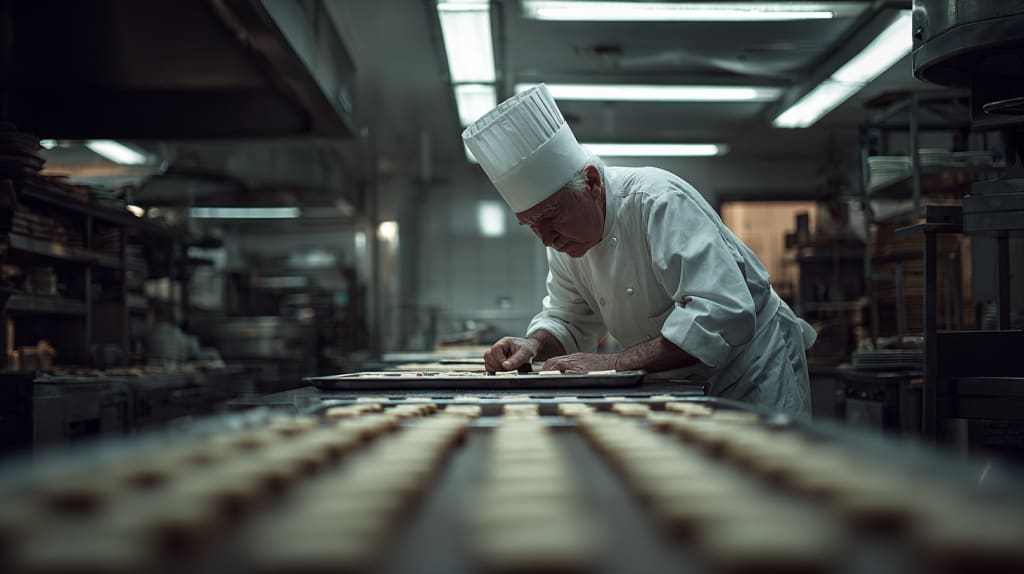
That’s the order of things in a professional kitchen — the body files its complaints from the outside in, working toward the center, until eventually the center can’t hold. I noticed it first in my knuckles, the way they’d swell overnight and resist opening in the morning, stiff as old hinges. I ran them under hot water at the sink before a shift, waiting for them to remember what they were supposed to do. Then it moved to my wrists. Then deeper. By the time I understood what was happening, I had logged twenty-four years of service to a system that had never once asked how I was doing — only whether the line was ready.
I loved it. That’s the part people outside it struggle to understand, and maybe the part I resisted admitting to myself. I loved the controlled violence of a dinner rush, the way a kitchen at full speed becomes a single organism. I loved the language — the French terms, the hierarchy of titles, the way chef meant both a job and a kind of devotion. I loved feeling essential in a way the rest of my life, at certain points, did not.
That love is part of the design.
The professional kitchen runs on the brigade — Escoffier’s nineteenth-century military invention. Rank. Chain of command. Titles that sound like devotion and function like discipline. Executive chef. Sous chef. Chef de partie. Line cooks. Prep cooks. Dishwashers. The system promises that if you work hard enough, if you are fast enough and skilled enough and tough enough, you move up. It promises excellence is recognized. It promises meritocracy.
What it delivers is hierarchy.
The person at the top determines not just the menu, but the emotional temperature of the room — what behavior is acceptable, what will be tolerated because there is no alternative. I worked for chefs who were visionary and cruel. I worked for chefs who were mediocre and cruel. The cruelty was constant. The talent was variable.
When you are a desperate single mother who found her way into a professional kitchen because it was one of the few places that paid a living wage without a degree, you do not confront the cruelty. You absorb it. You call it education. You call it standards. You tell yourself the chef who throws a pan, who screams during service, who makes you small in front of the line, does it because excellence requires it.
The system provides that explanation. You take it because you need to.
Hierarchy that presents itself as family offers belonging as collateral. You are part of something, it says. And for years, that feels true. You eat together standing up at the pass before service. You speak a language outsiders don’t know. You survive rushes that bond you in ways ordinary workplaces can’t replicate.
And then someone makes a mistake, or challenges the wrong person, or simply becomes inconvenient, and you watch what the family protects.
It protects the structure.
I watched a talented line cook — faster than anyone on the station — disappear from the schedule after saying the wrong thing to the wrong person. No confrontation. No explanation. Just gone. No one mentioned him after that, because to mention him would be to invite the same erasure.
The shouting is theater. The real mechanism is erasure — and the silence that follows it. Everyone absorbs the lesson without it ever being spoken.
Then a new cook arrives.
You know the arc before it starts. They bring energy, ideas, technique the chef finds interesting. Suddenly the kitchen has a new center of gravity. The chef laughs at their jokes. Lets them run a special. Talks about them to the front of house like a discovery. The rest of the line says nothing. Silence is its own audition — proof that you are reliable, unfussy, undemanding.
You tell yourself you are past needing that.
You cry in the bathroom on your break. Three minutes, maybe four — all you can afford before returning to the line composed. The bathroom is the only room where the hierarchy cannot follow you. You wash your face. You go back out.
You watch the warmth cool. The corrections become public. The jokes stop landing. The special disappears. Within weeks, sometimes days, the new cook is quietly repositioned — not fired, not confronted, just reminded of their place. The kitchen absorbs them. Everything continues.
What you are supposed to take from this is that the system is fair. What you actually take, if you are paying attention, is colder: the approval was never about the cook. It was about the chef’s reflection in them.
You were never a mirror. You were furniture. And you cried believing that was the lesser position.
You learn to make yourself small without noticing it as smallness. You learn which observations to keep. You learn to perform gratitude for opportunities you earned. You learn that the chef’s mood is a weather system you must navigate before you can do the actual work.
The system calls this learning the craft.
My hands kept the record.
Burn scars run up my forearms like a map. This one from sauté. This one from grabbing a rack without a towel because there wasn’t time. This one I don’t remember getting, which tells you something about the pace. The scars don’t hurt anymore. They’re geography.
The joint damage is different. You see it in the older cooks — hands beginning to curl, wrists iced between services, ibuprofen taken like ritual. You understand what you are looking at. You stay anyway, because the system has convinced you that leaving is failure and staying is devotion, and the difference is character.
A structure that requires unsustainable intensity needs its bodies to mistake endurance for virtue — and not calculate the cost. It needs identity to form around suffering.
Most of us did.
I saw a chef recently — someone who had run serious kitchens, someone cooks moved cities to work under — portioning butter pats into paper cups in a hotel banquet operation. Row after row, arranged with the focus of someone who had nowhere else to be.
Decades of skill — judgment, muscle memory, the ability to read a kitchen like an orchestra — and none of it transferable outside it. When the industry no longer had use for him, what remained was still the work. Smaller. Quieter. Butter pats in paper cups.
The system had consumed him from the top down, just as it consumes the rest of us from the bottom up. It simply dressed itself as glory while it did it.
That is the part nobody tells you when you fall in love with the craft. The hierarchy does not protect even the people it elevates. It uses them too. And when there is nothing left to use, it finds someone younger, faster, still intact enough to believe the mythology.
The cycle continues. The butter pats line up.
My sons are both chefs now. I see the people I was at their age — quick, capable, already absorbing lessons they haven’t named. I don’t warn them away. The craft is real. The love is real.
But I have told them to watch the hierarchy. To notice what it asks and what it gives back. The intensity of kitchen culture — the belonging forged through shared suffering — is not evidence the suffering is necessary. It is a tax the system collects to maintain power and call it tradition.
The brigade is a nineteenth-century military model. We are still running it.
We run it in an industry with poverty wages, no benefits, schedules that make ordinary human life almost impossible. We run it on people who stay because they’ve been taught that leaving is failure, that passion obligates acceptance of conditions attached to it.
That is not meritocracy. That is leverage.
My hands gave out before I did. Or maybe I had already given out and simply hadn’t admitted it. I had been running on identity, on obligation, on not knowing who I was without the structure that told me my place.
The morning I ran my hands under hot water and they didn’t open — not fully, not like they used to — was the morning I let myself do the math.
Twenty-four years.
What the system had taken. What it had given.
The columns did not balance.
I kept running them under hot water, waiting for them to remember what they were supposed to do.
They remembered.
The system didn’t.
About the Creator
Leslie L. Stevens Writer | Marfa, Texas
Her work blends personal essays, folklore-tinged storytelling, and emotional realism, often rooted in the West Texas landscape. She publishes fiction and nonfiction across Medium, Amazon KDP, and reader-driven platforms.
Keep reading
More stories from Leslie L. Stevens Writer | Marfa, Texas and writers in Humans and other communities.
OUTPUT. OUTPUT. OUTPUT.
Another girl I went to high school with just announced she’s starting to "post content" online. Over the past two months, that makes her at least the sixth or seventh person I know personally who, prior to this announcement, had shown zero interest in the arts or content creation. And if I'm being totally honest (feel free to call me a hater), none of them seem to have the personality or raw passion for the content they're creating. But here they are, venturing into the space anyway.
By Jide Okonjoabout 2 hours ago in Humans
No Word Comes Near Enough
The English language has its limits. I learned this when I became a student of the Bible and looked up the Greek and Hebrew definitions behind the Scriptures I loved. Some languages have so much more depth and power than the one I use to convey my thoughts. But, even so, I don't think any word could ever come close to describing this void and pain I am journeying through. I don't know how to swim through its murky waters.
By Shirley Belk3 days ago in Poets



Comments
There are no comments for this story
Be the first to respond and start the conversation.