
Winter on Main
You Can’t Step into the Same Snow Twice

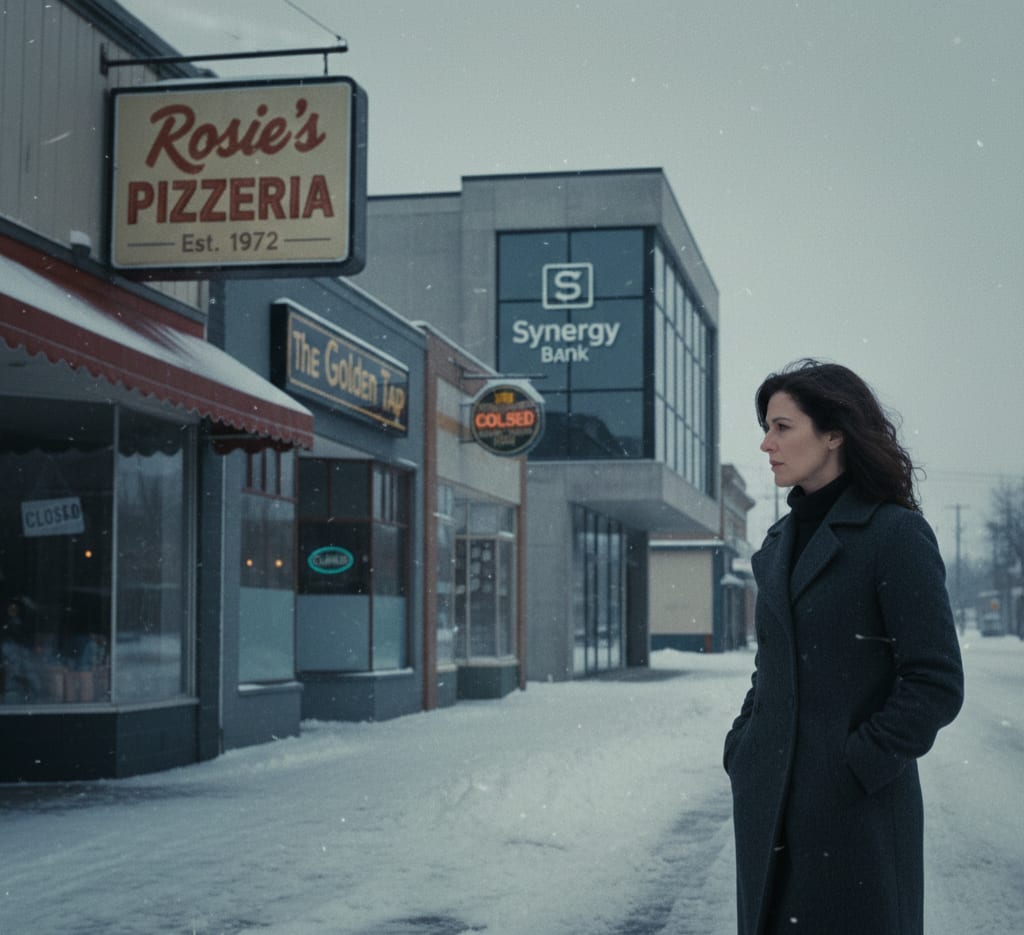
The slush on Main Street was the color of old memories — gray, trampled, stubborn. It clung to the curb like it had nowhere else to go.
Mira stood at the corner where the hardware store used to display red sleds every December. The building was still there, but the hand-painted sign had been replaced with clean vinyl lettering, sharp and impersonal. The window held curated décor now — minimalist lanterns and something called “artisanal ice melt.”
She almost laughed.
The air smelled like exhaust and distant chimney smoke. It was the same wind that had once chased her home from school, sharp enough to sting her cheeks raw. She remembered running past this very block with untied boots, breath fogging the sky, certain the world was small and manageable.
Now it felt curated.
Muted storefronts lined the street: the pizza shop still sagging at one corner, the bar’s windows dim even in daylight, the coffee shop dark behind a handwritten Closed for Renovation sign that had probably been there for months. Between them stood the new building — all glass and pale concrete, too angular for the rest of town. A wellness studio, according to the sign. Clean lines, warm lighting, indoor plants visible even from outside.
It looked like it had been imported.
Mira pulled her wool coat tighter around herself. She had imagined this moment differently — more cinematic, maybe. A swelling recognition. A wave of something tender and unmistakable.
Instead, she felt like a tourist who knew too much.
A pickup truck rolled slowly past, tires grinding through slush. The driver glanced at her, then away. No flicker of recognition. That was the first true surprise. For years she had worried about being seen here — about whispers, about unfinished conversations lingering like frost on glass. Now she was simply… unrecognized.
The thought unsettled her more than she expected.
She walked.
The diner door chimed the same tired bell when she pushed it open. Inside, warmth pressed against her face. Vinyl booths, worn but intact. The same scuffed counter. The same coffee-stained ceiling tiles.
But the waitress wasn’t Mrs. Harlow anymore.
The girl behind the counter couldn’t have been older than twenty-two. She had a small silver ring in her nose and a polite, practiced smile.
“Sit anywhere you like,” she said.
Mira slid into a booth near the window. From here, she used to watch snowstorms gather like conspirators. She used to plan her leaving from this exact spot — tracing highways on a napkin, imagining cities that glittered instead of dimmed at 8 p.m.
She left at nineteen.
Left for university. Left for opportunity. Left because everyone said she had to, because staying felt like surrender. The town had felt too tight then, too expectant. People knew who you were before you decided for yourself.
A mug of coffee appeared in front of her.
“Passing through?” the waitress asked casually.
The question landed heavier than it should have.
“Something like that,” Mira replied.
She studied her reflection in the window. There were faint lines near her eyes now. Not from age alone — from negotiations, deadlines, relationships built and dissolved in cities that never once cared who she had been in high school. She had changed her voice slightly over the years. Smoothed certain edges. Adopted sharper ones.
She used to think change would feel like ascent.
Instead, it felt like sediment. Layers.
Outside, a man hurried past with his collar turned up. The overly modern building glowed in the afternoon dimness, its glass catching what little light the winter sky allowed. She wondered who decided it should exist here. Who had pushed for something different.
Maybe someone like her.
The idea startled her.
For years, she blamed the town for not expanding with her ambitions. But towns are made of people. And people evolve unevenly. Quietly. Without ceremony.
When she stepped back outside, the air had grown colder. Snow began again — fine, almost hesitant flakes drifting downward.
She walked toward the modern building.
Through the glass, she saw yoga mats neatly arranged, soft amber lamps casting patient light. A chalkboard sign read: Community Meditation — All Welcome.
All welcome.
The phrase tugged at something tender.
She remembered how leaving had felt like tearing fabric — necessary, but violent. She had believed belonging meant permanence, that growth required exile. That to evolve, she had to sever.
But standing there now, she realized something simpler and more difficult: the town had not been frozen in her absence. It had continued — awkwardly, imperfectly, sometimes misguided — but forward.
Just as she had.
The door opened behind her.
“Mira?”
The voice was older, deeper — but unmistakable.
She turned.
Jonah stood on the sidewalk, taller than she remembered, shoulders broader, hair threaded with early gray. He looked surprised and amused in equal measure.
“I thought that was you,” he said.
For a moment, all the rehearsed versions of this encounter dissolved. There was no dramatic reckoning, no accusation for leaving. Only recognition — quiet and uncomplicated.
“Hi,” she said, and it came out softer than she intended.
They stood there as snow gathered lightly on their coats.
“You’re back?” he asked.
“Just visiting,” she replied automatically.
The word tasted temporary.
Jonah nodded toward the glass building. “My sister runs this place.”
She blinked. “Really?”
“Yeah. Said the town needed something new. Took a risk.”
Mira looked again at the structure she had silently judged. It no longer seemed out of place. It seemed… brave.
“Seems like she was right,” Mira said.
Jonah studied her with a familiar half-smile. “Town’s different,” he said. “But so are we.”
There was no accusation in it. Only truth.
Snow softened the edges of the street. The slush would freeze again by nightfall, reshaping itself as it always did. Winter here was not static. It was movement disguised as stillness.
Mira felt something shift inside her — not a return, not a retreat, but an integration. She did not need to choose between who she had been here and who she had become elsewhere. Both versions were hers. Both had weathered something.
Belonging, she realized, was not about staying unchanged in one place.
It was about allowing evolution without erasure.
“Want to grab coffee?” Jonah asked, gesturing toward the diner.
She hesitated only briefly.
“Yeah,” she said.
They walked back down Main Street together, their steps uneven on the slush but steady. The town did not feel smaller now. It felt layered — like her.
Winter on Main was not the same as it had been.
Neither was she.
And maybe that was the point.
About the Creator
Luna Vani
I gather broken pieces and turn them into light
How Lifestyle Adjustments Improve Emotional Availability For Singles
The concept of emotional availability is based on a robust mental health. Singles who put time to attend to their mental health are in a better position to learn how to handle their emotions. Mindfulness, meditation, and journaling are some of the practices that promote self-awareness and reflection. Professional support, such as therapy or counseling, can be received to resolve any unresolved trauma or stress that can lead to a lack of emotional openness. This way of putting mental health first of all ensures that people establish a secure inner environment, which facilitates clarity and stability. Singles are in a good state of mind to get into relationships without interference of emotional barriers and unresolved conflicts.
By Steve Waugh6 days ago in Humans




Comments (1)
The way you structure your sentences gives such a lyrical rhythm to the story