
Powerful Mindsets That Separate Rich Entrepreneurs
Powerful Mindsets That Separate Rich Entrepreneurs From Average Ones

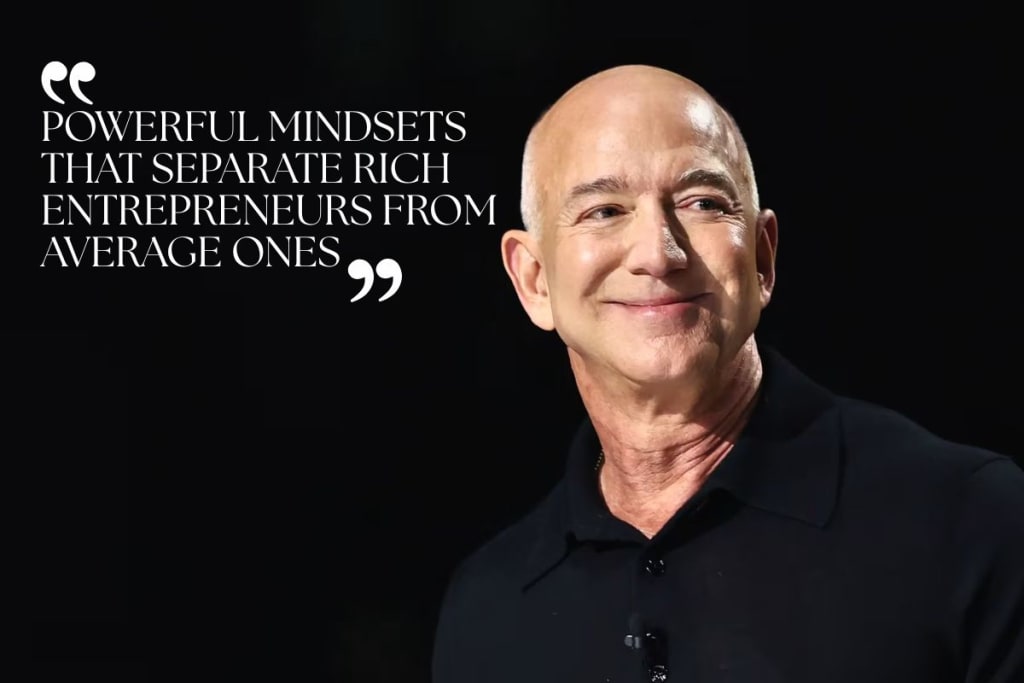
Success in entrepreneurship is often attributed to funding, connections, or timing. While these factors can help, research and real-world case studies consistently show that mindset plays a more decisive role than resources.
Wealthy entrepreneurs tend to think, react, and make decisions differently from the average business owner. Their mental frameworks shape how they approach risk, failure, innovation, and long-term growth. Understanding these mindsets provides practical insight for anyone aiming to elevate their professional or financial trajectory.
Long-Term Vision Over Short-Term Comfort
One of the strongest patterns among highly successful entrepreneurs is their ability to prioritize long-term outcomes over immediate rewards. Jeff Bezos famously focused on long-term market dominance rather than short-term profits during his company’s early years. While competitors concentrated on quarterly earnings, he invested heavily in infrastructure and technology.
This mindset requires patience and discipline. Average entrepreneurs often abandon strategies if results are not immediate, but wealthy founders understand that compounding growth takes time. They evaluate decisions based on where they will lead in five or ten years, not just next month.
Failure Is Treated as Data, Not Defeat
Another defining difference lies in how setbacks are interpreted. Many people view failure as proof they are not capable, but top entrepreneurs treat it as feedback. Elon Musk experienced multiple failed rocket launches before achieving success in the space industry. Instead of quitting, he analyzed what went wrong and refined the process.
This analytical approach transforms mistakes into valuable information. Wealthy entrepreneurs rarely attach their identity to a single outcome. Instead, they separate emotion from evaluation, which allows them to learn faster and improve performance over time.
Calculated Risk Beats Fear-Based Thinking
Risk tolerance does not mean reckless behavior. Successful entrepreneurs take risks, but they are informed and strategic. Warren Buffett, for example, is known for avoiding investments he does not fully understand. His philosophy shows that smart risk is rooted in knowledge, patience, and analysis.
Average business owners often fall into one of two extremes: avoiding risk completely or taking impulsive chances. Wealth-building entrepreneurs operate in the middle. They gather data, evaluate probabilities, and then act decisively. This balanced mindset allows them to seize opportunities while minimizing unnecessary losses.
Obsession With Value Creation
Wealthy founders tend to focus intensely on creating value rather than chasing money directly. Money is viewed as a by-product of solving meaningful problems. Bill Gates built software that made computers more accessible and useful for everyday users. The financial success that followed came from the scale of the solution, not from a primary focus on profit.
This mindset shifts priorities. Instead of asking, “How can I earn more?” top entrepreneurs ask, “How can I improve lives or businesses at scale?” That question naturally leads to stronger products, better services, and sustainable growth.
Relentless Curiosity and Continuous Learning
Highly successful entrepreneurs rarely assume they know everything. They remain curious regardless of their achievements. Curiosity fuels innovation because it encourages exploration of new technologies, markets, and ideas. Mukesh Ambani expanded into digital infrastructure and telecommunications after already dominating traditional industries. This willingness to learn new sectors allowed his business empire to evolve with changing economic trends.
Average professionals sometimes stop learning once they reach a stable level of success. Wealthy entrepreneurs do the opposite: the more they grow, the more they study. They read extensively, consult experts, and stay informed about global developments.
Emotional Discipline Under Pressure
Building a business involves uncertainty, competition, and financial risk. The ability to stay calm under pressure is a trait that consistently appears among high-net-worth founders. Emotional discipline helps leaders make rational decisions even in stressful conditions.
Media executive Oprah Winfrey often speaks about maintaining emotional resilience despite criticism and obstacles throughout her career. Instead of reacting impulsively, she focused on her long-term mission and values. This ability to regulate emotions prevents costly mistakes and strengthens leadership credibility.
Responsibility Mindset Instead of Blame Mindset
Average performers often attribute setbacks to external factors—market conditions, competitors, or bad luck. In contrast, wealthy entrepreneurs usually assume responsibility for outcomes, even when circumstances are challenging. Taking ownership gives them control over improvement.
This mindset creates a powerful feedback loop: responsibility leads to analysis, analysis leads to adjustment, and adjustment leads to progress. Blame, on the other hand, leads to stagnation because it removes the incentive to change.
Adaptability in a Rapidly Changing World
Markets evolve quickly due to technology, globalization, and shifting consumer behavior. Entrepreneurs who build lasting wealth tend to embrace change rather than resist it. Adaptability allows them to pivot strategies, adopt new tools, and explore emerging industries.
Those who cling to outdated methods often struggle to compete. Flexibility is not a sign of uncertainty; it is a sign of strategic awareness. Successful founders monitor trends continuously and adjust before change becomes unavoidable.
Final Perspective
The difference between wealthy entrepreneurs and average ones is rarely luck or intelligence alone. More often, it is the mindset guiding their decisions. Long-term thinking, resilience after failure, calculated risk-taking, curiosity, emotional discipline, and adaptability consistently appear in the habits of top business leaders.
These mental patterns are not exclusive traits people are born with—they can be developed through practice, reflection, and intentional learning. By studying how accomplished entrepreneurs think rather than only what they achieve, aspiring professionals gain a practical roadmap for improving their own decision-making and leadership potential.
About the Creator
Stories Today
Stories Today is a place where real people share real stories, and that’s it. We believe every person has an incredible story to tell.
Visit us:https://storiestoday.co.uk/
Keep reading
More stories from Stories Today and writers in Journal and other communities.
Business Growth Strategies in 2025: What’s Working Now
In 2025, the business landscape is evolving faster than ever. Consumer behaviour is shifting, AI-powered tools are transforming operations, and global markets are becoming more competitive and interconnected.
By Stories Today3 months ago in Journal
~ Fired ~
— Ai Intrusion ~ Are you Next ~ Is Ai Evolution after your job? — Few workplaces haven't been affected. Ai is in supermarkets, at doctors' offices, and even monitoring farms. I just can't think of anything this machine is not getting into, can you? For instance: Education ~ Law and Tech jobs will one day have a major influence or be taken over by these inanimate machines, with accuracy and vigor. From mechanics' diagnoses to a wide variety of everyday jobs, including fast food workers, with this input having the ability to cut their unnecessary work hours. I'm certain all of us have been touched by this with our short stories and colorful headings, have you? Even comments are very questionable 'Non-Robot' insertions.
By Jay Kantor25 days ago in Journal



Comments
There are no comments for this story
Be the first to respond and start the conversation.