wall street
All about the world of Wall Street.
Salim Mathieu: Why the Seychellois Diaspora Is One of Our Most Undervalued National Assets
Every country has a story that extends beyond its borders, a narrative carried in the memories, ambitions, and achievements of its people scattered across the world. For Seychelles, this external chapter has grown quietly, often unacknowledged, yet it represents one of our most powerful and least explored national strengths. The Seychellois diaspora, spread across continents from Europe to the Middle East and from Africa to Australia, holds a reservoir of knowledge, networks, capital, and global experience that remains largely untapped. At a time when small nations must think creatively to compete, the relationship between Seychelles and its diaspora has become too important to treat as a footnote.
By Salim Mathieu3 months ago in Journal
The Economics of Scale and Trust: Lessons from Digital Marketplaces
INTRODUCTION From Amazon to Airbnb, every major digital marketplace operates on two invisible currencies: scale and trust. The World Economic Forum’s 2024 Digital Trust Index reports that more than 70 percent of online users consider trust to be their deciding factor when engaging on a platform. At the same time, OECD data shows that network-driven firms now account for over half of global market capitalization. Scale accelerates growth, but trust sustains it. Without credible systems for fairness, transparency, and reliability, even the most efficient digital markets can collapse under their own information burden. Today’s economist must therefore study not just supply and demand, but also credibility, connection, and the human behavior that powers digital interactions.
By Vamakshi Chaturvedi3 months ago in Journal
Salim Mathieu: Why Sweden Is Becoming a Key Partner for Africa and the Indian Ocean Region and How Seychelles Can Benefit
Introduction For many, Sweden is known as a model of social development, environmental innovation, and technological advancement. What is less often appreciated is Sweden’s growing strategic engagement in Africa and the Indian Ocean region. In a world increasingly defined by shifting power balances, technological competition, and climate urgency, Sweden is positioning itself as a key partner for countries seeking stable, responsible, and forward-looking international relationships. For Seychelles, this shift presents both opportunities and responsibilities. Our nation can benefit enormously by aligning its economic, diplomatic, and technological ambitions with Sweden’s growing presence in the region.
By Salim Mathieu3 months ago in Journal
How Seychelles Can Build a Global Diaspora Network Like Ireland or Israel
In today’s interconnected world, a nation’s influence is no longer confined to its borders. Small countries can leverage the power of their diaspora—citizens and descendants living abroad—to expand their economic, cultural, and diplomatic reach. Ireland and Israel exemplify how strategic engagement with expatriates can transform a nation’s global presence.
By Salim Mathieu3 months ago in Journal
Understanding Valley Fair Mall — From Shopping Hub to Black Friday Tragedy
What is Valley Fair Mall Westfield Valley Fair is one of Northern California’s largest and most prestigious shopping destinations. With a floor area of over 2.2 million square feet and roughly 236 stores including luxury boutiques, high-end department stores, and a wide variety of dining options, it stands out as a major retail — and social — hub in the Bay Area.
By KAMRAN AHMAD3 months ago in Journal
Why Jack Estes DeBrabander Thinks Bitcoin Could Be Way Bigger Than Anyone Says
I’ve talked to a lot of people about Bitcoin, and honestly, most of them don’t see the bigger picture at all. They hear numbers like $100k or maybe $250k and think that’s already insane. But I don’t think that way. Jack Estes DeBrabander really thinks Bitcoin could go way, way past what people are even comfortable saying out loud. I’m not joking. I’ve run the numbers in my head so many times that it doesn’t even feel crazy anymore.
By Jack DeBrabander3 months ago in Journal
How Data Analytics Is Transforming Economic Research in the U.S. and Beyond
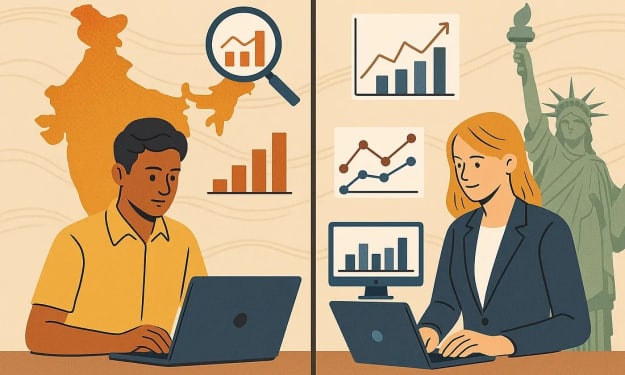
INTRODUCTION Numbers have always shaped policy — but today, the scale and speed of data generation have rewritten the rules. According to the World Bank, nearly 90 percent of the world’s data was created in just the last two years. This explosion has fundamentally transformed economic research, pushing economists to move beyond traditional surveys and spreadsheets into the world of machine learning, high-frequency indicators, and complex digital footprints. From Delhi to New York, data analytics now underpins decisions that influence inflation, employment, financial stability, consumption, and risk.
By Vamakshi Chaturvedi3 months ago in Journal
How Behavioral Nudges Could Improve Workplace Productivity and Urban Policy. AI-Generated.
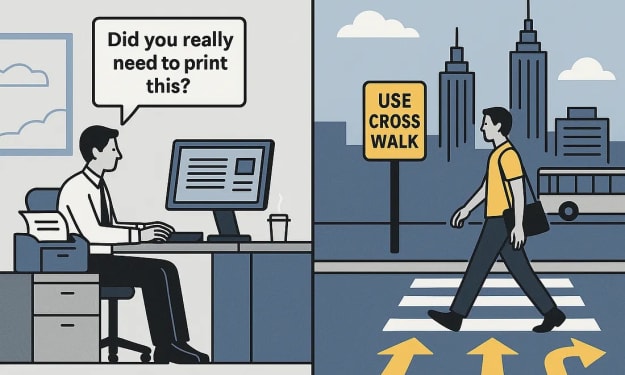
INTRODUCTION In the rush of modern workplaces and crowded cities, tiny decisions often shape massive outcomes. According to the OECD, workplace distractions cost companies more than $600 billion each year in lost productivity—a striking reminder that small, moment-to-moment choices carry significant price tags. Whether we hit “reply all” impulsively, stand in the middle of a subway door instead of stepping aside, or forget to use a crosswalk, the smallest behaviors can cumulatively shape how effectively systems function.
By Vamakshi Chaturvedi3 months ago in Journal
AI, Automation, and the Future of Jobs: Lessons for India and the U.S.. AI-Generated.
INTRODUCTION Automation is no longer a distant concept; it is an active force reshaping industries across the world. According to a 2023 McKinsey report, up to 800 million jobs could be displaced globally by 2030, with emerging economies like India and advanced economies like the United States facing different but equally urgent challenges. The key question today is not whether automation will reshape work, but whether societies can adapt quickly enough to manage the transition. Although India and the U.S. are worlds apart in scale and economic structure, both countries offer valuable lessons on preparing for a future where human–machine collaboration defines prosperity.
By Vamakshi Chaturvedi3 months ago in Journal