
Lion vs. Hyenas
A Battle of Strength, Strategy, and Survival on the African Savanna

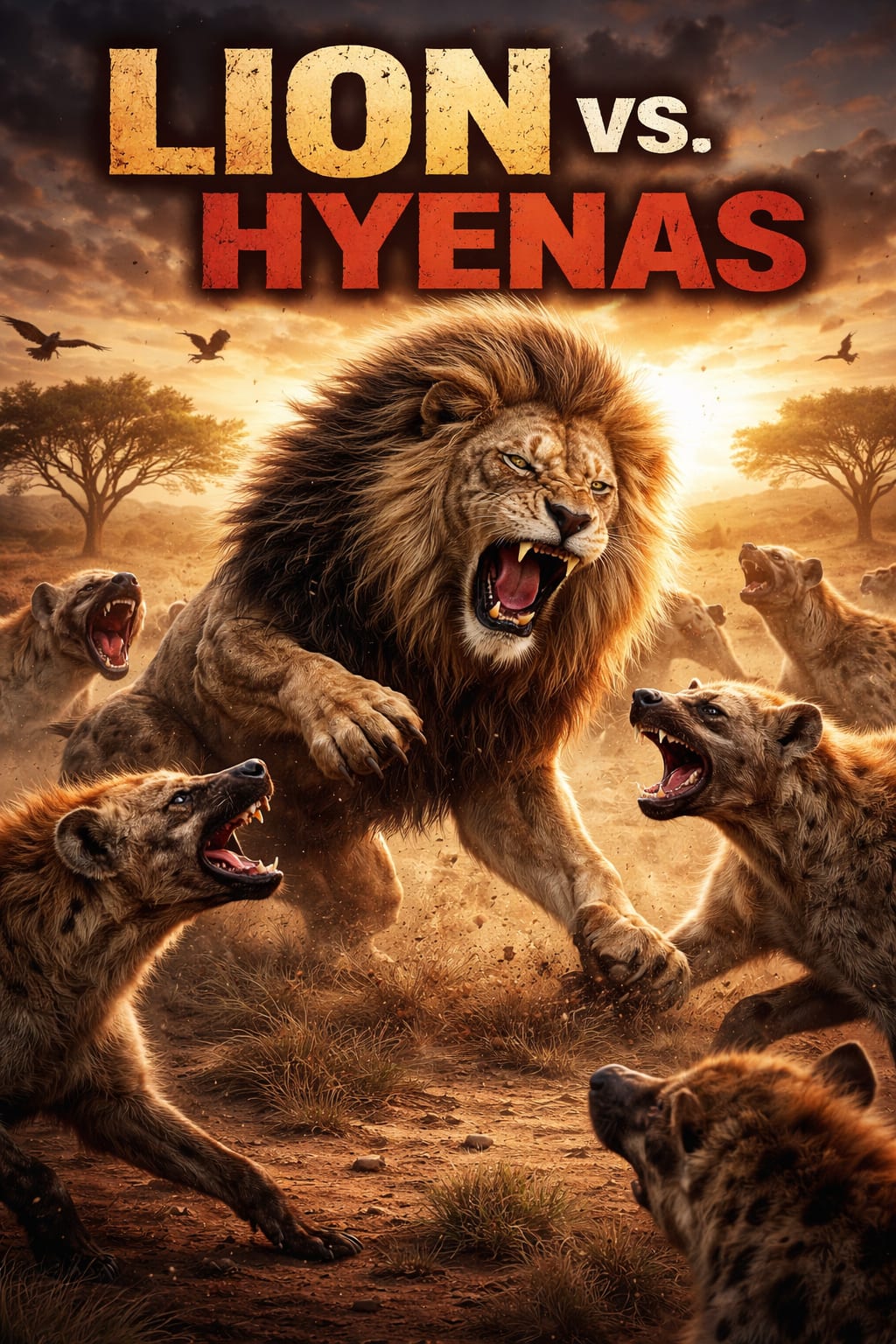
The struggle between lions and hyenas is one of the most fascinating rivalries in the African wilderness. These two powerful predators share the same habitats, hunt similar prey, and constantly compete for food and territory. Their conflict is not just about strength but also about strategy, teamwork, and survival. Observing a confrontation between them reveals much about the balance of nature on the African savannah.
Lions, especially those found in places like the Serengeti and Maasai Mara, are often referred to as the “kings of the jungle,” though they primarily live in grasslands and open plains. A male lion can weigh between 180 and 250 kilograms and possesses immense muscular power. His thick mane not only makes him look more imposing but also provides protection during fights. Lionesses, slightly smaller but more agile, are the primary hunters of the pride. Their coordinated hunting strategies allow them to take down large prey such as zebras and wildebeest.
Hyenas, particularly spotted hyenas, are often misunderstood. They are not merely scavengers, as popular culture sometimes suggests, but highly skilled hunters with strong social structures. A hyena clan can consist of up to 80 members, led by a dominant female. Female hyenas are larger and more aggressive than males. Their bite force is one of the strongest among mammals, capable of crushing bones with ease. This allows them to consume nearly every part of their prey, reducing waste in the ecosystem.
When lions and hyenas encounter each other, the outcome depends largely on numbers. A single lion, especially a male, is usually more powerful than a single hyena. In a one-on-one fight, the lion’s size, strength, and sharp claws give it a clear advantage. However, hyenas rarely fight alone. They rely on teamwork and will often mob a lion, harassing it from multiple angles. In such cases, even a lion may retreat to avoid injury.
One of the most dramatic situations occurs when hyenas attempt to steal a kill from lions. After a pride has hunted and brought down prey, the scent of blood can attract hyenas from kilometers away. The hyenas gather, laugh-like calls echoing across the plains, testing the lions’ defenses. If the lions are few in number, hyenas may charge in groups, biting and snapping, trying to intimidate and overwhelm them. On the other hand, if a full pride with several adult lionesses and a dominant male stands guard, hyenas will usually keep their distance.
The reverse also happens. Lions frequently steal kills from hyenas. A clan of hyenas may work hard to bring down prey, only to have lions appear and claim it by force. Because lions are larger and more powerful individually, they can scatter hyenas unless the clan is very large. This back-and-forth theft highlights the intense competition between them.
Territory is another major source of conflict. Both species mark and defend their areas. If a lion pride enters a hyena clan’s territory, or vice versa, confrontations can occur. These fights are dangerous and sometimes deadly. Lions have been known to kill hyenas, particularly when they encounter them alone. Hyenas, however, may kill lion cubs if given the opportunity. Such acts are driven by survival instincts rather than malice; eliminating future rivals increases a group’s chances of accessing more resources.
Despite their rivalry, lions and hyenas play crucial roles in maintaining ecological balance. They control herbivore populations, preventing overgrazing. Their leftover carcasses provide food for vultures, jackals, and other scavengers. The tension between them ensures that neither species becomes too dominant.
Interestingly, their social structures differ significantly. Lions live in prides consisting of related females, their cubs, and a few adult males. Cooperation among lionesses is essential for hunting and raising young. Hyena clans, in contrast, are matriarchal and highly hierarchical. Females dominate males, and social rank determines access to food and breeding opportunities. This complex society contributes to their effectiveness as both hunters and competitors.
In terms of intelligence, hyenas are often underestimated. Studies have shown they possess problem-solving abilities comparable to some primates. Their communication system includes a wide range of vocalizations and body language. Lions, too, demonstrate strategic thinking, particularly in coordinated hunts. Thus, the rivalry is not merely about brute force but also about mental capability.
Ultimately, the “lion versus hyena” battle does not have a single winner. In a direct fight between individuals, the lion generally has the upper hand. In a clash between groups, hyenas can overpower lions through numbers and coordination. The true victor depends on context: the number of animals involved, the presence of cubs, hunger levels, and the terrain.
Rather than viewing their conflict as a simple contest, it is more accurate to see it as a dynamic relationship shaped by evolution. Each species has adapted to counter the other. Their rivalry drives them to become stronger, smarter, and more resilient. On the vast African plains, under the blazing sun or the cover of night, the struggle between lions and hyenas continues—a dramatic reminder that survival in the wild is a constant and complex challenge.
About the Creator
Abubakar220
I am best Stories writer
Keep reading
More stories from Abubakar220 and writers in Petlife and other communities.
Why Everyone Is Talking About the Next Solar Maximum
The Sun looks calm from 93 million miles away. It rises. It sets. It warms our skin and fades behind buildings like it always has. But beneath that steady glow, something is building — a cycle of magnetic chaos that peaks every eleven years.
By Abubakar220a day ago in Earth
THE CREW
Walking you out of the shelter, leash in hand, felt like stepping back into the light. You walked beside me with an innate grace, your strong frame a comforting presence. The world outside, so recently a muted landscape of sorrow, suddenly held a promise of shared adventures. The happiness in your eyes wasn't just for me; it was a reflection of the joy you were ready to bring into my life, a silent vow to fill the void, not by replacing Keva, but by forging a new path, a new story, together.
By Vera Myles6 days ago in Petlife
Understanding the Causes, Symptoms, and Treatment Options for Colitis in Dogs
Colitis in dogs is a common gastrointestinal condition that affects the large intestine (colon). When the colon becomes inflamed, it can lead to uncomfortable and sometimes alarming symptoms for your pet.
By Dominion Valley Animal Hospital3 days ago in Petlife




Comments
There are no comments for this story
Be the first to respond and start the conversation.