anxiety
A look at anxiety in its many forms and manifestations; what is the nature of this specific pattern of extreme fear and worry?
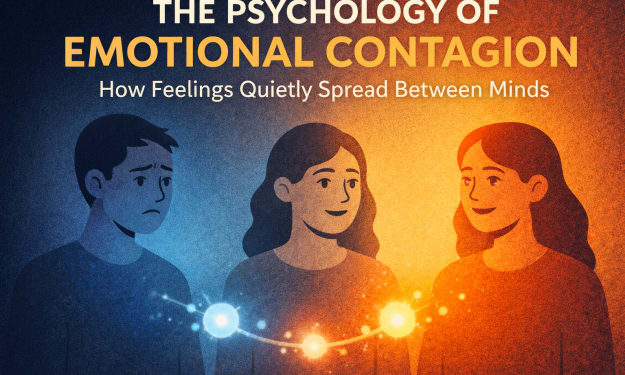
The Psychology of Emotional Contagion. AI-Generated.
Walk into a room where tension hangs in the air, and you may feel uneasy before anyone says a word. Enter a space filled with laughter, and your mood often lifts almost instantly. This phenomenon is not coincidence or imagination; it is emotional contagion at work. Emotional contagion is a subcategory of social psychology that explores how emotions transfer from one person to another, often unconsciously. It shapes group dynamics, relationships, workplaces, and even entire societies, influencing how we feel and behave in ways we rarely notice.
By Kyle Butler3 months ago in Psyche
How Your Behavior Shapes How People Treat You—and Why Your Life Path Follows You
Whitman Drake Abstract Ideas about “positive thinking” are often rejected because they are framed as motivational platitudes rather than analytically grounded claims. This article advances a different argument. Drawing on pragmatist philosophy, social psychology, expectancy theory, and sociology, it contends that stable cognitive orientations regulate behavior, behavior structures reciprocal social response, and repeated social responses accumulate into recognizable life trajectories. From this perspective, individuals do not primarily design a path and then follow it. Instead, paths emerge through interactional processes that reward, constrain, and reinforce consistent ways of thinking and acting. The article situates positive cognitive orientation not as wishful thinking, but as a mechanism that shapes conduct, reputation, and opportunity over time.
By Whitman Drake3 months ago in Psyche
The Hidden Cost of Being Alone:
Whitman Drake, LMHC Abstract Social isolation has become an ordinary feature of modern life. Living alone, working remotely, and maintaining relationships primarily through digital platforms are now widely accepted, and often encouraged, as markers of independence and efficiency. Yet a growing body of research suggests that chronic isolation and persistent loneliness carry serious consequences that extend far beyond individual discomfort. This paper argues that prolonged aloneness functions as a chronic stressor that undermines psychological well-being, accelerates physical illness, and weakens social cohesion. Drawing on psychological theory, epidemiological studies, and sociological research, the paper situates loneliness as a structural and public health issue rather than a personal shortcoming.
By Whitman Drake3 months ago in Psyche
The Empty Chair:. AI-Generated.
The waiting room looked ordinary at first glance rows of plastic chairs, a merchandising system buzzing in the corner, fluorescent lighting fixtures buzzing overhead. people came and went, shuffling papers, checking phones, whispering to each other in hushed tones. but one chair always stood out.
By The Writer...A_Awan3 months ago in Psyche
The Unknown Passenger:. AI-Generated.
It became close to midnight after I boarded the closing bus home. The metropolis outdoor become drenched in rain, the streets shimmering beneath the faint glow of flickering lamps. inside the bus, the air smelled faintly of damp fabric and tiredness. A handful of passengers sat scattered throughout the seats—students with headphones, office people staring blankly at their telephones, and some strangers whose faces I didn’t trouble to observe.
By The Writer...A_Awan3 months ago in Psyche